
Measure the bed and choose a target layer
Measure the surface that will receive mulch in square feet. For a rectangular bed, multiply its length by width; for curved or irregular planting areas, divide the outline into manageable shapes and approximate the total without overlapping them. Record the existing layer separately so you can decide whether the new material replaces, tops up, or covers bare ground.
The depth field is in inches. Oregon State University Extension discusses mulch use around woody plants and emphasizes checking existing mulch before reapplying it. The calculator does not choose a horticultural depth; use guidance appropriate to plant type, soil, climate, and local practice, and avoid burying stems or trunks.
Understand the cubic-yard conversion
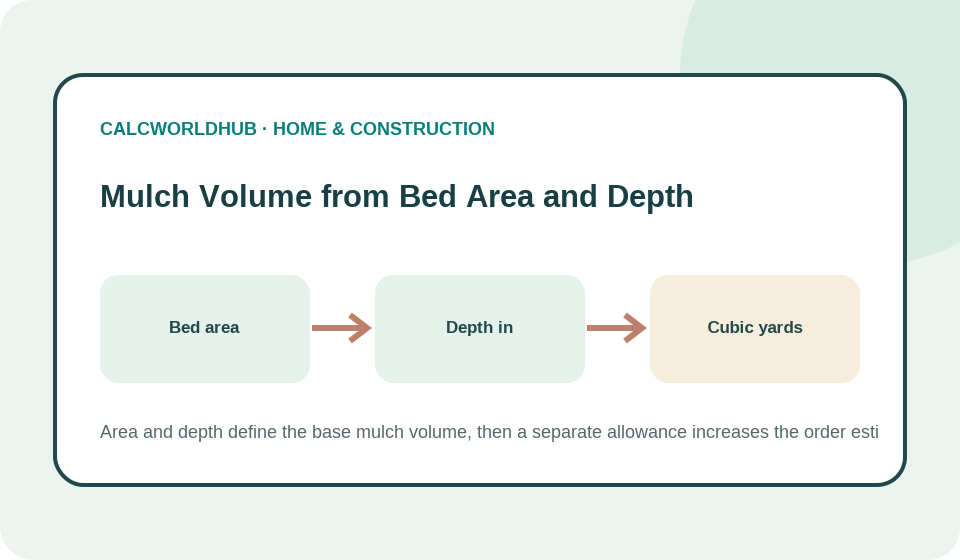
The base volume is area multiplied by depth in feet. Since an inch is one-twelfth of a foot and a cubic yard contains 27 cubic feet, square feet multiplied by inches is divided by 324 to produce cubic yards. The optional allowance then multiplies that base quantity by one plus the entered percentage divided by 100.
The allowance is not a hidden depth recommendation. It can provide for uneven surfaces, settling, handling, or small measurement errors, but those reasons are different from intentionally applying a thicker layer. If part of the bed already has mulch, measure the areas separately or account for their different fill needs before entering a single average depth.
Use dimensions that match the material order
Landscape suppliers may quote loose mulch by cubic yard while bags are sold by volume in cubic feet. Convert the unit before comparing quantities; NIST’s volume guidance defines the SI volume units and supports careful unit conversion. Bag fill volume does not tell you how many bags a vendor packs on a pallet, so use the quantity shown on the package rather than a generic bag-size assumption.
Different materials settle differently. Bark, wood chips, composted products, and blended soil can change in volume with moisture, particle size, and storage. This calculator returns a nominal geometric volume, not a delivered weight, moisture content, nutrient contribution, or settled depth. Ask the supplier which volume basis the price uses if the quote is ambiguous.
Interpret the allowance and visible result
The output shows the area and depth you entered while the cubic-yard result includes the allowance. That is useful when the estimate is transferred to a supplier, but it means the displayed area-and-depth line is not a second volume. Keep the allowance visible in your notes so someone reviewing the order can tell which quantity represents geometry and which includes the extra margin.
For a bed with paths, tree rings, or a tapered edge, a single rectangular footprint can overstate the filled area. Measure only the actual bed surface. If the depth varies, split it into sections and add the volumes, or use a separate worksheet; averaging dramatically different depths can conceal how much material is needed in each area.
Check the bed and existing layer before ordering
Before ordering, compare the estimated quantity with the supplier’s minimum load, delivery access, and the product’s stated volume. Recheck bed dimensions on site, especially narrow strips where a small width error creates a large proportional change. If you are topping up, do not automatically count the full desired depth as new material when an existing layer remains in place.
The estimate does not evaluate plant health, soil drainage, weed suppression, fire safety, or the proper material for a specific landscape. Extension guidance and local horticultural advice help answer those separate questions. Use the calculator for transparent volume arithmetic, then choose the material and application method for the site.
Worked examples
The volume conversion uses 27 cubic feet per cubic yard, with depth converted from inches.
A 180 sq ft bed with a 2.5-inch layer
Inputs: Area = 180 sq ft; depth = 2.5 in; extra allowance = 10%.
Calculation: Base = 180 × 2.5 ÷ 324 = 1.388888… cu yd. Order volume = 1.388888… × 1.10 = 1.527777… cu yd, displayed as 1.53 cu yd.
The estimator returns 1.53 cubic yards after the 10% allowance. The unrounded volume is retained through the calculation before the display is rounded to two decimal places.
A deeper 300 sq ft bed
Inputs: Area = 300 sq ft; depth = 3.5 in; extra allowance = 5%.
Calculation: Base = 300 × 3.5 ÷ 324 = 3.240740… cu yd. Order volume = 3.240740… × 1.05 = 3.402777… cu yd, displayed as 3.40 cu yd.
The result is 3.40 cubic yards including the selected 5% extra. Its larger quantity comes from both a larger surface and a deeper layer than the first case; the allowance is shown separately in the arithmetic.
