Mulch and soil estimator
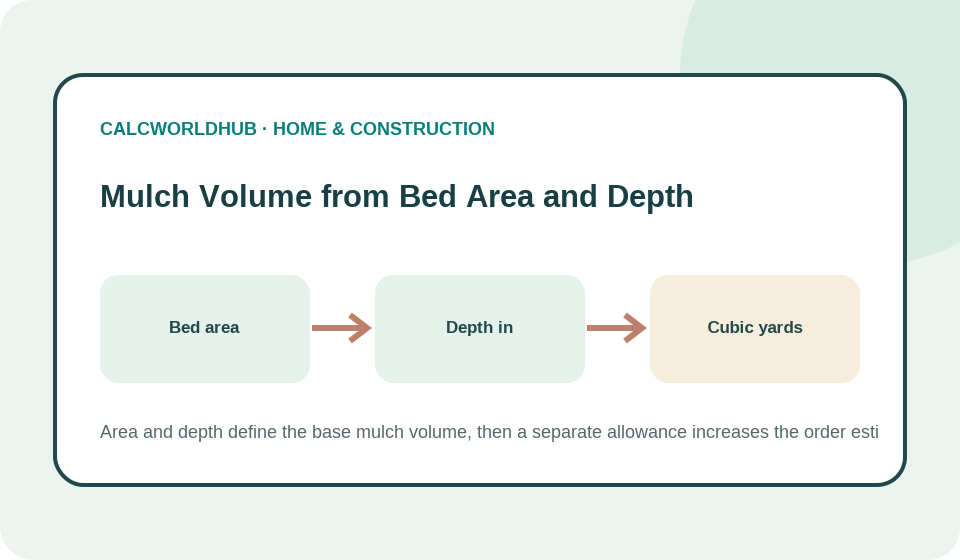
Estimate loose material volume from a level area and an average depth. The allowance is added after converting the base volume to cubic yards.
Calculator
How to use this calculator
Convert area and depth into cubic yards, then add an editable allowance for settling, cuts, or spillage.
- Area (sq ft) Depth (in) Extra allowance (%)
- Read the worked example below to check the expected input format and result.
- Compare another scenario by changing one input at a time. Use Reset to return to the starting values.
Mulch and soil estimator
Estimate loose material volume from a level area and an average depth. The allowance is added after converting the base volume to cubic yards.
Inputs and units
- Area (sq ft)
- Depth (in)
- Extra allowance (%)
Formula and method
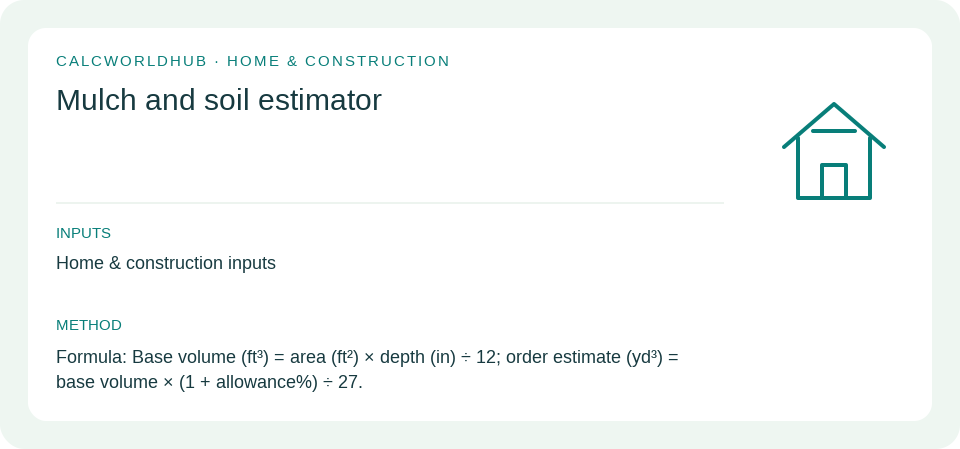
Formula: Base volume (ft³) = area (ft²) × depth (in) ÷ 12; order estimate (yd³) = base volume × (1 + allowance%) ÷ 27.
Worked example
For 200 ft² at 3 in depth, base volume is 200 × 3/12 = 50 ft³. Add 10%: 55 ft³ ÷ 27 = 2.037 yd³, or 2.04 yd³.
Interpreting the result
The result is a volume estimate before supplier packaging increments. If the supplier sells whole cubic yards or bags, round the purchase quantity to the next available size.
Assumptions and limits
Depth is treated as uniform and the area is treated as flat. Compaction, uneven ground, settlement, edging, and material moisture can change the amount actually needed.
Frequently asked questions
Why divide depth by 12?
The area is in square feet, so depth in inches must be converted to feet before multiplying.
Does the allowance change the target depth?
No. It adds material above the calculated volume as a separate percentage.
How do I use the Mulch and soil estimator?
Area (sq ft) Depth (in) Extra allowance (%)
What is a worked example of Mulch and soil estimator?
For 200 ft² at 3 in depth, base volume is 200 × 3/12 = 50 ft³. Add 10%: 55 ft³ ÷ 27 = 2.037 yd³, or 2.04 yd³.
What does the Mulch and soil estimator calculate?
Convert area and depth into cubic yards, then add an editable allowance for settling, cuts, or spillage.
See the calculation methodology.
Good calculators show their work.
CalcWorldHub is built around clear inputs and visible assumptions. Results are estimates for planning; check official sources or your provider’s terms when exact figures matter.