
Define the water quantity and lift
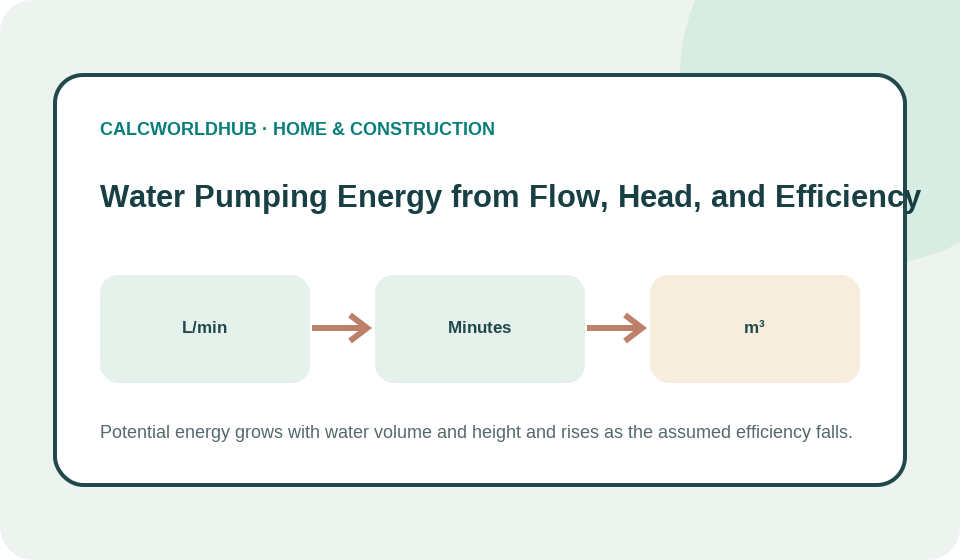
The input flow rate is in litres per minute and operating time is in minutes. Their product is litres moved; divide by 1,000 to express the volume in cubic metres. Pump head is a vertical height in metres, and efficiency is entered as a fraction greater than zero and no more than one.
Use a head that represents the lift in the scenario being estimated. In a real piping system, total dynamic head can also include pressure requirements and losses through pipe, valves, fittings, and elevation changes. The calculator asks for one head value and does not derive it from a system curve.
Formula for ideal lift energy
Gravitational work is E = ρgVH. The model uses water density ρ = 1,000 kg/m³ and standard gravity g = 9.80665 m/s². Divide this ideal work by efficiency η to approximate input energy, then divide joules by 3,600,000 to obtain kilowatt-hours: kWh = ρgVH ÷ (η × 3,600,000).
Efficiency is a multiplier expressed from 0 to 1, not a percentage-point adjustment. For example, 65% is entered as 0.65. A lower efficiency increases estimated input energy because more energy is required for the same useful lift. The calculator rejects values above 1 or at or below zero, as well as negative flow, duration, or head.
What the simple model leaves out
The equation represents lifting a volume through a stated vertical head. It does not separately model friction losses, changing flow, pump start-up, control cycling, motor efficiency, or a pump’s performance at a particular operating point. If the chosen efficiency excludes the motor, the result can understate electricity drawn from the supply.
Use a combined wire-to-water efficiency only when its definition and operating point fit the system. Manufacturer curves and engineering calculations may be needed for a real installation. The U.S. Department of Energy’s pumping resources discuss system performance and energy considerations; this calculator reduces those details to one entered head and efficiency for a first estimate.
Separate energy from power and cost
Kilowatt-hours measure energy accumulated over the entered operating interval. Kilowatts measure a rate of energy use at a moment or over a specified period. The calculator reports energy for the stated flow and duration; it does not output pump power, motor current, electricity cost, or the duration required to move a different quantity.
To estimate a variable electricity charge, multiply the kWh result by an applicable electricity rate, while keeping any fixed charges and time-of-use pricing separate. Do not infer motor size from an energy total alone. A pump can deliver the same total energy over different periods at different power levels.
Interpret the answer as an energy estimate
Check that the same water volume, vertical head, and efficiency describe the scenario. For repeated pumping cycles, calculate one cycle and multiply by the actual count only if the conditions stay comparable. If the flow varies across a cycle, divide it into intervals or measure energy directly with appropriate equipment.
Treat the result as a comparison tool. A small change in head or efficiency can alter energy, but it does not prove that a pump can deliver the flow against that head. Confirm the required operating point, pressure, materials, and controls with the pump manufacturer or a qualified designer before selecting equipment.
Worked examples
Both examples convert flow and operating time into cubic metres before applying head and efficiency.
340 litres lifted 18 metres
Inputs: Flow = 8.5 L/min; time = 40 min; head = 18 m; efficiency = 0.70.
Calculation: Volume = 8.5 × 40 = 340 L = 0.34 m³; energy = 1,000 × 9.80665 × 0.34 × 18 ÷ (0.70 × 3,600,000) = 0.02381615 kWh ≈ 0.0238 kWh.
The model estimates about 0.0238 kWh for the stated lift and interval. It does not include an electricity price or a separate power rating.
330 litres lifted 11 metres at 50% efficiency
Inputs: Flow = 6 L/min; time = 55 min; head = 11 m; efficiency = 0.50.
Calculation: Volume = 6 × 55 = 330 L = 0.33 m³; energy = 1,000 × 9.80665 × 0.33 × 11 ÷ (0.50 × 3,600,000) ≈ 0.019776744 kWh ≈ 0.0198 kWh.
The lower entered efficiency raises the energy estimate for the stated volume and head. The result remains a simplified calculation, not a measured motor draw.
