Water pumping energy calculator
Estimate the energy to lift flowing water through the entered head.
inputs.
Calculator
How to use this calculator
Estimate electrical energy to pump a stated water volume through a head at a supplied efficiency.
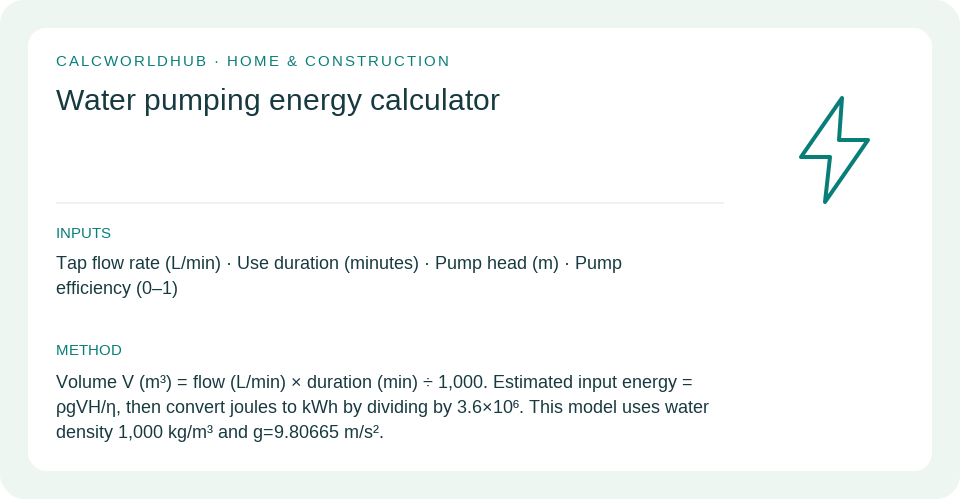
- Enter Tap flow rate (L/min), Use duration (minutes), Pump head (m), Pump efficiency (0–1). Match the units shown beside each field and review the result together with the assumptions below.
- Read the worked example below to check the expected input format and result.
- Compare another scenario by changing one input at a time. Use Reset to return to the starting values.
Estimate electrical energy to lift a stated water volume
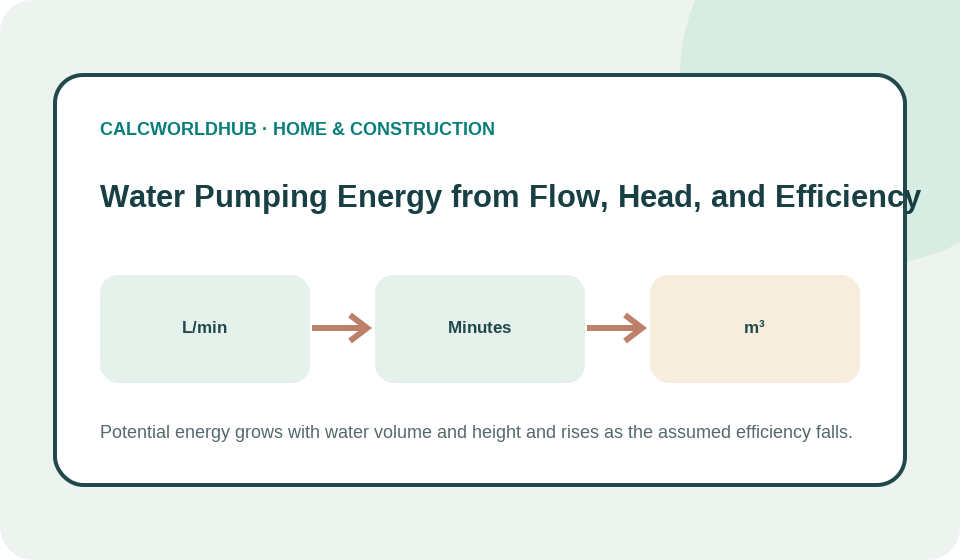
This idealized calculation estimates input energy from the water’s gravitational potential-energy increase divided by pump efficiency. It converts a flow rate and duration into volume before applying head and efficiency.
Inputs and units
- Tap flow rate (L/min): Water volume delivered per minute, in liters per minute.
- Use duration (minutes): Operating time at the entered average flow rate.
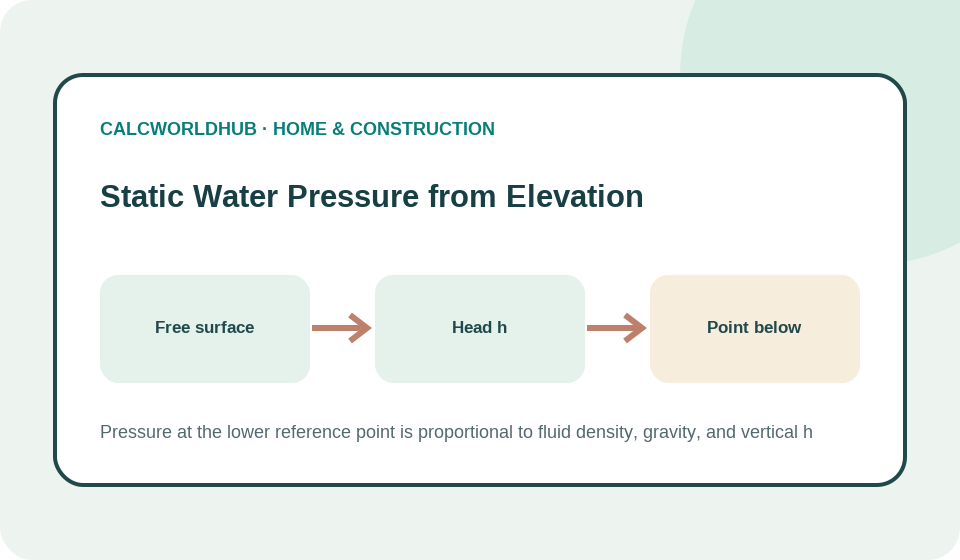
- Pump head (m): Vertical lift or total modeled hydraulic head in meters.
- Pump efficiency (0–1): Overall fraction of electrical input converted into useful hydraulic energy; enter as a decimal such as 0.65.
Formula and method
Volume V (m³) = flow (L/min) × duration (min) ÷ 1,000. Estimated input energy = ρgVH/η, then convert joules to kWh by dividing by 3.6×10⁶. This model uses water density 1,000 kg/m³ and g=9.80665 m/s².
Worked example
At 9 L/min for 12 min, V=108 L=0.108 m³. For H=14 m and η=0.65, energy = 1000×9.80665×0.108×14/0.65/3,600,000 ≈ 0.006337 kWh.
Interpreting the result
The idealized input is about 0.0063 kWh for the stated water volume and head. Actual metered energy can be higher because of pipe losses, pump curves, motor efficiency, starts, and operating conditions.
Assumptions and limits
Treat entered head as total hydraulic head and efficiency as the overall wire-to-water efficiency. The estimate does not include friction losses unless represented in head; it does not calculate a water bill or tank fill volume.
Method references
Frequently asked questions
Why is water price not part of the energy result?
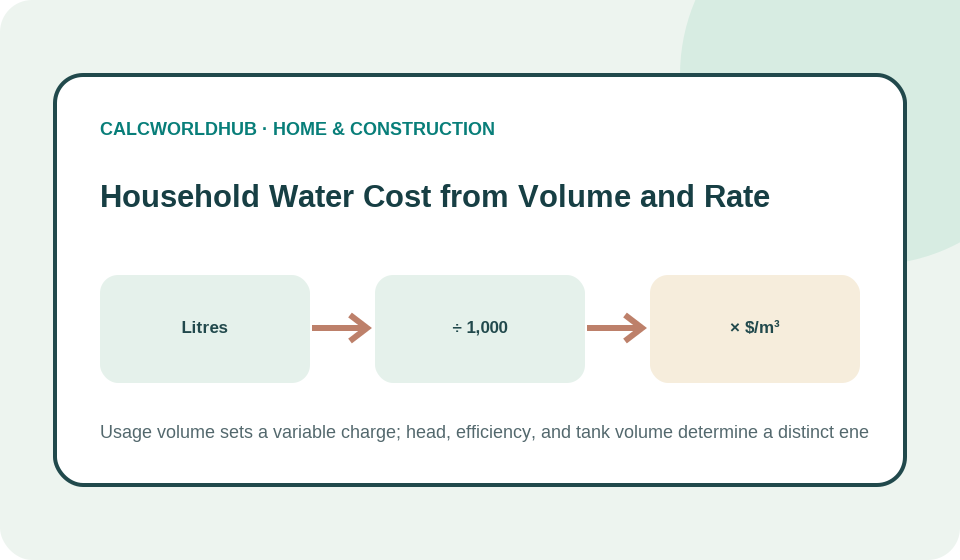
Price affects cost, not the physical energy needed to lift the water. A separate cost calculation multiplies volume by a tariff.
How do I use the Water pumping energy calculator?
Enter Tap flow rate (L/min), Use duration (minutes), Pump head (m), Pump efficiency (0–1). Match the units shown beside each field and review the result together with the assumptions below.
What is a worked example of Water pumping energy?
At 9 L/min for 12 min, V=108 L=0.108 m³. For H=14 m and η=0.65, energy = 1000×9.80665×0.108×14/0.65/3,600,000 ≈ 0.006337 kWh.
What does the Water pumping energy calculator calculate?
Estimate electrical energy to pump a stated water volume through a head at a supplied efficiency.
What assumptions apply to Water pumping energy?
Treat entered head as total hydraulic head and efficiency as the overall wire-to-water efficiency. The estimate does not include friction losses unless represented in head; it does not calculate a water bill or tank fill volume.
Good calculators show their work.
CalcWorldHub is built around clear inputs and visible assumptions. Results are estimates for planning; check official sources or your provider’s terms when exact figures matter.