Water use cost calculator
Estimate water bill cost from litres used and tariff per cubic metre. Enter your values below for a free estimate, with no account required.
inputs.
Calculator
How to use the Water use cost calculator
Estimate water bill cost from litres used and tariff per cubic metre. Enter your values below for a free estimate, with no account required.
What this calculator measures
Estimate a tap-water charge from flow and duration, and separately estimate the ideal electrical energy needed to lift a tank volume through a stated pump head.
Inputs and units
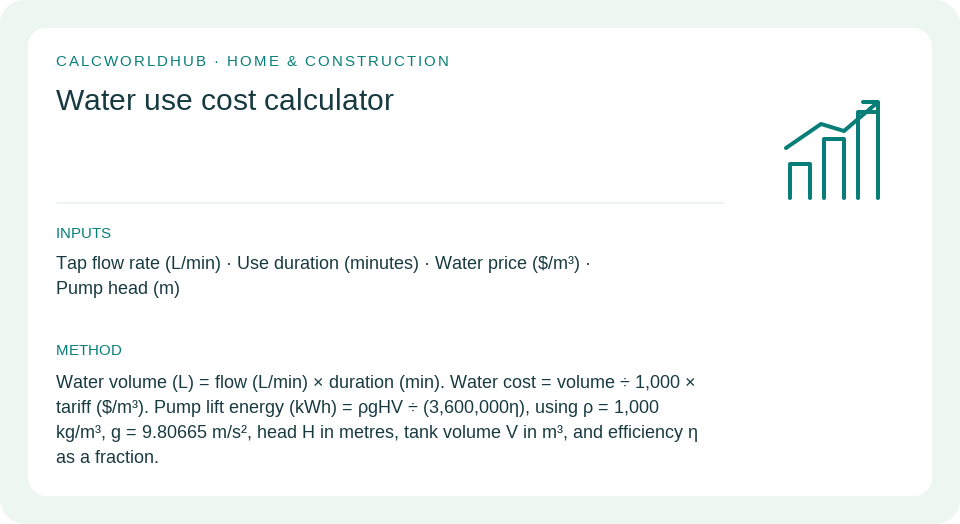
The required fields are Tap flow rate (L/min), Use duration (minutes), Water price ($/m³), Pump head (m), Pump efficiency (0–1), Tank volume (m³). Each value should describe the same object, sample, transaction, or time period wherever the formula compares them.
- Tap flow rate (L/min): Enter a percentage in the format shown; do not switch between a whole percent and a decimal fraction.
- Use duration (minutes): Keep the date or time basis consistent with the other entries; check the displayed unit.
- Water price ($/m³): Use the same currency and accounting period as the other money fields in this calculation.
- Pump head (m): Enter the value that matches the field label and its displayed unit.
- Pump efficiency (0–1): Enter the value that matches the field label and its displayed unit.
- Tank volume (m³): Use the unit printed beside the field and convert measurements before entering mixed units.
Formula and method
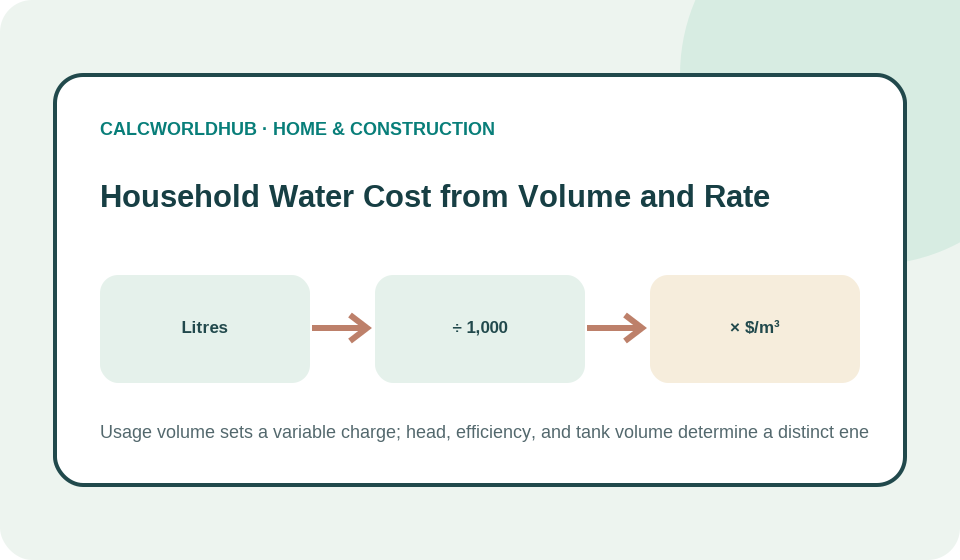
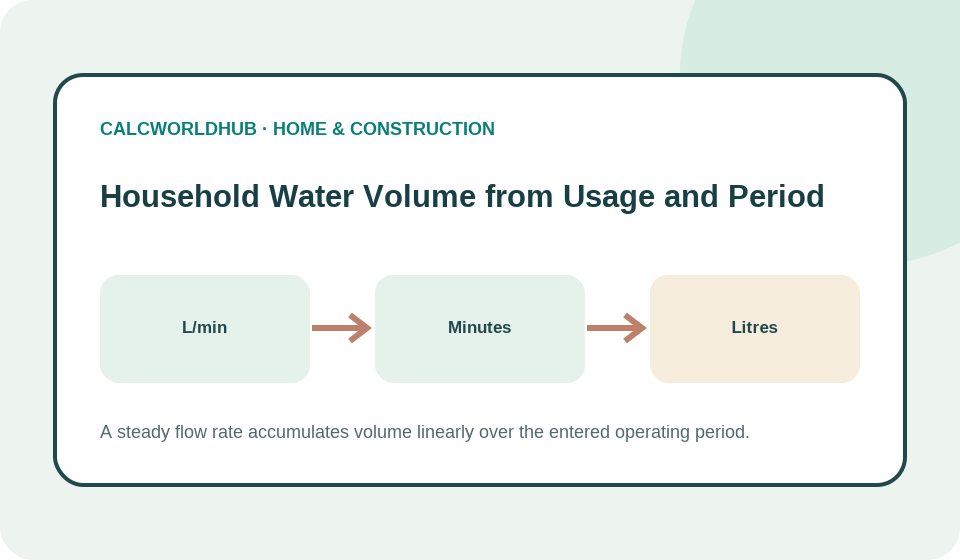
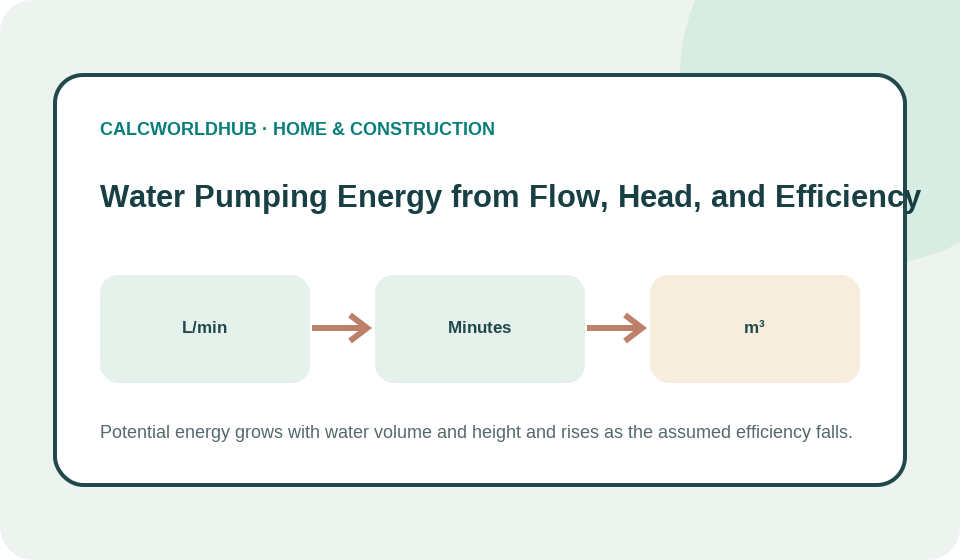
Water volume (L) = flow (L/min) × duration (min). Water cost = volume ÷ 1,000 × tariff ($/m³). Pump lift energy (kWh) = ρgHV ÷ (3,600,000η), using ρ = 1,000 kg/m³, g = 9.80665 m/s², head H in metres, tank volume V in m³, and efficiency η as a fraction.
Worked example
At 9 L/min for 12 minutes, use is 108 L = 0.108 m³; at $2.50/m³ the estimated water charge is $0.27. Lifting 1 m³ through 14 m at 65% efficiency requires about 0.0587 kWh in this simplified model.
How to use the calculator
- Read the field labels and select values from the same source and measurement basis.
- Enter Tap flow rate (L/min) and the other required values. Use the units printed on the page and convert mixed units first.
- Review the displayed method, then compare the result with the question you are trying to answer.
- Change one input at a time to see which assumption has the greatest effect on the result.
Interpreting the result
The water-cost output and pump-energy output describe different quantities: one is a tariff-based charge for tap use, the other is an idealized energy estimate for tank lifting. The tariff does not price electricity.
Assumptions and limits
The water charge uses only the entered tap flow, duration, and tariff. Pump energy is a separate estimate for lifting the entered tank volume through the entered head; it assumes water density 1,000 kg/m³ and omits friction, pressure losses, pump curves, and standby power. Efficiency must be greater than 0 and no more than 1.
Treat quantities as planning estimates. Site conditions, openings, cuts, product coverage, and local building requirements can change the final material or design choice.
Frequently asked questions
What information do I need?
Enter tap flow in litres per minute, duration in minutes, water tariff per cubic metre, pump head in metres, pump efficiency as a fraction, and tank volume in cubic metres. The last three inputs affect only the pump-energy estimate.
How should I interpret the result?
Water cost is the consumed volume multiplied by the entered tariff. The lift-energy estimate is separate and does not include electricity price or real pump/system losses.
Is the Water use cost calculator free to use?
Yes. This calculator is free and works in your browser without an account.
How do I use the Water use cost calculator?
Enter Tap flow rate (L/min), Use duration (minutes), Water price ($/m³), Pump head (m), then complete the remaining labeled fields. Match the units shown beside each field and review the result together with the assumptions below.
What is a worked example of Water use cost?
At 9 L/min for 12 minutes, use is 108 L = 0.108 m³; at $2.50/m³ the estimated water charge is $0.27. Lifting 1 m³ through 14 m at 65% efficiency requires about 0.0587 kWh in this simplified model.
Read the calculation methodology and privacy policy.
Good calculators show their work.
CalcWorldHub is built around clear inputs and visible assumptions. Results are estimates for planning; check official sources or your provider’s terms when exact figures matter.