How to use this calculator
Estimate aggregate volume and mass for a gravel-filled drain trench after subtracting the pipe displacement.
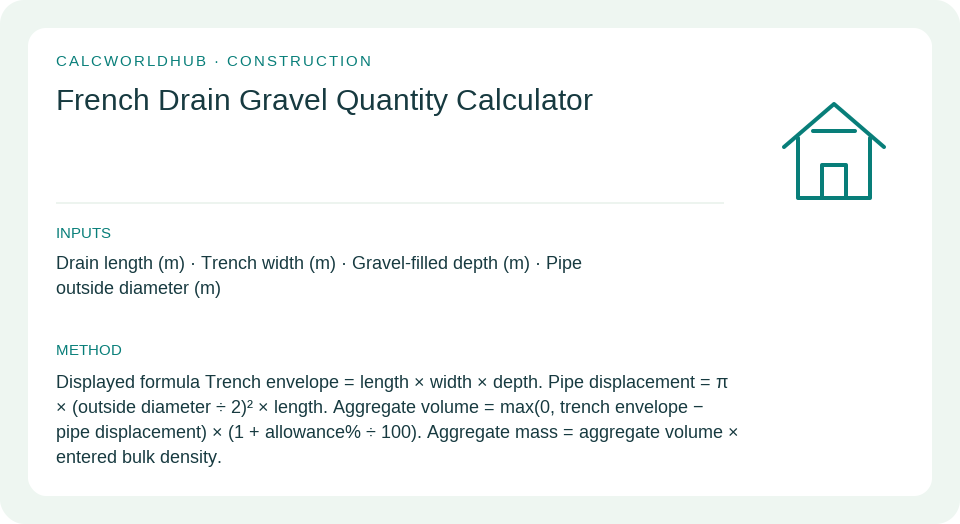
- Enter Drain length (m), Trench width (m), Gravel-filled depth (m), Pipe outside diameter (m), then complete the remaining labeled fields. Match the units shown beside each field and review the result together with the assumptions below.
- Read the worked example below to check the expected input format and result.
- Compare another scenario by changing one input at a time. Use Reset to return to the starting values.
How this calculation works
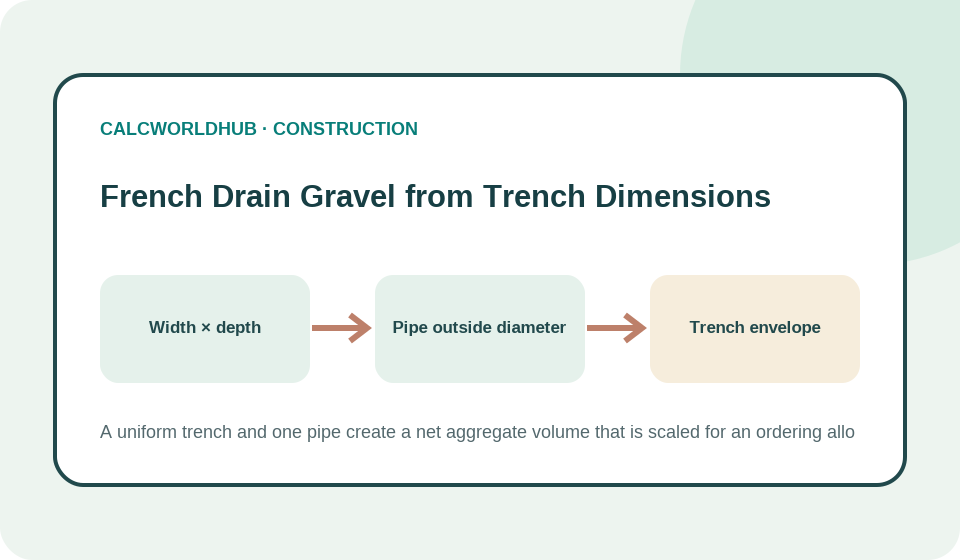
A trench excavation figure includes the space occupied by the drainage pipe. This estimate starts with the rectangular trench envelope, subtracts the pipe's cylindrical volume, and applies a separate allowance for ordering. Use the entered bulk density only to convert the resulting loose aggregate volume to mass.
Inputs and units
lengthM— Drain length (m)- Measured length of the gravel-filled trench.
widthM— Trench width (m)- Average inside width of the excavated trench.
depthM— Gravel-filled depth (m)- Average depth of the filled trench, including the pipe zone.
pipeOutsideDiameterM— Pipe outside diameter (m)- Use zero if no pipe displacement should be subtracted; otherwise the pipe must fit within the trench cross-section.
allowancePct— Ordering allowance (%)- A separate allowance for handling, irregular excavation, or placement loss.
bulkDensityKgM3— Loose aggregate bulk density (kg/m³)- Supplier or material estimate used to convert ordered loose volume to mass.
Formula
Trench envelope = length × width × depth. Pipe displacement = π × (outside diameter ÷ 2)² × length. Aggregate volume = max(0, trench envelope − pipe displacement) × (1 + allowance% ÷ 100). Aggregate mass = aggregate volume × entered bulk density.
Method
The trench is modeled as a uniform rectangular prism and the pipe as one full-length cylinder inside the trench. The allowance is applied to the net geometric volume; bulk density converts loose volume to estimated aggregate mass.
Worked example
For a 20 m trench 0.30 m wide and 0.60 m deep with a 0.10 m outside-diameter pipe, the net geometric aggregate volume is 3.443 m³. Adding a 10% order allowance gives 3.787 m³; at 1,600 kg/m³, that is about 6.06 metric tonnes.
Assumptions and limits
This estimate does not design a drainage system or establish required trench dimensions, pipe slope, filter fabric, grading, or aggregate gradation. It assumes a straight trench, uniform cross-section, one centered pipe, and no additional fittings or excavation overbreak.
Frequently asked questions
Why subtract the pipe volume?
The pipe occupies part of the trench envelope, so counting it as gravel would overstate the aggregate quantity.
Does the 10% allowance always apply?
No. It is an editable planning input; actual ordering allowance depends on excavation shape, compaction, handling, and supplier packaging.
Does the calculator determine the right trench dimensions?
No. It only estimates material for dimensions you provide; drainage design and local site conditions need separate review.
Why might the delivered mass differ?
Bulk density varies with aggregate type, grading, moisture, and how it is loaded.
How do I use the French Drain Gravel Quantity Calculator?
Enter Drain length (m), Trench width (m), Gravel-filled depth (m), Pipe outside diameter (m), then complete the remaining labeled fields. Match the units shown beside each field and review the result together with the assumptions below.
Read our calculation methodology.