How to use this calculator
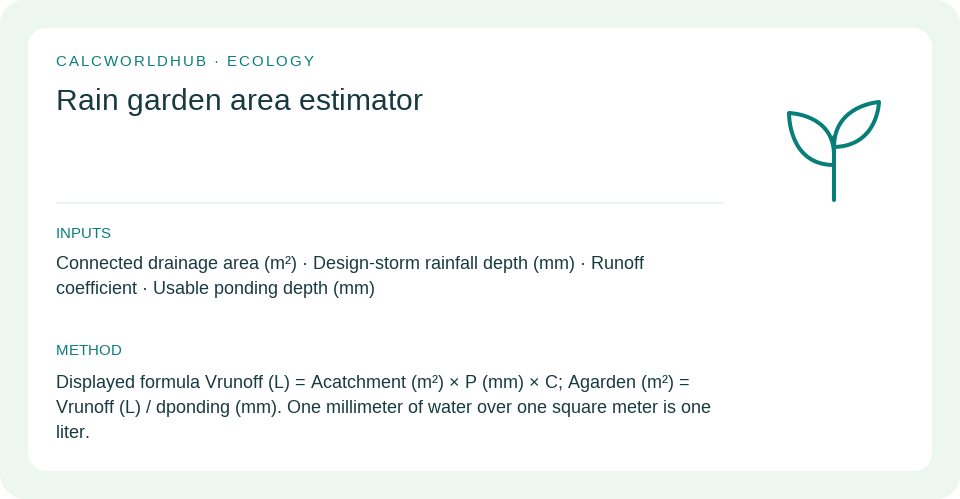
Estimate rain garden area from drainage area, design-storm depth, runoff coefficient, and ponding depth.
- Enter Connected drainage area (m²), Design-storm rainfall depth (mm), Runoff coefficient, Usable ponding depth (mm). Match the units shown beside each field and review the result together with the assumptions below.
- Read the worked example below to check the expected input format and result.
- Compare another scenario by changing one input at a time. Use Reset to return to the starting values.
How this calculation works
A rain garden needs storage volume for runoff entering from an impervious catchment. This simplified estimate first calculates runoff from a selected storm, then divides by the usable surface ponding depth to estimate a footprint area.
Inputs and units
area— Connected drainage area (m²)- Impervious surface area draining to the garden.
rain— Design-storm rainfall depth (mm)- Rain depth selected for the local design event.
coefficient— Runoff coefficient- Fraction from 0 to 1 representing rainfall routed to the garden.
ponding— Usable ponding depth (mm)- Maximum standing-water depth used for storage sizing.
Formula
Vrunoff (L) = Acatchment (m²) × P (mm) × C; Agarden (m²) = Vrunoff (L) / dponding (mm). One millimeter of water over one square meter is one liter.
Method
The entered runoff coefficient represents the fraction of the design-storm rainfall that reaches the garden. Dividing the resulting runoff volume by ponding depth gives the minimum water-storage surface area under the simple bucket assumption.
Worked example
A 120 m² connected area receiving 25 mm of design rain at a runoff coefficient of 0.90 produces 2,700 L. At 150 mm of ponding depth, the storage-area estimate is 18.0 m², or 15% of the drainage area.
Assumptions and limits
This is a preliminary storage estimate, not a site design. It excludes infiltration during the storm, soil permeability, drawdown time, freeboard, underdrains, overflow, snowmelt, and local design-storm rules. Follow local stormwater requirements and confirm soil conditions before construction.
Frequently asked questions
How is runoff coefficient used?
It scales rainfall volume to represent the share of rain expected to reach the garden from the entered surface.
Does this account for soil infiltration?
No. It divides runoff volume by surface ponding depth and assumes no infiltration during the storm.
Can this replace local rain-garden design rules?
No. Stormwater criteria, soil testing, setbacks, overflow paths, and drawdown requirements are site-specific.
How do I use the Rain garden area estimator?
Enter Connected drainage area (m²), Design-storm rainfall depth (mm), Runoff coefficient, Usable ponding depth (mm). Match the units shown beside each field and review the result together with the assumptions below.
What is a worked example of Rain garden area estimator?
A 120 m² connected area receiving 25 mm of design rain at a runoff coefficient of 0.90 produces 2,700 L. At 150 mm of ponding depth, the storage-area estimate is 18.0 m², or 15% of the drainage area.
Reference: U.S. EPA public water-system planning guidance. See our calculation methodology.