Catchment runoff calculator
Estimate an event’s runoff volume from rainfall depth, catchment area, and a chosen coefficient.
inputs.
Calculator
How to use this calculator
Estimate catchment runoff volume in liters from rainfall depth, area, and a runoff coefficient.
- Enter Rainfall (mm), Catchment area (m²), Runoff coefficient (0 to 1). Match the units shown beside each field and review the result together with the assumptions below.
- Read the worked example below to check the expected input format and result.
- Compare another scenario by changing one input at a time. Use Reset to return to the starting values.
Estimate event runoff volume from rainfall over a catchment
This page estimates a runoff volume by applying a dimensionless runoff coefficient to rainfall depth over the entered area. It does not calculate a peak flow rate or hydrograph.
Inputs and units
- Rainfall (mm): Accumulated rainfall depth for the event or period being estimated.
- Catchment area (m²): The contributing surface area in square meters.
- Runoff coefficient (0 to 1): The entered fraction of rainfall volume treated as runoff; it summarizes losses rather than modeling them separately.
Formula and method
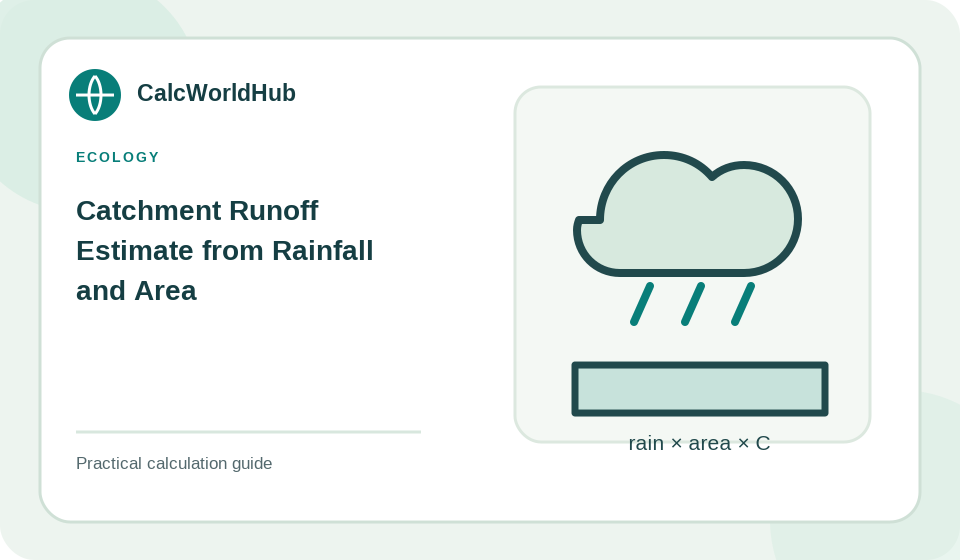
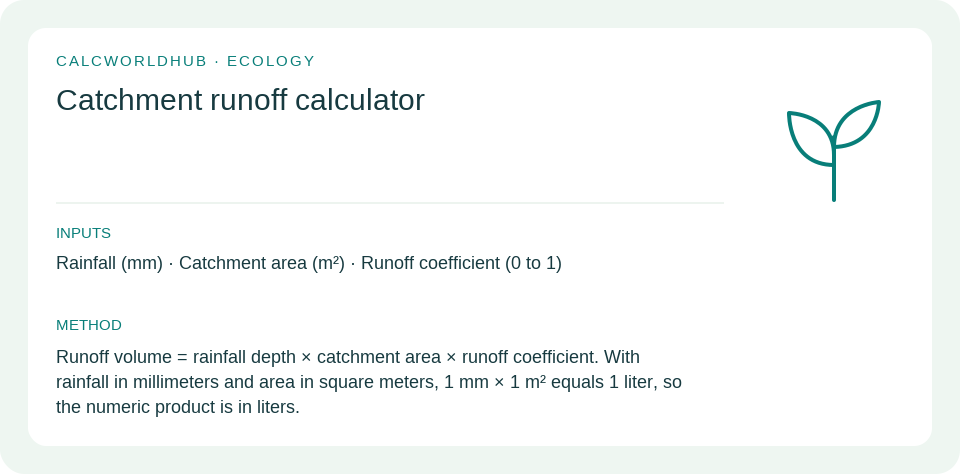
Runoff volume = rainfall depth × catchment area × runoff coefficient. With rainfall in millimeters and area in square meters, 1 mm × 1 m² equals 1 liter, so the numeric product is in liters.
Worked example
For 40 mm over 250 m², total rainfall volume is 40 × 250 = 10,000 L. With a coefficient of 0.75, estimated runoff is 10,000 × 0.75 = 7,500 L.
Interpreting the result
The result estimates an event volume. A coefficient of 0.75 assigns three quarters of the rainfall volume to runoff under the selected assumption; the remaining quarter represents losses not resolved by this simple calculation.
Assumptions and limits
A single coefficient cannot represent changing soil moisture, surface connectivity, rainfall intensity, infiltration, storage, or routing through the catchment. Peak discharge requires a time-based rainfall and flow method; do not read liters as liters per second.
Method references
Frequently asked questions
Is the result a peak flow rate?
No. It is a volume in liters. A peak flow estimate needs rainfall intensity and a method that relates rainfall and catchment response over time.
How do I use the Catchment runoff calculator?
Enter Rainfall (mm), Catchment area (m²), Runoff coefficient (0 to 1). Match the units shown beside each field and review the result together with the assumptions below.
What is a worked example of Catchment runoff?
For 40 mm over 250 m², total rainfall volume is 40 × 250 = 10,000 L. With a coefficient of 0.75, estimated runoff is 10,000 × 0.75 = 7,500 L.
What does the Catchment runoff calculator calculate?
Estimate catchment runoff volume in liters from rainfall depth, area, and a runoff coefficient.
What assumptions apply to Catchment runoff?
A single coefficient cannot represent changing soil moisture, surface connectivity, rainfall intensity, infiltration, storage, or routing through the catchment. Peak discharge requires a time-based rainfall and flow method; do not read liters as liters per second.
Good calculators show their work.
CalcWorldHub is built around clear inputs and visible assumptions. Results are estimates for planning; check official sources or your provider’s terms when exact figures matter.