Rainwater harvesting calculator
Convert a rainfall event into a first-pass harvestable volume before storage and treatment losses.
inputs.
Calculator
How to use this calculator
Estimate roof runoff volume from rainfall depth, roof catchment area, and a runoff coefficient.
- Complete the labeled inputs for Rainwater harvesting. Use the units requested by each field, then read the displayed result alongside the method and limits below.
- Read the worked example below to check the expected input format and result.
- Compare another scenario by changing one input at a time. Use Reset to return to the starting values.
Millimetres over square metres become litres
Formula and method
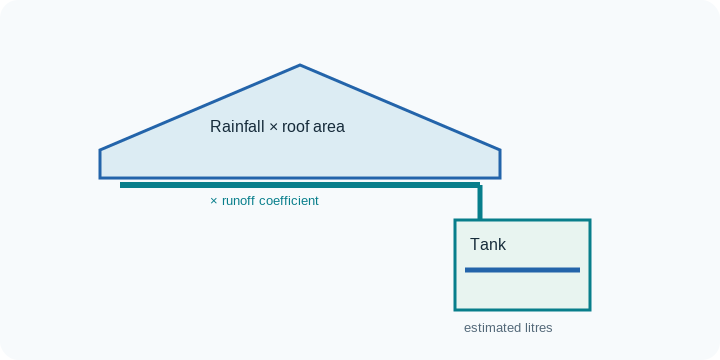
Estimated runoff in litres = rainfall in millimetres × catchment area in square metres × runoff coefficient. One millimetre of water over one square metre is one litre.
Worked example
For 25 mm of rain on an 80 m² roof with coefficient 0.8, 25 × 80 × 0.8 = 1,600 L of estimated runoff before first-flush diversion, leakage, or overflow.
Interpreting the result
The result estimates the event volume entering a collection system under the selected coefficient. Compare it with usable tank capacity and expected demand.
Assumptions and limits
The coefficient summarizes roof and conveyance losses. Actual yield varies with rainfall intensity, roof material, gutters, debris screens, first-flush devices, and tank overflow.
Sources and method notes
Read our calculation methodology.
Frequently asked questions
How do I use the Rainwater harvesting calculator?
Complete the labeled inputs for Rainwater harvesting. Use the units requested by each field, then read the displayed result alongside the method and limits below.
What is a worked example of Rainwater harvesting?
For 25 mm of rain on an 80 m² roof with coefficient 0.8, 25 × 80 × 0.8 = 1,600 L of estimated runoff before first-flush diversion, leakage, or overflow.
What does the Rainwater harvesting calculator calculate?
Estimate roof runoff volume from rainfall depth, roof catchment area, and a runoff coefficient.
What assumptions apply to Rainwater harvesting?
The coefficient summarizes roof and conveyance losses. Actual yield varies with rainfall intensity, roof material, gutters, debris screens, first-flush devices, and tank overflow.
Which method does the Rainwater harvesting calculator use?
Estimated runoff in litres = rainfall in millimetres × catchment area in square metres × runoff coefficient. One millimetre of water over one square metre is one litre. The calculation estimates roof runoff before storage losses.
Good calculators show their work.
CalcWorldHub is built around clear inputs and visible assumptions. Results are estimates for planning; check official sources or your provider’s terms when exact figures matter.