How to use this calculator
Close an annual water budget and convert the residual to a storage-volume change.
- Enter Precipitation depth (mm/year), Actual evapotranspiration (mm/year), Runoff leaving catchment (mm/year), Other water inflow (mm/year), then complete the remaining labeled fields. Match the units shown beside each field and review the result together with the assumptions below.
- Read the worked example below to check the expected input format and result.
- Compare another scenario by changing one input at a time. Use Reset to return to the starting values.
Catchment annual water balance explained
The example accounts for annual precipitation and other inflows against evapotranspiration, runoff, and outflow.
A numerical walkthrough
Precipitation depth (mm/year) = 800; Actual evapotranspiration (mm/year) = 500; Runoff leaving catchment (mm/year) = 200; Other water inflow (mm/year) = 0; Other water outflow (mm/year) = 0; Catchment area (hectares) = 100.
- Water-budget storage residual: 100 mm/year
- Equivalent volume residual: 100000 m³/year
The listed annual terms leave a 100 mm/year residual, equivalent to 100,000 m³/year over 100 ha. That imbalance equals storage change only when the accounting boundary includes all relevant inflows and outflows.
The model behind the numbers
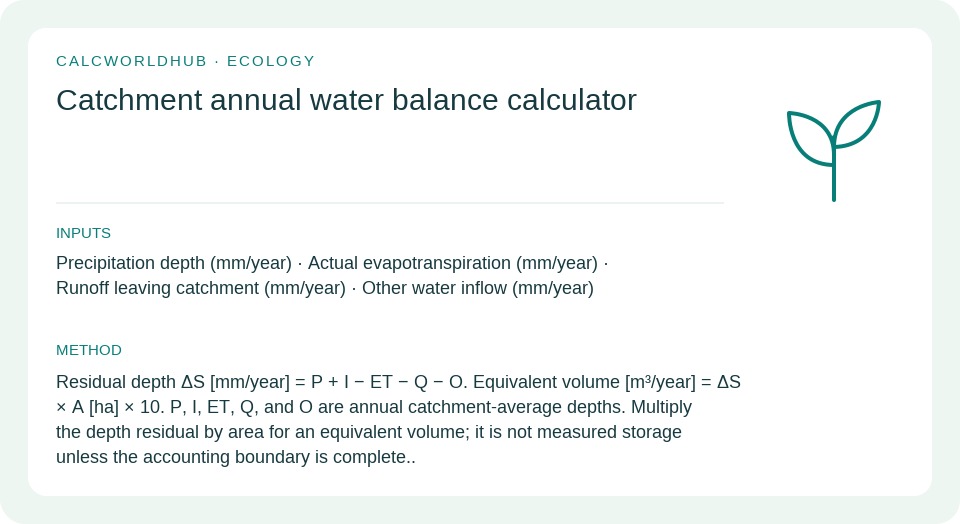
Residual depth ΔS [mm/year] = P + I − ET − Q − O. Equivalent volume [m³/year] = ΔS × A [ha] × 10.
P, I, ET, Q, and O are annual catchment-average depths. Multiply the depth residual by area for an equivalent volume; it is not measured storage unless the accounting boundary is complete..
What to enter
p— Precipitation depth (mm/year)- Annual precipitation averaged over the catchment area, expressed as a depth.
et— Actual evapotranspiration (mm/year)- Water actually returned to the atmosphere by evaporation and transpiration, not reference ETo.
q— Runoff leaving catchment (mm/year)- Surface-water runoff leaving the accounting boundary, converted to an equivalent depth.
i— Other water inflow (mm/year)- Additional inflows such as imports or upstream transfers, on the same annual depth basis.
o— Other water outflow (mm/year)- Additional exports or withdrawals not already counted in runoff, on the same annual basis.
a— Catchment area (hectares)- Area used only to convert the depth residual to an equivalent volume; 1 mm over 1 ha is 10 m³.
Interpreting the result
All terms must use the same area and period; a residual can reflect measurement error or omitted groundwater exchange rather than true storage change.
Verified reference: USGS, Water-budget methods.
Frequently asked questions
Does positive residual mean recharge?
Not necessarily; it is net storage change only if all other terms are complete.
Is reference ETo the ET input?
No, use actual catchment evapotranspiration.
Can the residual be negative?
Yes.
How do I use the Catchment annual water balance calculator?
Enter Precipitation depth (mm/year), Actual evapotranspiration (mm/year), Runoff leaving catchment (mm/year), Other water inflow (mm/year), then complete the remaining labeled fields. Match the units shown beside each field and review the result together with the assumptions below.
What is a worked example of Catchment annual water balance?
Precipitation depth (mm/year) = 800; Actual evapotranspiration (mm/year) = 500; Runoff leaving catchment (mm/year) = 200; Other water inflow (mm/year) = 0; Other water outflow (mm/year) = 0; Catchment area (hectares) = 100. Water-budget storage residual: 100 mm/year Equivalent volume residual: 100000 m³/year The listed annual terms leave a 100 mm/year residual, equivalent to 100,000 m³/year over 100 ha. That imbalance equals storage change only when the accounting boundary includes all relevant inflows and outflows.
Read our calculation methodology.