How to use this calculator
Convert an area-based drainage coefficient into a continuous equivalent discharge.
- Enter Drained field area (hectares), Drainage depth to remove (mm/day). Match the units shown beside each field and review the result together with the assumptions below.
- Read the worked example below to check the expected input format and result.
- Compare another scenario by changing one input at a time. Use Reset to return to the starting values.
Field drainage coefficient design flow explained
The example turns an area-based daily drainage depth into an equivalent continuous flow rate.
A numerical walkthrough
Drained field area (hectares) = 20; Drainage depth to remove (mm/day) = 10.
- Field drainage coefficient design flow: 23.148148 L/s
This example converts a 10 mm/day drainage depth over 20 ha into a continuous daily-average discharge; it does not estimate a storm peak.
The model behind the numbers
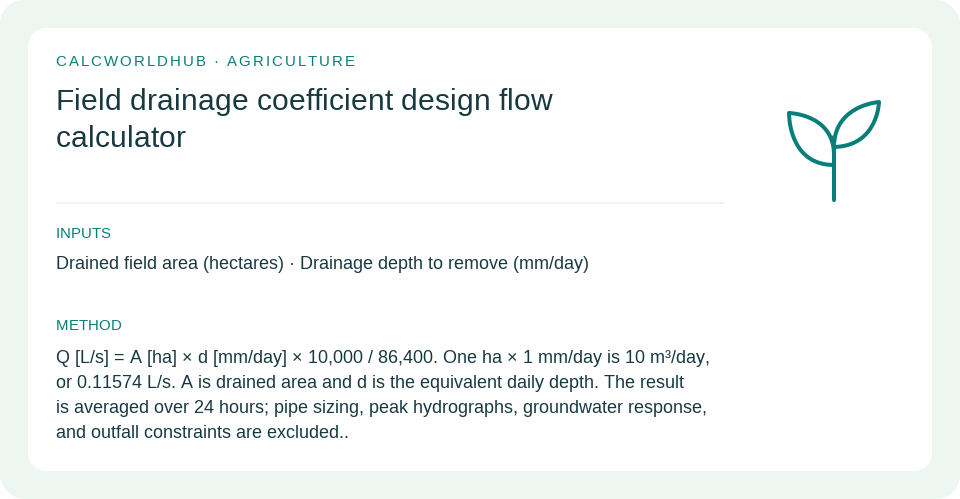
Q [L/s] = A [ha] × d [mm/day] × 10,000 / 86,400. One ha × 1 mm/day is 10 m³/day, or 0.11574 L/s.
A is drained area and d is the equivalent daily depth. The result is averaged over 24 hours; pipe sizing, peak hydrographs, groundwater response, and outfall constraints are excluded..
What to enter
a— Drained field area (hectares)- Total land area served by the drainage coefficient; 1 hectare is 10,000 m².
d— Drainage depth to remove (mm/day)- Equivalent water depth removed each day across that area, not a storm rainfall intensity.
Interpreting the result
Use this equivalent daily discharge for a volume-to-rate check, not as a peak storm-flow or pipe-capacity design value.
Frequently asked questions
Is this peak storm flow?
No, it is the daily averaged equivalent flow.
Does slope affect the answer?
Not this volume-to-rate conversion; it affects conveyance design.
Is one hectare 10,000 m²?
Yes, that is the area conversion used.
How do I use the Field drainage coefficient design flow calculator?
Enter Drained field area (hectares), Drainage depth to remove (mm/day). Match the units shown beside each field and review the result together with the assumptions below.
What is a worked example of Field drainage coefficient design flow?
Drained field area (hectares) = 20; Drainage depth to remove (mm/day) = 10. Field drainage coefficient design flow: 23.148148 L/s This example converts a 10 mm/day drainage depth over 20 ha into a continuous daily-average discharge; it does not estimate a storm peak.
Read our calculation methodology.