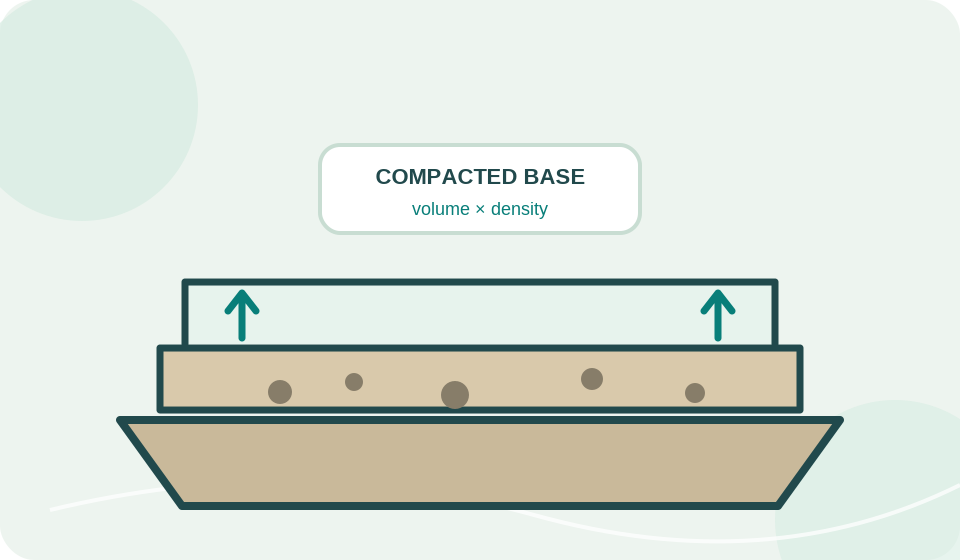

Measure the finished base footprint
Enter the length and width of the finished base in feet and its final compacted thickness in inches. The calculator treats the layer as a rectangular prism, converting inches to feet before multiplying. For an irregular footprint, split the plan into simple non-overlapping areas and add the results. Do not use excavation dimensions where the specified finished base is smaller or where side slopes are part of the cut.
The base volume is a geometric estimate, not a truckload count. Edges, localized thickening, subgrade corrections, and loss during grading are not represented unless you include them in the chosen allowance. If thickness varies, measure the zones separately. Recording the measurement date and where each dimension came from helps reconcile field changes against the order.
Use density that matches compacted material
The formula first finds cubic feet: length × width × thickness ÷ 12. It converts that to cubic yards by dividing by 27. The mass estimate uses cubic feet multiplied by the entered density in pounds per cubic foot, then divides by 2,000 pounds per U.S. short ton. A metric tonne is not the same mass unit as a U.S. short ton, so keep the calculator’s output label with the number.
Density depends on gradation, particle shape, moisture, compaction, and whether the value is dry, moist, loose bulk, or in-place. FHWA guidance describes granular base materials and notes their engineering properties vary with material and testing; its geotechnical reference also distinguishes dry and total unit weight. Ask the supplier or project specification which density to use. A popular default is not a substitute for a material-specific figure.
Read the allowance as an order adjustment
The entered allowance increases the base mass once: order tons = base tons × (1 + allowance ÷ 100). With an 8% allowance, 15.0 short tons becomes 16.2 short tons. The geometric volume remains 8.889 cubic yards in that example. Keep those two outputs distinct: one describes the planned compacted layer, while the other is the suggested mass after the selected margin.
The allowance can cover handling and grading uncertainty, but it is not a compaction ratio or a conversion from loose stockpile volume to compacted volume. If the supplier quotes loose tons, a moisture-adjusted scale weight, or a truck volume, confirm the quote’s basis before comparing. Supplier delivery increments may also make the purchasable amount differ from a mathematically exact target.
Use the result for planning, not pavement design
This estimate does not specify aggregate type, gradation, lift thickness, moisture conditioning, compaction effort, drainage, or load capacity. FHWA describes granular base as an engineered pavement layer with material and placement characteristics, not merely a mass of gravel. Follow the project drawings and agency specification for those decisions, and use the calculator only after the intended section is known.
For a quote, send the measured footprint, finished depth, named material, density source, and allowance rule. For work completed, compare the predicted quantity with tickets and as-built thickness. A mismatch may indicate changed area, over-excavation, variable moisture, or a different delivery basis rather than an arithmetic error. Retain the entered figures so the result can be recalculated without relying on a rounded tonnage alone.
Worked examples
Both examples use compacted dimensions in feet and inches, supplier or project density in pounds per cubic foot, and U.S. short tons.
A rectangular driveway base
Inputs: 55 ft × 18 ft, 4 in compacted thickness, 125 lb/ft³ density, 8% allowance
Calculation: V = 55 × 18 × 4/12 = 330 ft³ = 12.222222 yd³; base = 330 × 125/2,000 = 20.625 short tons; order = 22.275 tons
The base layer is 12.2222 cubic yards by geometry and 20.625 short tons at the entered density. The 8% allowance raises the mass estimate to 22.275 short tons.
A narrower garden path
Inputs: 24 ft × 10 ft, 6 in compacted thickness, 118 lb/ft³ density, 5% allowance
Calculation: 24 × 10 × 6/12 = 120 ft³ = 4.444444 yd³; base = 120 × 118/2,000 = 7.08 short tons; order = 7.434 tons
At the selected density the base mass is 7.08 short tons; the entered 5% margin produces an order estimate of 7.434 tons. Confirm whether the supplier quotes compacted or loose material.
