How to use this calculator
Estimate compacted gravel mass from base dimensions and a stated in-place density. Free calculator with formula, example, and assumptions.
- Enter Base length (ft), Base width (ft), Compacted thickness (in), Compacted density (lb/ft³), then complete the remaining labeled fields. Match the units shown beside each field and review the result together with the assumptions below.
- Read the worked example below to check the expected input format and result.
- Compare another scenario by changing one input at a time. Use Reset to return to the starting values.
How the estimate works
The order allowance is applied after the compacted volume and density produce the base mass; it changes the planned quantity, not the geometric volume or the material density.
Inputs and units
length— Base length (ft)- Enter the finished base length.
width— Base width (ft)- Enter finished width.
thickness— Compacted thickness (in)- Enter the final compacted layer thickness.
density— Compacted density (lb/ft³)- Use a project or supplier value for the installed material.
wastePct— Order allowance (%)- Optional allowance for handling and grading.
Formula and method
V = L × W × (t/12); M_base = Vρ/2000; M_order = M_base × (1 + w/100) US short tons.
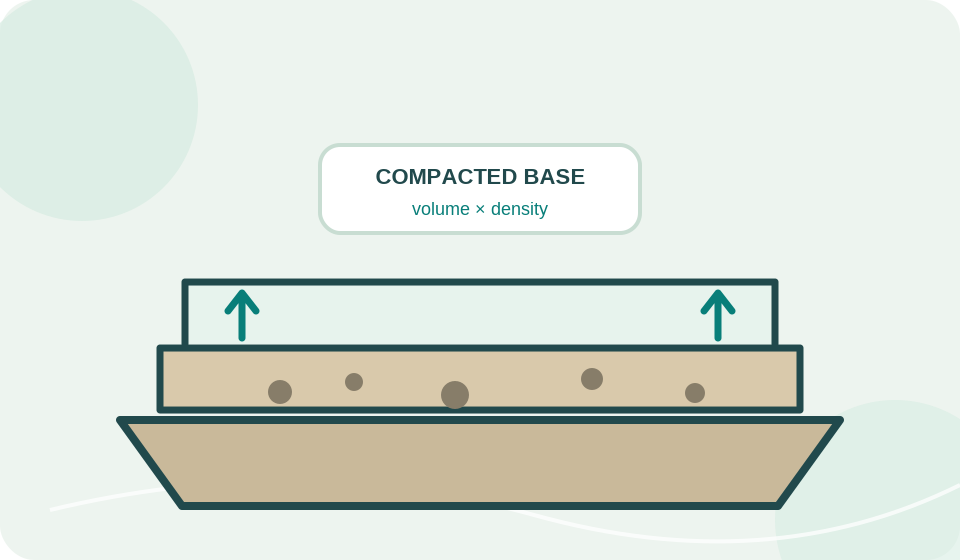
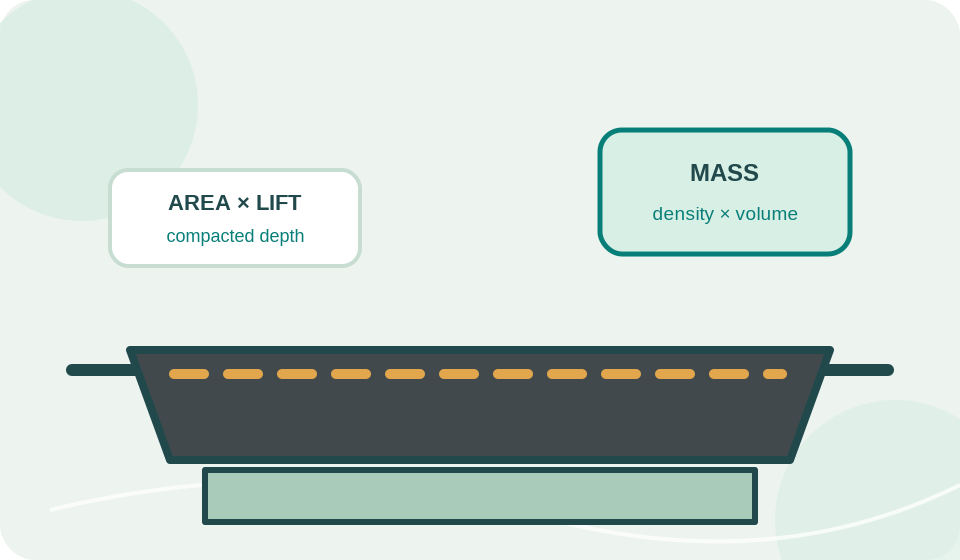
Length, width, and thickness produce the compacted geometric volume. The entered density converts that volume to tons; no generic density is silently assumed.
Worked example
A 40×12 ft base at 6 in is 240 ft³ = 8.89 yd³. At an assumed compacted density of 125 lb/ft³, mass is 30,000 lb = 15 short tons; an 8% allowance gives 16.2 tons.
Assumptions and limits
Use density from the supplier or project specification and confirm whether it describes compacted material. This estimate excludes grading losses and delivery constraints.
Frequently asked questions
Why must I enter density?
Aggregate density varies with material, grading, moisture, and compaction. A supplied value is more defensible than a hidden default.
Is this loose delivery volume?
No. Geometry uses compacted thickness. Ask the supplier whether billing mass or loose truck volume is the relevant order basis.
Does the tool account for compaction shrinkage?
No. It estimates mass at the entered density and compacted dimensions; do not apply a second factor without a clear basis.
How do I use the Compacted gravel base tonnage estimator?
Enter Base length (ft), Base width (ft), Compacted thickness (in), Compacted density (lb/ft³), then complete the remaining labeled fields. Match the units shown beside each field and review the result together with the assumptions below.
What is a worked example of Compacted gravel base tonnage estimator?
A 40×12 ft base at 6 in is 240 ft³ = 8.89 yd³. At an assumed compacted density of 125 lb/ft³, mass is 30,000 lb = 15 short tons; an 8% allowance gives 16.2 tons.
Read our calculation methodology.