How to use this calculator
Estimate asphalt mass needed for a uniform pavement layer from plan area and compacted thickness.
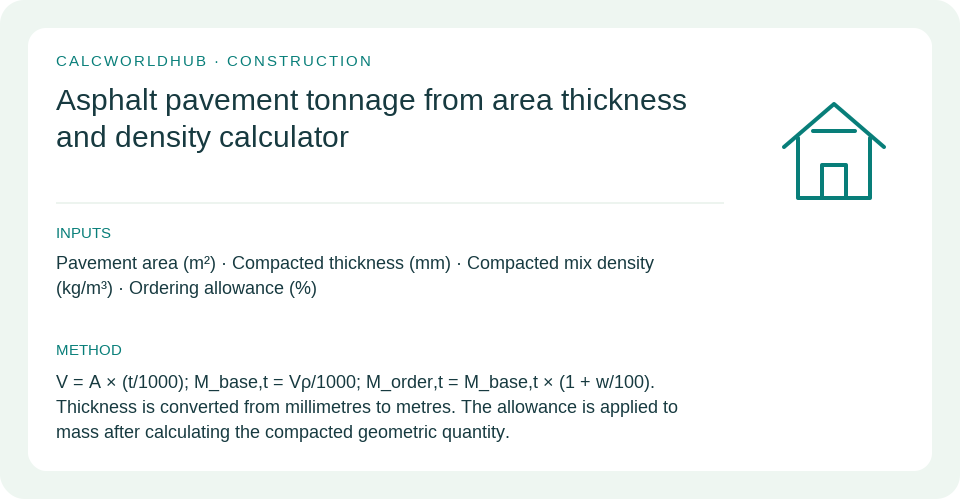
- Enter Pavement area (m²), Compacted thickness (mm), Compacted mix density (kg/m³), Ordering allowance (%). Match the units shown beside each field and review the result together with the assumptions below.
- Read the worked example below to check the expected input format and result.
- Compare another scenario by changing one input at a time. Use Reset to return to the starting values.
Asphalt pavement tonnage from area thickness and density explained
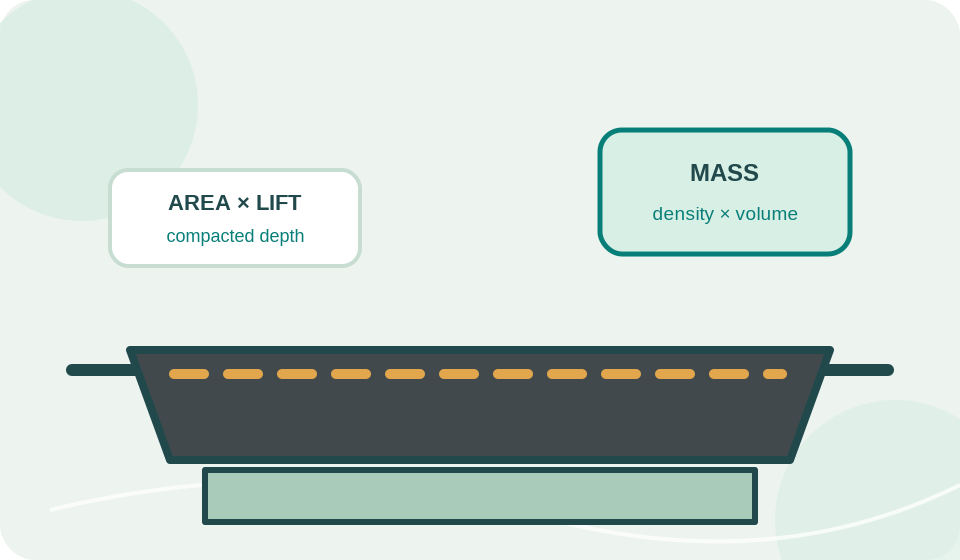
Convert compacted thickness from millimeters to meters before multiplying by area and density; apply the order allowance after calculating compacted mass.
Inputs, symbols, and units
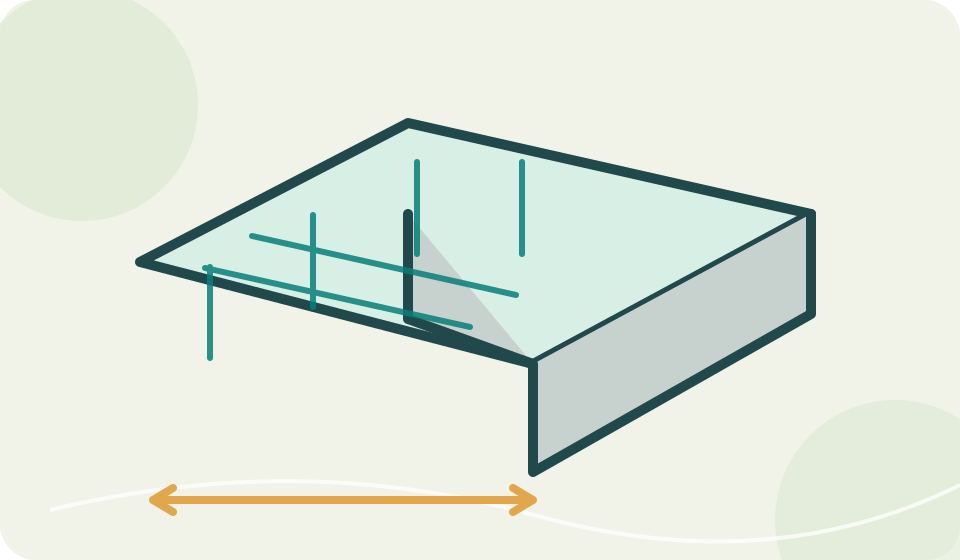
area— Pavement area (m²)- Plan area to receive the asphalt layer.
thick— Compacted thickness (mm)- Finished compacted layer thickness.
density— Compacted mix density (kg/m³)- Specified or measured compacted density of the mix.
waste— Ordering allowance (%)- Additional material allowance for handling and irregularities.
Formula and method
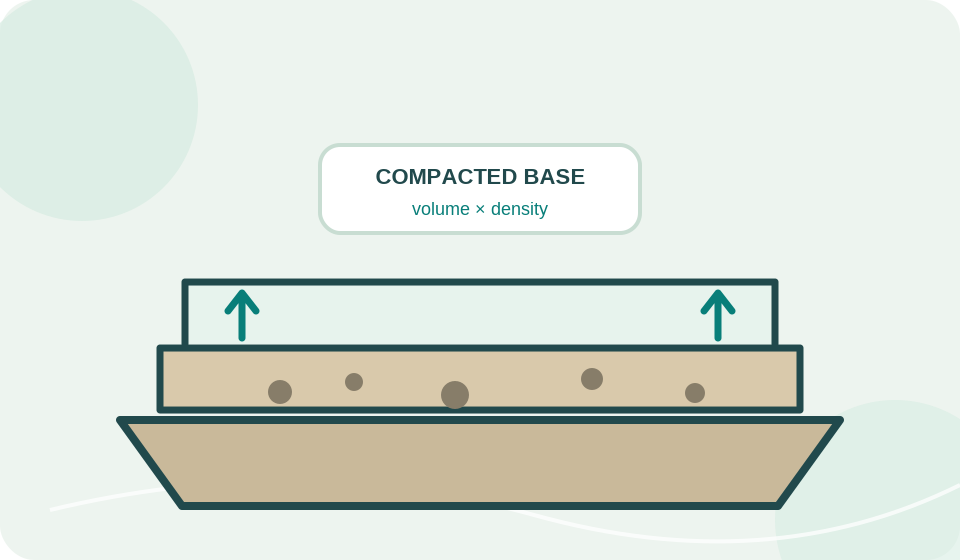
V = A × (t/1000); M_base,t = Vρ/1000; M_order,t = M_base,t × (1 + w/100).
Thickness is converted from millimetres to metres. The allowance is applied to mass after calculating the compacted geometric quantity.
A worked scenario
Pavement area (m²) = 240; Compacted thickness (mm) = 50; Compacted mix density (kg/m³) = 2350; Ordering allowance (%) = 5.
- Compacted volume: 12 m³
- Base asphalt mass: 28.2 metric tonnes
- Mass with allowance: 29.61 metric tonnes
A 240 m² surface at 50 mm and 2,350 kg/m³ needs 28.2 t before allowance, or about 29.6 t with 5%.
Assumptions and edge cases
Uniform thickness and density are assumed. Base irregularities, compaction variability, truck load limits, and mix-specific ordering rules are not included.
Reading the outputs
The main result is asphalt mass in metric tonnes; supporting outputs are labeled with their own units. Use the units shown beside each input and result.
Frequently asked questions
What does the asphalt pavement tonnage from area thickness and density calculate?
A 240 m² surface at 50 mm and 2,350 kg/m³ needs 28.2 t before allowance, or about 29.6 t with 5%.
Which inputs most affect asphalt mass in metric tonnes?
Thickness is converted from millimetres to metres. The allowance is applied to mass after calculating the compacted geometric quantity.
Can this result replace a site-specific or measured value?
Uniform thickness and density are assumed. Base irregularities, compaction variability, truck load limits, and mix-specific ordering rules are not included.
How do I use the Asphalt pavement tonnage from area thickness and density calculator?
Enter Pavement area (m²), Compacted thickness (mm), Compacted mix density (kg/m³), Ordering allowance (%). Match the units shown beside each field and review the result together with the assumptions below.
What is a worked example of Asphalt pavement tonnage from area thickness and density?
Pavement area (m²) = 240; Compacted thickness (mm) = 50; Compacted mix density (kg/m³) = 2350; Ordering allowance (%) = 5. Compacted volume: 12 m³ Base asphalt mass: 28.2 metric tonnes Mass with allowance: 29.61 metric tonnes A 240 m² surface at 50 mm and 2,350 kg/m³ needs 28.2 t before allowance, or about 29.6 t with 5%.
Read our calculation methodology.