
Measure the lift you intend to pave
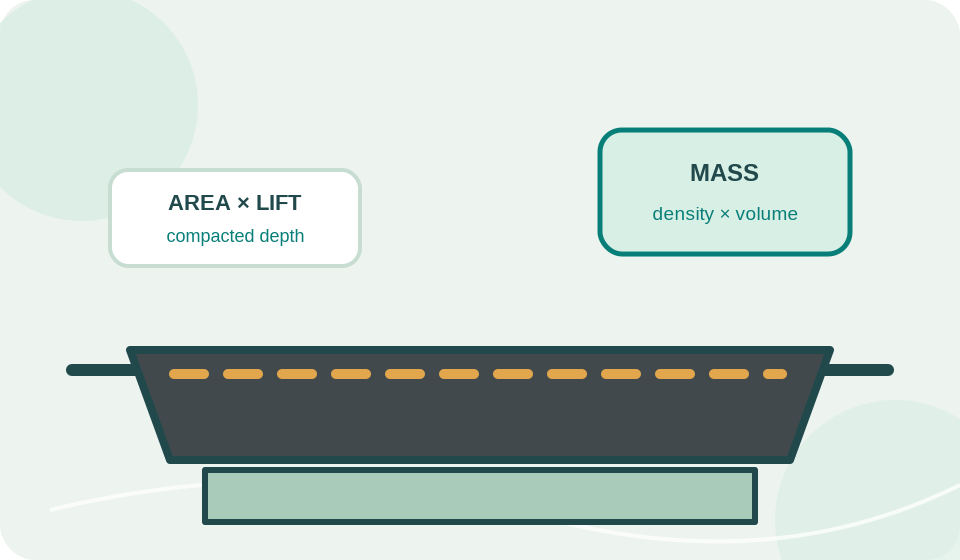
Use the area covered by the lift, not automatically the lot size or the excavated footprint. Break a complicated surface into measured rectangles or other shapes, add the areas, and subtract genuine openings. If the project has separate paving zones, calculate each zone at its own thickness and density before totaling orders. A single area value assumes one continuous layer with a consistent compacted depth.
Thickness means the finished, compacted lift entered in millimetres. Do not enter loose truck depth or convert a design thickness twice. The calculator divides millimetres by 1,000 to obtain metres, then multiplies by the plan area. The resulting volume is in cubic metres. Uneven base elevation, variable edge thickness, and a changing cross-slope can make the actual placed volume differ from this ideal prism.
Convert compacted volume into mass
The formula is volume = area × thickness in metres. Base mass in metric tonnes = volume × compacted density ÷ 1,000. The density must use kilograms per cubic metre and should describe the compacted mix selected for the work. The Ontario Ministry of Transportation’s estimating guidance expresses hot-mix tonnage from area, lift thickness, and recommended mix density; use the mix or project value relevant to your specification rather than copying a generic figure.
For example, a 100 m² lift at 50 mm has 5 m³ of compacted volume. At 2,350 kg/m³, that is 11,750 kg, or 11.75 metric tonnes, before an allowance. The dimensions matter independently: increasing thickness by 10% increases volume and mass by 10% when area and density stay fixed. This is a direct quantity relationship, not a compaction model.
Apply the ordering allowance once
The allowance is entered as a percentage from 0 to 100. The calculator multiplies the base mass by one plus that percentage divided by 100. A five percent allowance on 20 tonnes produces 21 tonnes for planning. It does not alter the displayed compacted volume or claim that exactly five percent will be consumed; it is a separate ordering margin for irregularities, handling, and project practice.
Choose the allowance with the paving contractor or estimator and apply it consistently. Avoid adding an allowance to area, thickness, and final mass at the same time: that would multiply the same contingency several times. Before ordering, confirm supplier dispatch increments, truck payload limits, plant minimums, and whether the quoted material mass is measured at the same moisture and density basis used in the estimate.
Know what the tonnage estimate leaves out
This calculator assumes one uniform compacted layer and a stated density. It does not determine pavement design, binder grade, aggregate gradation, layer bonding, base condition, temperature, traffic loading, or the number of lifts. Those choices affect specification and performance, not just arithmetic. The FHWA and local transport-agency documents treat pavement structure and construction requirements separately from a basic area-thickness takeoff.
Use the output as a first quantity check, then reconcile it with the paving plan, measured site levels, and supplier’s approved mix data. If a surface contains thickened edges, patches, ramps, or several mix types, calculate those areas as separate quantities. Record the source of each input so another person can reproduce the estimate and explain why a later delivery ticket is higher or lower.
Worked examples
Each example uses compacted thickness, a density stated on a mass-per-volume basis, and a single allowance applied after the base mass is calculated.
A small resurfacing lift
Inputs: 180 m² of area, 60 mm compacted thickness, 2,350 kg/m³ density, and 5% allowance
Calculation: 180 × 0.060 = 10.8 m³; 10.8 × 2,350 ÷ 1,000 = 25.38 t; 25.38 × 1.05 = 26.649 t
The base estimate is 25.38 metric tonnes. With the entered allowance the calculator returns 26.649 tonnes for planning; the actual order should follow the project’s mix and supplier increments.
A thinner service-lane section
Inputs: 82.5 m², 45 mm compacted thickness, density 2,320 kg/m³, and 7.5% allowance
Calculation: 82.5 × 0.045 = 3.7125 m³; × 2,320 ÷ 1,000 = 8.613 t; × 1.075 = 9.258975 t
The unadjusted mass is 8.613 tonnes and the allowance-adjusted estimate is 9.258975 tonnes. The calculator may display a rounded result; retain the full inputs and project density for procurement review.
