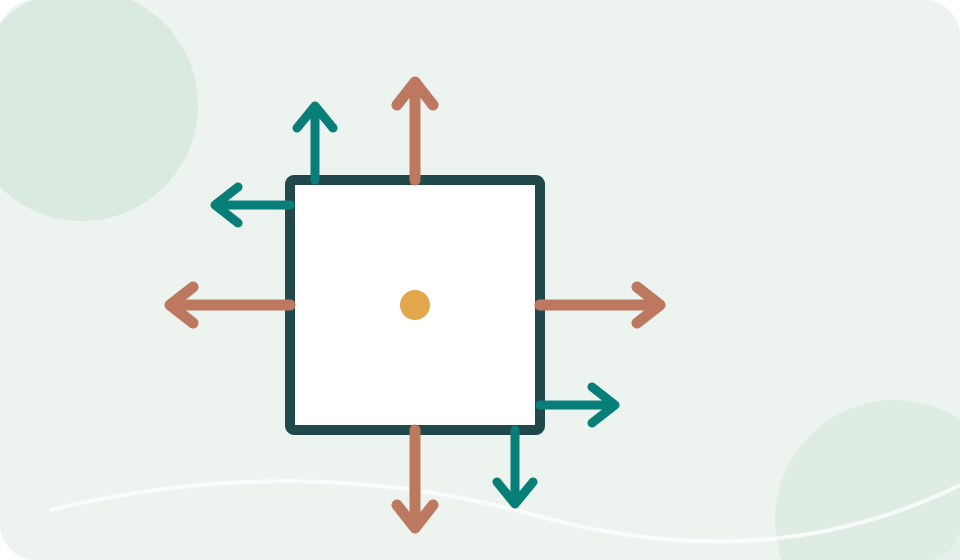

Why an equivalent value is used
A point in a loaded body can have normal and shear components on a chosen set of faces. For many ductile-metal analyses, an equivalent stress lets a multiaxial state be compared with a uniaxial yield criterion. The von Mises measure reflects distortion energy in the idealized continuum model; it is not the same as maximum principal stress and it does not preserve the direction of each component.
This calculator uses a plane-stress case: σx and σy are the in-plane normal stresses, τxy is the in-plane shear, and the out-of-plane normal and shear components are treated as zero. That assumption can be reasonable for thin plates away from local constraints, but not for every 3D connection, thick body, contact zone, or constrained layer.
Enter components with one sign convention
All three fields are in MPa and accept finite signed values. Record whether tension is positive and how positive shear is defined on the x and y faces. The equivalent magnitude is nonnegative, but the signs of σx, σy, and τxy affect the expression through the cross term and squared shear term. Reversing shear alone leaves this scalar unchanged because τxy is squared.
Do not mix psi, Pa, and MPa in the same input set. Convert every component to one unit first. Values from a finite-element result should be components at the same point in the same coordinate system, at the same load step. Do not combine a peak normal stress at one element with shear from another.
Plane-stress expression and a worked calculation
For the calculator’s inputs, σv = √(σx² − σxσy + σy² + 3τxy²). The result is in the same stress unit as the inputs. The negative product term means a compressive σy paired with tensile σx can increase the result; shear contributes through three times its square. Because terms are squared or multiplied, signs should be checked before substituting values.
With 120, −40, and 35 MPa, the radicand is 120² − 120(−40) + (−40)² + 3(35²) = 14,400 + 4,800 + 1,600 + 3,675 = 24,475 MPa². Its square root is 156.444878 MPa, displayed as 156.4449 MPa. Retain more digits through intermediate steps and round only the final display.
Compare a second state without hiding the assumption
For σx = 80 MPa, σy = 20 MPa, and τxy = 30 MPa, the radicand is 6,400 − 1,600 + 400 + 2,700 = 7,900 MPa². The equivalent value is 88.881944 MPa, or 88.8819 MPa at four decimals. This is lower than the first case even though shear is similar because the normal-stress combination is different.
The comparison illustrates why checking only one component can mislead: the scalar depends on the combined state. It does not say that the second part is automatically acceptable. A yield comparison needs a material yield value appropriate to its condition and a design factor required by the governing method.
Worked examples
Tension, compression, and in-plane shear
Inputs: σx = 120 MPa; σy = −40 MPa; τxy = 35 MPa.
Calculation: σv = √(120² − 120(−40) + (−40)² + 3×35²) = √24,475 = 156.444878 MPa.
The displayed plane-stress equivalent is 156.4449 MPa.
A lower combined state
Inputs: σx = 80 MPa; σy = 20 MPa; τxy = 30 MPa.
Calculation: σv = √(6,400 − 1,600 + 400 + 2,700) = √7,900 = 88.881944 MPa.
The equivalent stress is 88.8819 MPa to four decimal places under the same plane-stress assumption.

What this result can and cannot support
For an isotropic ductile material under the assumed plane-stress state, an analyst may compare the equivalent stress with an appropriate uniaxial yield strength as one part of an elastic-yield assessment. The tool does not apply a safety factor, account for strain hardening, evaluate fatigue, or select a material allowable. Brittle fracture, buckling, local bearing, and instability require different checks.
If the out-of-plane stress is not negligible, use a full three-dimensional von Mises equation with all principal components. If the stress state varies rapidly near a notch, mesh singularity, weld toe, or contact edge, a single reported point may be mesh-sensitive. The plane-stress output is a mathematical combination of supplied values, not a stress analysis solver.
A repeatable review checklist
Confirm the source report’s axes, units, load case, and stress location; verify that the plane-stress approximation is justified; write the radicand term by term; check that the square root is nonnegative; and compare like-for-like material values. For a simple independent check, compute principal stresses separately and confirm the equivalent measure is consistent with the same plane state.
Preserve the original component values beside the equivalent result. This makes it possible to revisit the sign convention or add the missing out-of-plane component if the physical model changes. A scalar is convenient for comparison, but it should not replace the stress tensor or the assumptions that produced it.