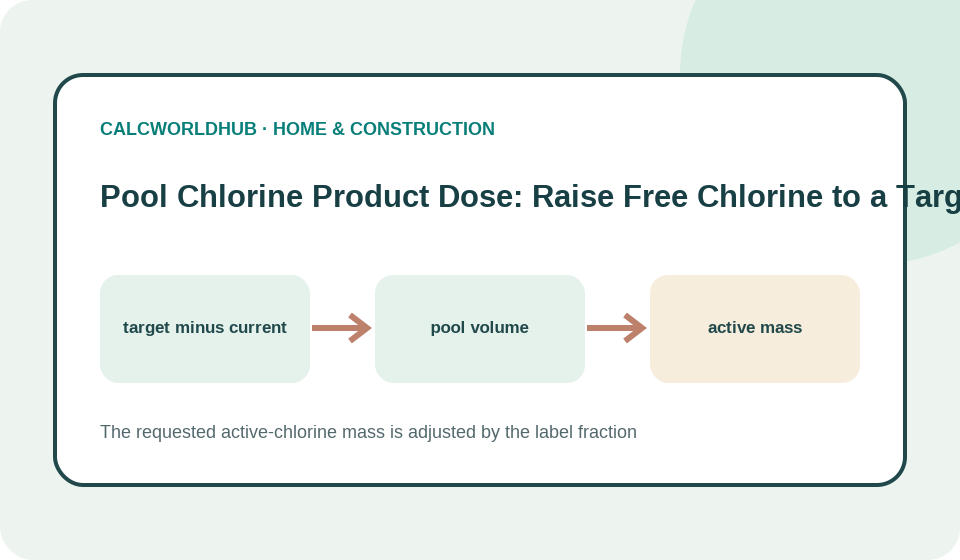

Turn the test gap into a mass estimate
The practical question is how much product would supply a stated increase in free chlorine for a known water volume. This is different from deciding what target is appropriate for a particular pool. The calculator only uses entered volume, current and target concentration, and available-chlorine percentage; it does not test the water or determine a safe or legally permitted operating level.
Use pool volume and measured free chlorine
Enter pool water volume in cubic metres, the current free chlorine and target in mg/L or ppm, and the product’s available-chlorine percentage. For dilute water, 1 mg/L is commonly treated as approximately 1 ppm by mass. Use a recent measurement from a suitable test method and the percentage stated on the product label; do not substitute a total-chlorine reading or a generic product value.
Convert concentration rise into active mass
Subtract current concentration from target concentration to obtain the requested rise. In water, one mg/L across one cubic metre corresponds to one gram of material: a cubic metre contains 1,000 litres, so a 1 mg/L rise represents 1,000 mg, or 1 g. Multiplying the rise by volume therefore yields an ideal active-chlorine mass in grams.
Account for the product’s available fraction
The available-chlorine percentage must be expressed by mass (w/w) for this formula. Divide the ideal active mass by that fraction to estimate total product mass in grams. For a 65% product, use 0.65 in the division; a lower percentage requires more product for the same ideal active mass. The result is product mass, not volume: for a liquid product, grams are not millilitres, and conversion to volume requires the product’s density in g/mL. The tool does not account for product hydration, age, stabilizer, or label-specific dosing tables beyond the entered fraction.
Treat the answer as a starting estimate
The result assumes uniform mixing and that the requested increase remains in the water. Sunlight, organic matter, swimmers, pH, circulation, and other conditions can affect the measured free chlorine after application. A computed mass is therefore a theoretical starting point for reading the exact label and planning a measured treatment, not a guaranteed post-treatment test result.
The calculation is a chemical mass balance, not an instruction to add a particular dose. Actual chlorine demand can consume sanitizer, test methods have uncertainty, and product labels specify permitted uses, target ranges, application steps, and precautions. Use the exact label for the product in hand, circulate and retest as directed, and never combine pool chemicals. If the test result or volume is uncertain, resolve that first rather than treating extra product as a substitute for measurement.
Worked examples
The examples calculate only the theoretical product mass for the requested concentration rise; follow the selected product label and retest.
Raise free chlorine by 2 mg/L in 50 cubic metres
Inputs: Volume = 50 m³; current = 1 mg/L; target = 3 mg/L; available chlorine = 65%.
Calculation: Rise = 3 − 1 = 2 mg/L; active mass = 2 × 50 = 100 g; product = 100 ÷ 0.65 = 153.8462 g.
The ideal estimate is about 154 g of this 65% product before real-world demand and label directions.
A smaller pool with a lower-strength product
Inputs: Volume = 32 m³; current = 0.5 mg/L; target = 2.5 mg/L; available chlorine = 12.5%.
Calculation: Rise = 2.5 − 0.5 = 2 mg/L; active mass = 2 × 32 = 64 g; product = 64 ÷ 0.125 = 512 g.
The ideal mass is 512 g; the product label and a follow-up test determine actual treatment.

Testing and product labels govern treatment
Measure the pool volume carefully, especially for irregular shapes or variable depths. A percentage error in volume carries through to the estimated mass. If the product’s label gives instructions by pool size or water condition, follow those instructions rather than extrapolating a laboratory-style equation beyond its intended use. Keep the product container and label available while handling it.
Follow the product label for protective equipment, storage, application, circulation, and re-entry conditions. The CDC advises pool operators to maintain and test disinfectant and pH according to applicable guidance, but those operational targets depend on pool type and governing rules. This calculator does not replace the label, a water test, or qualified pool-service advice.