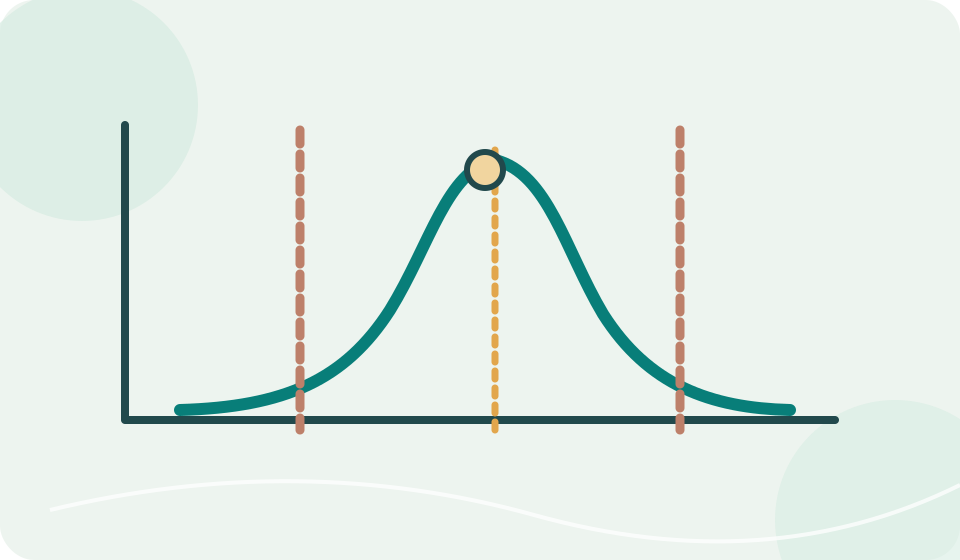

How the limiting side sets Cpk
The formula is Cpk = min(USL − μ, μ − LSL) / (3σ), where μ is the process mean. It calculates the distance from the mean to each specification boundary, selects the smaller distance, and divides by three standard deviations. The result is therefore governed by the side with less room. All four calculation inputs must use the same unit.
Unlike Cp, Cpk responds to mean position. If the mean is centered, the two side distances are equal and the index matches the spread-only value under the same σ. If the mean moves toward one limit, the shorter distance controls. A negative Cpk means the mean lies beyond at least one entered specification limit; it is a warning about the entered position, not a valid capability estimate to celebrate.
Use the fields that the formula actually needs
The calculator asks for upper and lower specification limits, process standard deviation, process mean, defect count, and number of units started. The first four determine Cpk. The visible defect-count and units-started fields are shown in the output details but do not change the index. This is a documented runtime behavior, so do not infer a defect rate from their presence. If you need a count-based rate, define opportunities and calculate DPMO separately.
Use positive σ and USL above LSL when evaluating a plausible process. The calculator does not enforce those conditions in every case, so check them before relying on the index. A mean outside the limits can still produce a finite, negative result, as the second example shows. Use the Cpk calculator after confirming valid limits and positive spread. The initial values are examples only. Keep the limits, unit, data period, sigma method, and mean source with the calculation.
Worked examples
These examples show both a mean inside the limits and a mean outside them. The defect and unit counts are supplied in the calculator fields for completeness, but the numerical Cpk check uses only USL, LSL, σ, and μ.
Mean shifted toward the upper limit
Inputs: USL = 10.5 mm; LSL = 9.5 mm; σ = 0.10 mm; μ = 10.10 mm; defect count = 12; units started = 5,000
Calculation: Cpk = min(10.5 − 10.10, 10.10 − 9.5) / (3 × 0.10) = min(0.40, 0.60) / 0.30 = 1.333333…
Cpk displays as 1.3333. The result is set by the upper side. The displayed defect count and unit count do not affect it.
Mean outside the upper specification
Inputs: USL = 100 N; LSL = 90 N; σ = 2 N; μ = 105 N; defect count = 3; units started = 1,000
Calculation: Cpk = min(100 − 105, 105 − 90) / (3 × 2) = min(−5, 15) / 6 = −0.833333…
Cpk displays as −0.8333. The negative value follows from the mean being beyond the upper limit; it is not an acceptance result.

Read the one-sided constraint
With USL 10.5, LSL 9.5, σ 0.10, and mean 10.10, the upper-side distance is 0.40 and the lower-side distance is 0.60. The closer side yields Cpk = 0.40 / 0.30 = 1.3333. This differs from a centered process with the same tolerance and spread because 0.10 of the available half-width has been used by the shift in the mean.
With the second example's mean of 105 against an upper limit of 100, the selected distance is −5, so the arithmetic result is negative. In practice that describes an input mean outside specifications, where a capability summary is not a pass/fail determination. Investigate the measurement, process state, and applicable acceptance rule. Cpk does not report the observed share conforming and should not be converted directly into a guarantee of future output.
Assumptions and limits
A meaningful capability interpretation normally presumes a stable process and an appropriate distribution model. NIST discusses stability and distribution assumptions for capability work; this calculator does not assess them. It does not identify whether σ is within-subgroup, pooled, or another estimate, and it does not estimate σ from individual observations or provide an interval around Cpk.
The standard deviation and mean must describe the same process, time window, and measurement system. A mixed shift, a changing setup, or biased measurement can make the summary misleading. The tool also does not normalize defect opportunities or consider the severity of a defect. Keep count data separate, verify the extra visible fields independently, and document any customer-specific interpretation before acting on the number.