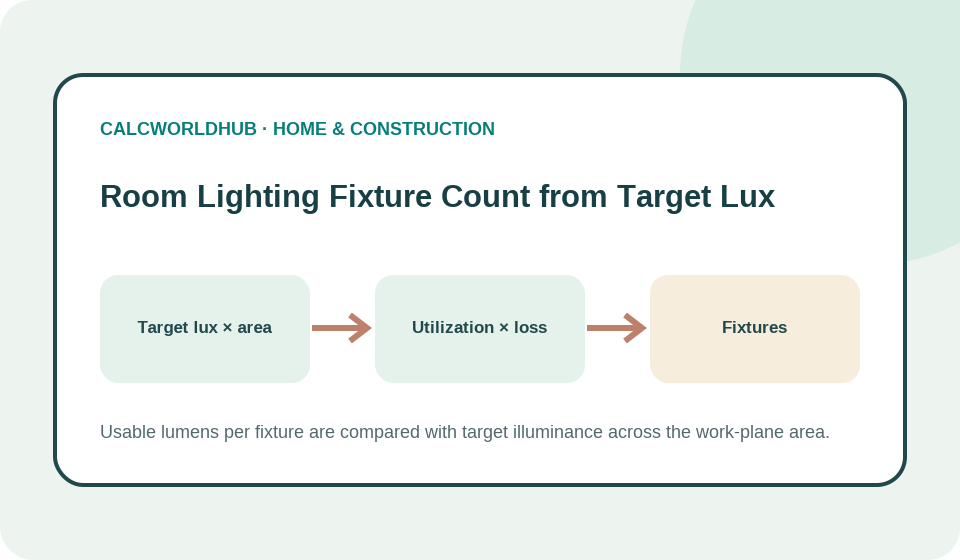

Set the work plane and photometric inputs
Enter target maintained illuminance in lux, the horizontal work-plane area in square metres, initial lumens per complete fixture, a utilization factor, and a light-loss factor. Lux is lumens per square metre. Use the luminaire output from its technical data when possible; a bare-lamp lumen value may overstate what a fixture delivers to the room.
Use utilization and light-loss factors above zero and no greater than one. The first estimates the share of fixture output reaching the work plane; the second scales initial output to maintained output. Both depend on room geometry, reflectance, luminaire distribution, dirt, aging, and maintenance assumptions.
Worked examples
The examples round the fixture count upward before calculating maintained lux and the energy outputs.
Five fixtures for a 20 m² work plane
Inputs: Target = 400 lux; area = 20 m²; initial output = 4,000 lm per fixture; utilization = 0.60; light loss = 0.80; fixture power = 40 W; schedule = 6 h/day for 26 days; rate = 0.20 currency/kWh.
Calculation: N = ceil(400 × 20 ÷ (4,000 × 0.60 × 0.80)) = ceil(4.1667) = 5; maintained lux = 5 × 4,000 × 0.60 × 0.80 ÷ 20 = 480; load = 5 × 40 = 200 W; energy = 0.2 × 6 × 26 = 31.2 kWh; cost = 31.2 × 0.20 = 6.24 currency.
The model selects five fixtures, estimating 480 average maintained lux and 31.2 kWh over the stated month. The arrangement's uniformity still depends on photometry and layout.
A smaller area with an exact four-fixture result
Inputs: Target = 300 lux; area = 15 m²; initial output = 3,000 lm per fixture; utilization = 0.50; light loss = 0.75; fixture power = 30 W; schedule = 8 h/day for 30 days; rate = 0.16 currency/kWh.
Calculation: N = ceil(300 × 15 ÷ (3,000 × 0.50 × 0.75)) = ceil(4) = 4; maintained lux = 4 × 3,000 × 0.50 × 0.75 ÷ 15 = 300; load = 4 × 30 = 120 W; energy = 0.12 × 8 × 30 = 28.8 kWh; cost = 28.8 × 0.16 = 4.608 currency.
Four fixtures meet the entered average target exactly under the selected factors. The energy and cost totals follow the 240 operating hours and user-entered rate.

The lumen-method estimate
Estimated fixture count N = ceil(target lux × area ÷ (lumens per fixture × utilization × light-loss factor)). The calculator rounds upward because a fractional fixture cannot be installed. It then calculates maintained average lux = N × lumens × utilization × light-loss factor ÷ area. The extra fixture may make the displayed average exceed the original target.
This average is a planning quantity, not a point-by-point lighting map. The calculator has no room length, width, mounting height, beam distribution, spacing, daylight, or reflectance inputs. It therefore cannot determine uniformity, glare, shadows, task contrast, or whether a particular work surface meets a lighting specification.
Separate light level from electrical use
The watt input is electrical input per complete fixture. Connected load = fixture count × watts. Monthly energy = connected kilowatts × operating hours per day × operating days per month. Estimated cost multiplies that energy by the entered price per kilowatt-hour. The price is kept in the currency unit you use; the calculator labels the output as generic currency rather than choosing a country or tariff.
The energy calculation assumes the same schedule on each entered operating day and no dimming, controls, standby draw, demand charge, tax, or fixed utility fee. If occupancy sensors or daylight controls change usage, use a realistic average schedule or compare separate scenarios. The cost output is not a utility-bill forecast.
Use the factors as documented design inputs
The U.S. Department of Energy describes the lumen method as an estimate of average horizontal illuminance using coefficient of utilization and light-loss factors. In practice, those factors should come from photometric data, an accepted design method, or an explicit planning assumption. Avoid selecting them only to force the result to a preferred fixture count.
The active calculator rejects zero target illuminance, area, lumens, utilization, or light-loss factor even though several field controls show zero as their minimum. Use positive values; that metadata/runtime mismatch is recorded separately and the runtime is unchanged. Watts, hours, days, and price may be zero within their stated ranges.
Check the layout before ordering fixtures
Treat the count as an early estimate. Before purchase, compare photometry and spacing with room dimensions, ceiling height, task positions, and required criteria. Use a point-by-point method when uniformity or visual comfort matters.
Keep area and schedule consistent across alternatives. Each fixture is assumed identical; the model does not choose a product or prove that a proposed layout will deliver the displayed average.