How to use this calculator
Estimate a fixture count for a target average room illuminance, then model connected load and monthly lighting energy cost.
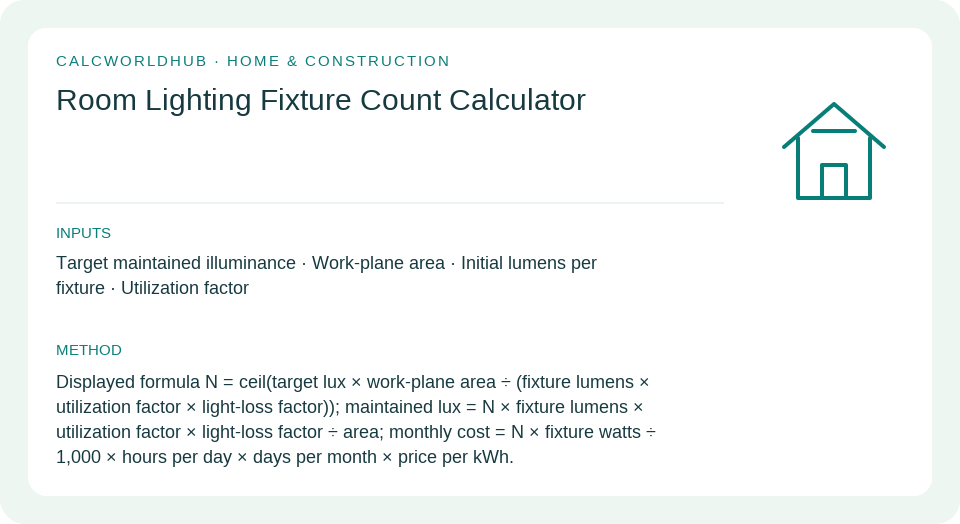
- Enter Target maintained illuminance, Work-plane area, Initial lumens per fixture, Utilization factor, then complete the remaining labeled fields. Match the units shown beside each field and review the result together with the assumptions below.
- Read the worked example below to check the expected input format and result.
- Compare another scenario by changing one input at a time. Use Reset to return to the starting values.
How this calculation works
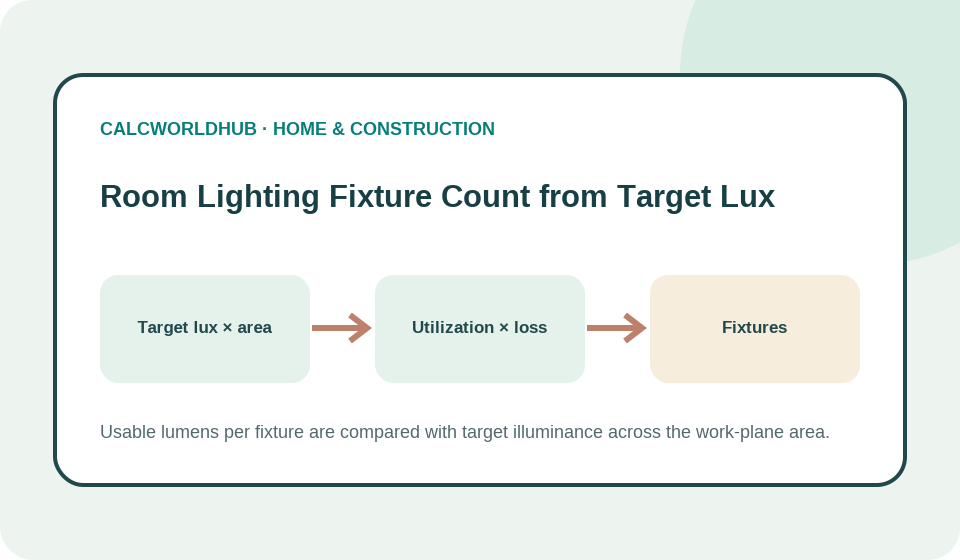
The lumen method turns a maintained illuminance target into a total useful-light requirement over a work plane. Utilization and light-loss factors reduce each fixture’s initial output to an estimated maintained contribution. This estimate assumes one fixture type and a reasonably uniform enclosed room.
Inputs and units
targetLux— Target maintained illuminance- Average target on the work plane, in lux (lumens per square metre).
area— Work-plane area- Horizontal room or task area in square metres.
fixtureLumens— Initial lumens per fixture- Use the luminaire output value, not a bare-lamp value unless it matches the fixture data.
utilization— Utilization factor- Fraction of luminaire output estimated to reach the work plane; enter 0 to 1.
lightLoss— Light-loss factor- Maintained-to-initial output multiplier; enter 0 to 1.
watts— Input watts per fixture- Electrical input power of one complete fixture in watts.
hoursPerDay— Operating hours per day- Average daily lighting schedule in hours.
daysPerMonth— Operating days per month- Days the lights operate during a representative month.
rate— Electricity price- Price per kilowatt-hour in the currency used for the estimated bill.
Formula
N = ceil(target lux × work-plane area ÷ (fixture lumens × utilization factor × light-loss factor)); maintained lux = N × fixture lumens × utilization factor × light-loss factor ÷ area; monthly cost = N × fixture watts ÷ 1,000 × hours per day × days per month × price per kWh.
Method
First compute the useful maintained lumens needed on the work plane. Divide by the maintained contribution per fixture and round the fixture count up to a whole number. The estimated maintained illuminance then uses that rounded count. Energy cost is calculated from the resulting connected wattage and the schedule entered.
Worked example
For 300 lux over 24 m², 4,000 lm fixtures, utilization 0.60, and light-loss factor 0.80, each fixture contributes 1,920 maintained lumens. The tool rounds 7,200 ÷ 1,920 = 3.75 up to 4 fixtures, estimating 320 lux. At 36 W each for 8 hours on 30 days, usage is 34.56 kWh; at $0.15/kWh, the modeled cost is $5.18.
Assumptions and limits
Utilization and light-loss factors depend on room proportions, surface reflectance, fixture photometry, dirt, and depreciation; use project or manufacturer values where available. The lumen method estimates average horizontal illuminance and does not check glare, uniformity, task locations, emergency lighting, or electrical-code requirements.
Frequently asked questions
Why does the fixture count round up?
A partial fixture cannot be installed, so the estimate uses the next whole number to meet or exceed the entered average target.
Where do I get the utilization factor?
Use a luminaire photometric table or a lighting-design calculation for the room geometry and surface reflectances. The default is only an editable example.
Does this guarantee every desk receives the target lux?
No. It estimates an average horizontal level. A layout or photometric simulation is needed to assess local levels, uniformity, and glare.
Does the cost include demand charges or taxes?
No. It multiplies estimated kWh by the unit price you enter and excludes fixed charges, demand charges, and taxes.
How do I use the Room Lighting Fixture Count Calculator?
Enter Target maintained illuminance, Work-plane area, Initial lumens per fixture, Utilization factor, then complete the remaining labeled fields. Match the units shown beside each field and review the result together with the assumptions below.
Reference: U.S. DOE FEMP guide to average illuminance and the lumen method. See our calculation methodology.