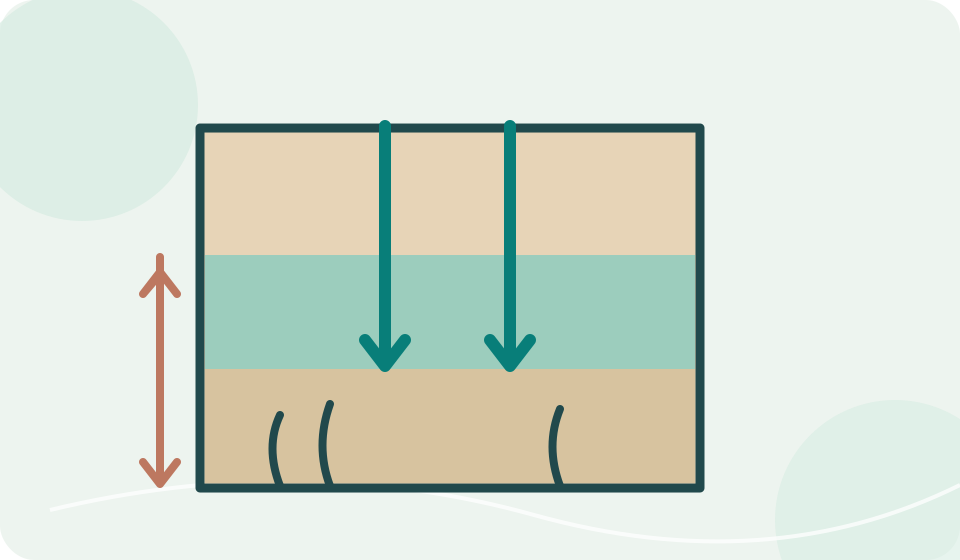

Define the two water-content limits
Field capacity is the soil-water content after excess gravitational water has drained under the stated measurement or model convention. Wilting point is a lower reference associated with water that plants cannot extract readily. The calculator takes both as volumetric percentages: water volume divided by total soil volume. A gravimetric percentage cannot be entered directly unless converted using an appropriate bulk density.
Use values representative of the same soil layer and texture, then choose an effective root-zone depth in metres. Rooting depth is not always the full plant’s maximum root length. Restrictive layers, compaction, salinity, shallow groundwater, and crop stage can reduce the soil volume that contributes to uptake.
Convert the water-content difference to depth
The available-water fraction is (FC − WP)/100. Multiplying that fraction by root-zone depth in metres gives metres of water; multiplying by 1,000 converts metres to millimetres. Thus the formula used here is storage(mm) = (FC − WP)/100 × depth(m) × 1,000. The output represents a depth of water over the ground area, not a volume for an entire field.
Field capacity should be at least as large as wilting point for a nonnegative result. If the values are reversed, check whether the two data points refer to the same layer, units, or method. A negative storage is not a meaningful plant-available reserve; it indicates an input mismatch.
Choose a useful root-zone depth
For a planning estimate, use the depth of active roots in the crop and field at the time being considered. A young crop may occupy a shallow zone even if mature roots can eventually extend deeper. If the calculator only accepts one depth, it assumes the same difference between field capacity and wilting point throughout that layer; layered soils require a layer-by-layer sum for higher accuracy.
Root-restricting layers shorten the effective profile. A mapped soil water-storage value may describe a standard depth or stop at a restrictive horizon, so compare its depth definition with the calculator input. Do not use a whole-profile depth if roots cannot access the lower layers.
Calculate water depth in the root zone
Enter volumetric percentages such as 30 and 12, not decimal fractions 0.30 and 0.12, because the field is expressed as a percent. Enter depth in metres; convert centimetres or feet before calculation. The result is the total available storage between the two reference water contents across that depth.
To check, subtract wilting point from field capacity, divide by 100, multiply by depth, then multiply by 1,000. The units reduce to millimetres. A useful independent check is that a 1% volumetric difference over one metre equals 10 mm of water. That shortcut catches common factor-of-100 and metre-to-millimetre conversion errors.
Worked examples
A 0.60 m root zone with an 18-point water range
Inputs: Field capacity = 30%; wilting point = 12%; depth = 0.60 m
Calculation: (30 − 12)/100 × 0.60 × 1,000 = 0.18 × 600
Available storage = 108 mm.
A deeper profile with a 14-point water range
Inputs: Field capacity = 24%; wilting point = 10%; depth = 1.20 m
Calculation: (24 − 10)/100 × 1.20 × 1,000 = 0.14 × 1,200
Available storage = 168 mm.

Distinguish storage from irrigation scheduling
Total available water is not the amount that should necessarily be depleted before irrigation. Crop-specific management may use a smaller allowable depletion fraction, and current soil moisture must be measured or estimated separately. Rainfall, irrigation efficiency, runoff, drainage, evapotranspiration, and crop demand determine how much water remains available on a particular day.
Use this number as a profile-capacity check or compare two root-depth scenarios by changing only depth. Doubling depth doubles the estimated storage only if the water-content difference is uniform through both layers. If the lower layer has a different texture or field capacity, the simple proportional comparison is not valid.
Limits and common data errors
Field capacity and wilting point are not universal values for a soil name; laboratory methods, structure, salinity, and organic matter matter. A single pair of percentages can smooth substantial variation across a field. Use measured or locally documented values when the estimate affects irrigation investment or crop-risk decisions.
NRCS defines available water capacity as water retained between field capacity and permanent wilting point and notes that soil depth and root restrictions affect total storage. The calculator performs the geometric conversion from a uniform volumetric difference and entered depth. It does not evaluate soil moisture, crop-specific depletion thresholds, irrigation timing, or the field’s actual water-use efficiency.