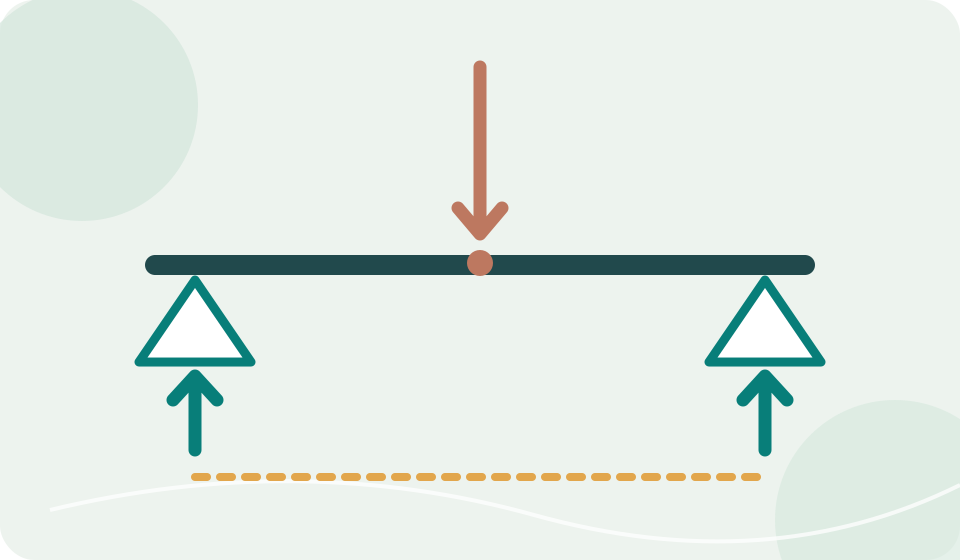

Why the centered load splits evenly
A simple support at each end can provide a vertical reaction. With a single load placed exactly halfway between the supports, the geometry and load are symmetric, so the reactions have equal magnitude. Vertical equilibrium requires their sum to balance the applied load: R₁ + R₂ = P. Combining that balance with R₁ = R₂ gives R₁ = R₂ = P/2.
This result is a statics calculation. It does not require the beam's modulus, section size, or span because those quantities affect deformation and internal moment, not the equal share of a centered load in the ideal determinate model. The span still matters for bending moment and deflection, so its absence from this calculator is intentional rather than a missing field.
Enter a force in newtons
The calculator has one field: center point load P in N. It accepts a finite nonnegative value and reports one reaction value, because the left and right reactions are equal. If the load is listed as a mass, convert it to force before entering it; for a stationary mass near Earth's surface, weight is approximately mass times gravitational acceleration. This simple conversion does not include impact or dynamic effects.
For the displayed 2,000 N default, the equilibrium equation is 1,000 N + 1,000 N = 2,000 N. Both supports act upward for a downward applied load. If you use a different sign convention on a hand sketch, label it clearly; the calculator is intended to report the nonnegative reaction magnitude for a nonnegative center load, not a signed reaction vector.
Check the assumptions before using P/2
The load must act at the center between two simple supports, and the beam must have no other vertical force or applied support moment in the model. If a load lies closer to the left support, moments about the supports show that the reactions are unequal. If there are several point or distributed loads, each contribution can sometimes be analyzed and summed for a linear statically determinate beam, but this single-input tool does not assemble those cases for you.
A common mistake is to split a load equally because the beam looks balanced while the load is actually offset. Another is to treat a distributed load's total force as a center point load without checking whether that is an appropriate equivalent for the reaction question. For a full-span uniform load, its resultant acts at midspan, so the equal reaction total can match P/2, but the bending-moment and deflection distributions still differ from those of one point load.
Connect reactions to other beam results
For a centered 2,000 N load on a 4 m span, each 1,000 N reaction creates a moment of 1,000 N × 2 m = 2,000 N·m at the center. That is the peak bending moment for this point-load case. A deflection estimate also needs the span, E, and I. Thus the support-reaction answer is often a useful equilibrium checkpoint, while a different calculation addresses how much the member bends or what stress develops.
The reaction is an external force at an idealized support. It is not automatically the design capacity of a bearing, wall, bracket, or foundation. Real contact pressures, local crushing, anchorage, eccentricity, load distribution, and support stiffness require their own checks. Keep the computed force as a demand for the relevant connection or support analysis, not as evidence that the support is adequate.
Worked examples
A centered 2,000 N load
Inputs: P = 2,000 N acting at the midpoint between two simple supports.
Calculation: R₁ = R₂ = P/2 = 2,000/2 = 1,000 N.
The calculator displays 1,000.0000 N for either support; the pair sums to the applied 2,000 N.
A centered 7.2 kN load
Inputs: P = 7.2 kN = 7,200 N at midspan.
Calculation: R₁ = R₂ = 7,200/2 = 3,600 N.
The calculator displays 3,600.0000 N at each idealized support.

A short hand check is enough for this case
Draw the support span, mark its midpoint, and place the downward load there. Write ΣFy = 0, so R₁ + R₂ − P = 0. Take moments about the left support: R₂L − P(L/2) = 0, which gives R₂ = P/2 for positive L. Substituting into vertical equilibrium gives R₁ = P/2. Both equations agree with the symmetry argument.
If your model requires unequal reactions, the load is not centered, additional loads exist, or the supports are not simple supports. Use a calculation that matches the actual layout. For high-consequence work, confirm support idealization and load combinations with an appropriate structural method and governing project requirements; this quick calculator only performs the one symmetric equilibrium split.