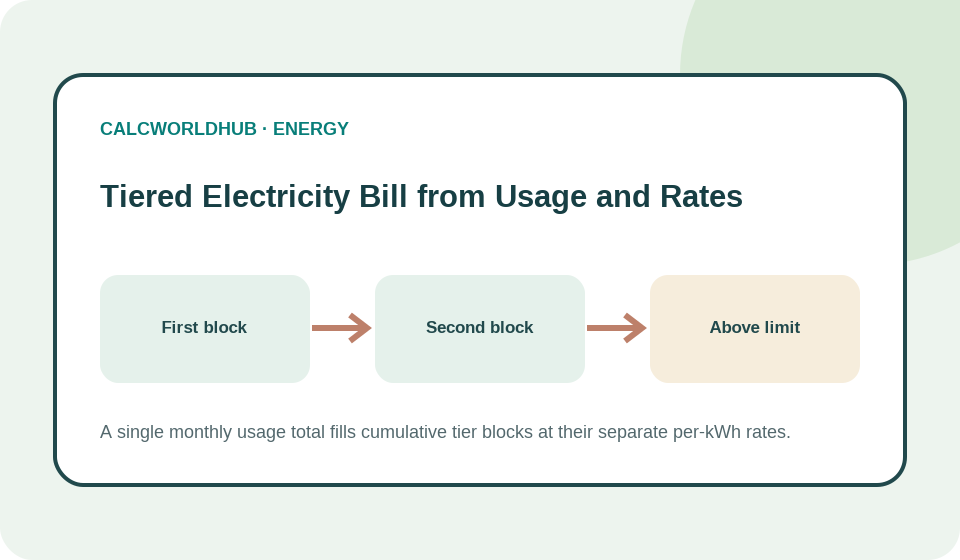

Read tier limits as cumulative thresholds
Monthly electricity use is the total billed kWh for one billing period. End of tier 1 and end of tier 2 are cumulative usage boundaries, not quantities to add to the usage total. If the first limit is 300 kWh and the second is 700 kWh, tier two spans the next 400 kWh, from 300 through 700.
Enter the two limits in increasing order and use the utility’s precise definition of the blocks. Some tariffs apply tiers by season, customer class, or baseline allowance. This calculator has three sequential blocks and does not identify a tariff from your address or account.
Allocate each kWh only once
Tier one use is the lesser of total usage and the first limit. Tier two use is the smaller of the remaining usage after tier one and the width of tier two. Tier three receives any usage above the second limit. This allocation keeps the blocks separate, so the first rate is not charged again on every kWh.
The energy charge is the sum of each tier’s kWh multiplied by that tier’s dollars-per-kWh rate. The fixed charge is then added once. Confirm whether the tariff’s fixed fee is monthly or prorated; the result represents the billing period you entered, not an annual cost.
Enter rates and fees on the same bill basis
The rate fields are in dollars per kWh, and the fixed charge is in dollars. Do not enter cents as though they were dollars: 12 cents per kWh is 0.12 dollars per kWh. If a statement combines generation and delivery charges, include the intended variable components consistently in each tier rate.
A zero use or zero rate can be a valid mathematical scenario, but the output may not represent an actual account. Keep taxes, credits, minimum bills, and delivery riders separate unless they are explicitly included in the rates you choose. EIA’s reported average electricity price is context; your utility tariff determines the bill calculation.
Understand what the estimate excludes
The calculator reports tier allocations, an energy charge, and an estimated bill after one fixed charge. It does not include time-of-use periods, demand charges, taxes, renewable surcharges, power-factor penalties, net-metering credits, arrears, or a minimum-bill floor. A utility may also calculate tiers over a season or a rolling baseline that differs from this simple monthly model.
When the actual bill differs, compare line items rather than changing a rate until the total happens to match. A tariff may have more than three blocks or a customer-specific allowance. Save the rate schedule and billing dates used so another person can reproduce the estimate.
Use the calculation to compare scenarios
A tiered estimate is useful for seeing how an additional unit of use changes the bill when it crosses a threshold. If a household is just below the second limit, the next kWh may use the second rate; after the second limit, new use is priced at the third rate. The average bill divided by all kWh is therefore not necessarily any one marginal tier rate.
For a budget, compare low, typical, and high usage against the same published tariff. Keep the fixed charge and billing period consistent. If the provider changes rates during the month, or time-of-use pricing also applies, a single three-tier calculation cannot reconstruct the bill without more detailed interval and tariff rules.
Worked examples
Each example treats tier limits as cumulative thresholds and applies each rate only to the usage inside its block.
Use passes through all three tiers
Inputs: Monthly use = 850 kWh; limits = 300 and 700 kWh; rates = $0.12, $0.18, and $0.25/kWh; fixed charge = $15.
Calculation: Tier 1 = 300 kWh; tier 2 = 700 − 300 = 400 kWh; tier 3 = 850 − 700 = 150 kWh. Energy = 300×$0.12 + 400×$0.18 + 150×$0.25 = $145.50. Bill = $145.50 + $15 = $160.50.
The model charges each block at its own rate and adds the fixed fee once. Other bill items are outside this total.
Usage ends partway through the third tier
Inputs: Monthly use = 500 kWh; limits = 200 and 450 kWh; rates = $0.10, $0.16, and $0.22/kWh; fixed charge = $12.
Calculation: Tier 1 = 200 kWh; tier 2 = 450 − 200 = 250 kWh; tier 3 = 500 − 450 = 50 kWh. Energy = 200×$0.10 + 250×$0.16 + 50×$0.22 = $71. Bill = $71 + $12 = $83.
Only 50 kWh use the top rate because total use is 50 kWh above the second boundary.

Keep billing units and period visible
A bill’s kWh is energy over the billing period, while kW is an instantaneous rate of use. The tier inputs expect energy in kWh; a peak demand value in kW belongs in a different charge calculation. Entering a monthly total as though it were a daily total changes each tier allocation and makes the comparison meaningless.
Use the account’s tariff and current rates; check whether the fixed fee is included elsewhere. Convert other currencies or per-MWh prices before entry and retain the conversion.