
Use one unknown in v = fλ
The relation is v = fλ. With frequency in cycles per second (Hz) and wavelength in metres, their product has units of metres per second. Rearranging gives f = v ÷ λ or λ = v ÷ f.
Enter two known nonnegative values and set only the unknown field to zero. A known denominator must be above zero: wavelength when solving for frequency, or frequency when solving for wavelength.
Worked examples
Example 1 · solve for wave speed
Inputs: Frequency 5 Hz; wavelength 0.8 m; speed set to 0 as the unknown.
Calculation: v = fλ = 5 × 0.8 = 4 m/s.
The entered frequency and wavelength imply a speed of 4 m/s in this example.
Example 2 · solve for wavelength
Inputs: Speed 340 m/s; frequency 400 Hz; wavelength set to 0 as the unknown.
Calculation: λ = v ÷ f = 340 ÷ 400 = 0.85 m.
At the stated speed and frequency, the wavelength is 0.85 m.

Make the units agree before calculating
Convert centimetres to metres and kilohertz to hertz before entering values if you want the displayed units. The dimensional check is useful: Hz × m gives m/s, m/s ÷ Hz gives metres, and m/s ÷ m gives s⁻¹.
The worked examples apply the same relation to solve for different unknowns; each result depends on the stated medium and units.
Frequency and speed depend on the setup
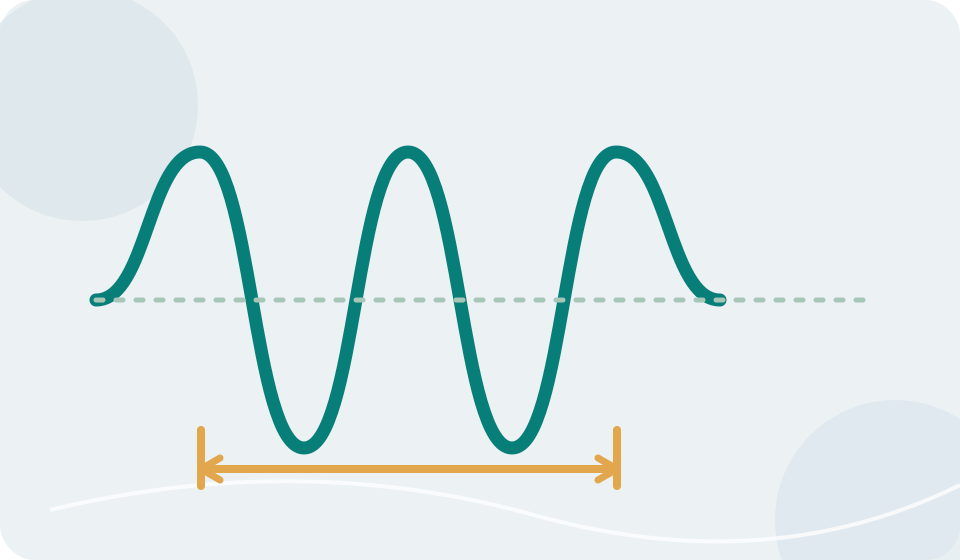
Frequency is the number of cycles passing a point each second; wavelength is the distance between corresponding points such as crest to crest. The equation links them through the propagation speed. For a wave in one medium under fixed conditions, changing frequency changes wavelength accordingly.
At a boundary, the source frequency is generally maintained while speed and wavelength may change with the medium. Sound speed is not universal; use a value appropriate to the medium and conditions.
Recognize the limits of the simple relation
The calculator applies the basic relation to one speed, frequency, and wavelength. It does not model dispersion, attenuation, interference, standing-wave boundaries, or wave shape. In a dispersive medium, speed may depend on frequency, so the result is tied to the selected frequency and conditions.
Use inputs that describe the same wave. This relationship does not determine amplitude, energy, direction, or the medium’s properties.
Check the wave and medium before substitution
Frequency, wavelength, and propagation speed must refer to the same wave component and the same conditions. A source can emit several frequencies, and a signal can contain harmonics; substituting one component’s frequency with another component’s wavelength does not describe a single wave under v = fλ.
Use the units shown by the calculator. Convert a wavelength in centimetres or millimetres to metres and a frequency in kilohertz to hertz before entry. The product of cycles per second and metres gives metres per second; keep the unit conversion with the value so the calculation can be reproduced.
The calculator uses zero to mark the one quantity being solved for. Set exactly one field to zero and enter positive values for the two known quantities. When solving for frequency, wavelength must be nonzero; when solving for wavelength, frequency must be nonzero. A zero known denominator has no finite quotient.
For a given medium under fixed conditions, speed links frequency and wavelength. At a boundary, the source may keep the frequency while the medium changes speed and wavelength. A speed value measured in one medium should not be carried into another without checking the material and conditions.
Use the simple relation as a consistency check, not as a complete wave model. Dispersion can make speed depend on frequency; boundaries can create standing waves; attenuation and interference affect the observed signal. The tool does not infer any of those properties from two entered values.
If measurements come from a standing-wave pattern, distinguish the spacing between adjacent nodes from the full wavelength before entering a value. The calculator expects wavelength itself and does not infer it from apparatus geometry. Preserve the measurement method and uncertainty when comparing the calculated speed with a reference.