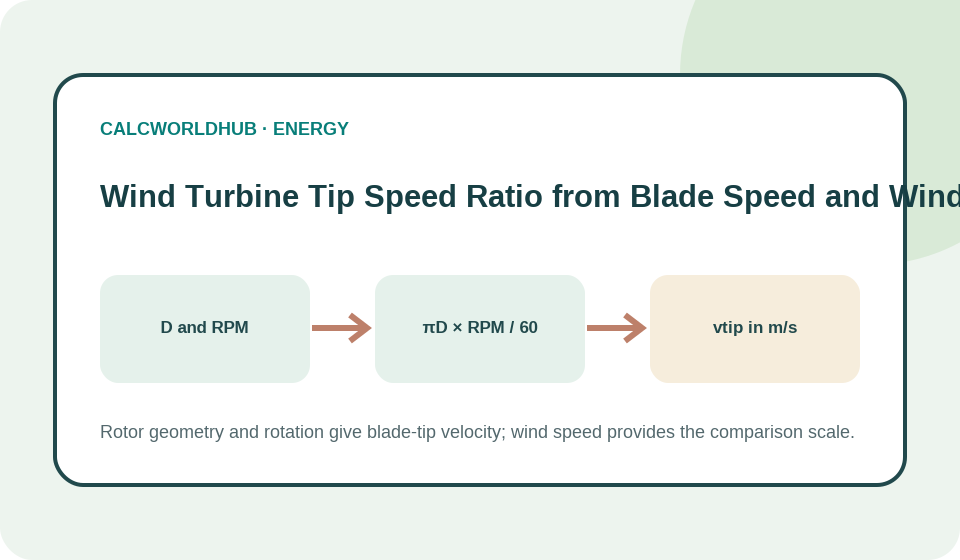

Build tip speed from diameter and rotation
The calculator first finds tip velocity vtip = π × D × RPM ÷ 60. Diameter D is in metres and RPM counts revolutions per minute. Multiplying circumference πD by revolutions per minute gives metres per minute; dividing by 60 converts to metres per second. Then λ = vtip ÷ Vwind, where wind speed uses the same unit.
Use rotor diameter, not blade radius. If only radius is known, double it first. Rotor RPM must describe the same operating moment as the wind reading. The unit ratio cancels, leaving λ dimensionless. A larger tip velocity relative to wind produces a larger ratio, but does not say whether the turbine is at its best aerodynamic point.
Match measurements to one operating point
A useful comparison needs wind speed representative of the air reaching the rotor and rotational speed measured at the same time. A distant weather-station reading, a gust average, and a generator shaft speed after a gearbox may not match the blade conditions. Confirm whether a controller reports rotor speed or another shaft’s speed.
The saved runtime requires finite inputs, positive rotor diameter and wind speed within its supported ranges, and nonnegative RPM. It rejects negative RPM and nonpositive wind speed. It returns blade-tip speed, λ, and angular speed. It does not validate instrument calibration or whether readings are synchronized.
Read λ without turning it into a power claim
Tip-speed ratio is a kinematic ratio: tangential speed at the blade tip divided by wind velocity. It is not a percentage and has no unit. Two turbines can share λ while differing in blade shape, pitch, diameter, generator, control strategy, turbulence exposure, and power curve. The ratio alone cannot establish annual energy, rated output, or overall efficiency.
The calculator also displays angular speed in rad/s using ω = RPM × 2π ÷ 60. This is a conversion of rotation rate, not an additional aerodynamic measurement. Blade-tip and angular speeds should agree through vtip = ω × D/2. The ratio still depends on the entered wind speed.
Why wind conditions matter
Wind varies over time and across a rotor disk. A single value may be instantaneous, averaged for a short interval, or measured at another height. The equation does not estimate the wind resource. For performance analysis, use a documented measurement method and averaging period suited to the question.
Turbulence, yaw, blade pitch, air density, wake effects, and control behavior affect loads and energy capture. None appears as an input. A turbine power curve and certified performance data answer questions that this ratio cannot. Treat λ as a description of an entered operating point, not a recommendation for siting, overspeed limits, or control settings.
Use a consistent rotor model
The geometry assumes a circular swept path and constant RPM during the comparison. It calculates speed at the outer blade tip; real blades twist along their span and local aerodynamic conditions vary from root to tip. A pitch change or changing RPM can alter performance without the simple ratio capturing the dynamics.
The output rounds speeds and λ to three decimals. When diameter, RPM, or wind speed is approximate, the last displayed digits are not measurement precision. Keep original readings, units, timestamps, and instrument sources with an engineering comparison. The estimate is suitable for transparent kinematics, not turbine commissioning, structural evaluation, or energy-yield modeling.
Worked examples
The examples use diameter in metres, rotor RPM, and wind speed in metres per second. Speeds and ratio are displayed to three decimal places.
A 10 m rotor at 30 RPM
Inputs: D = 10 m; rotor speed = 30 RPM; wind speed = 8 m/s.
Calculation: vtip = π × 10 × 30 ÷ 60 = 15.708 m/s; λ = 15.708 ÷ 8 ≈ 1.963.
The blade tip moves about 1.963 times as fast as the entered wind speed.
A larger rotor turning more slowly
Inputs: D = 20 m; rotor speed = 24 RPM; wind speed = 12 m/s.
Calculation: vtip = π × 20 × 24 ÷ 60 = 25.133 m/s; λ = 25.132741… ÷ 12 ≈ 2.094.
The ratio is about 2.094 at this paired rotor and wind operating point.
