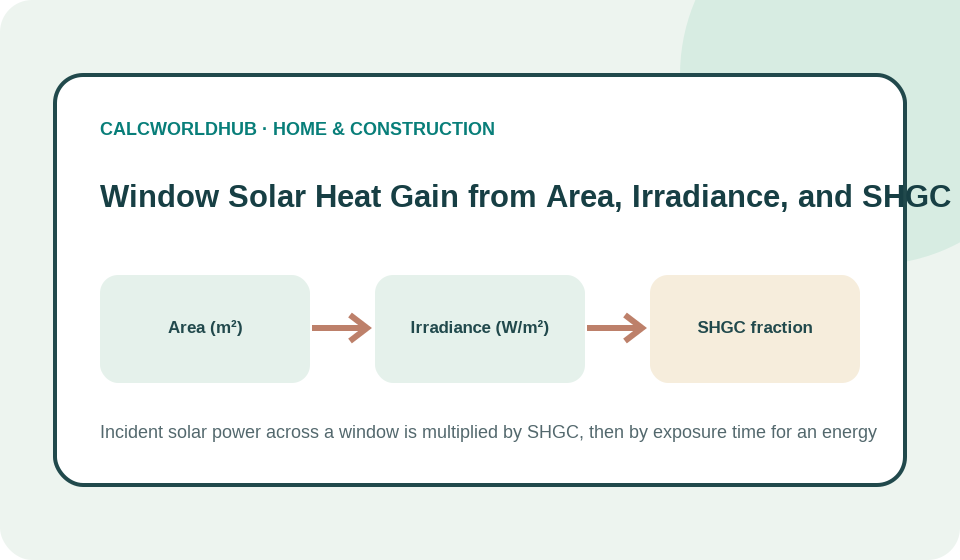

Choose the area and irradiance inputs
Use the glazed area in square metres, not the entire wall or window frame unless the calculator’s measured area is intentionally defined that way. If several panes receive similar conditions, sum their glazing areas; if orientation or shading differs, calculate them separately so one irradiance assumption does not conceal important differences.
Incident irradiance is solar power per square metre arriving at the glazing plane. A horizontal weather-station reading may not represent a vertical window, a different facade orientation, or a shaded pane. Use a value appropriate to the location, orientation, time period, and measurement basis, and keep units in watts per square metre.
Treat SHGC as a fraction
SHGC describes the fraction of incident solar radiation admitted as heat through a fenestration product. A value of 0.30 means 30 percent in fraction form. It is not a 30-point adjustment and should not be entered as 30. Product ratings depend on the rated assembly; verify that the value corresponds to the window or glazing being considered.
The Department of Energy describes SHGC as a measure used alongside U-factor when comparing windows. A lower SHGC generally admits a smaller fraction of solar gain under the rating conditions, but this calculator does not model spectral behavior, blinds, exterior overhangs, dirt, frame edge effects, or changes in sun angle throughout a day.
Convert admitted power into energy
Admitted solar heat rate in watts = glazed area in m² × incident irradiance in W/m² × SHGC. The square-metre units cancel, leaving watts. Estimated energy in kilowatt-hours = heat rate in watts × exposure hours ÷ 1,000. This is a dimensional calculation; multiplying by duration turns a rate into energy.
The result assumes the entered irradiance and SHGC stay constant for the full duration. Real solar input varies with cloud, orientation, sun angle, exterior shade, and season. For a day or longer period, use a representative average only when that average is meaningful, or split the time into intervals and add the individual estimates.
Worked examples
The examples treat irradiance and SHGC as constant over the selected exposure interval.
A south-facing pane during a short sunny interval
Inputs: Glazed area = 3.0 m²; incident irradiance = 600 W/m²; SHGC = 0.40; exposure = 3 hours.
Calculation: Heat rate = 3.0 × 600 × 0.40 = 720 W; energy = 720 × 3 ÷ 1,000 = 2.16 kWh.
Under constant inputs, the glazing admits an estimated 720 W of solar heat and 2.16 kWh over three hours.
A larger pane with a lower SHGC over a longer interval
Inputs: Glazed area = 5.5 m²; incident irradiance = 450 W/m²; SHGC = 0.30; exposure = 4.5 hours.
Calculation: Heat rate = 5.5 × 450 × 0.30 = 742.5 W; energy = 742.5 × 4.5 ÷ 1,000 = 3.34125 kWh ≈ 3.341 kWh.
The model estimates 742.5 W and about 3.341 kWh for these inputs; changing the exposure changes energy even when the rate is fixed.

Interpret the result without overstating it
Use the heat rate to compare glazing choices under the same conditions, or the energy estimate to understand the scale of admitted solar heat over a selected interval. The value describes heat admitted through the measured area under the assumptions entered. It is not the room’s temperature rise and does not tell you how much air conditioning is required.
A building cooling calculation also depends on conductive heat transfer, internal gains, thermal mass, ventilation, infiltration, control settings, and equipment performance. The calculator contains no fields for those effects. Avoid applying a single window estimate as a whole-house load or as a promised utility-bill saving.
Compare products and field conditions carefully
When comparing rated products, use compatible SHGC values and a consistent area, irradiance, and duration. A product label or NFRC directory can help identify a rated value, while the actual project may differ because the installed orientation, frame, shading, or glass configuration changes the effective exposure. Keep those distinctions visible in project notes.
The estimate is most transparent when you record the source of irradiance, its time basis, the glazing area, the rating used for SHGC, and the exposure interval. If you are assessing compliance, comfort, overheating, or HVAC capacity, use the applicable building-energy method or a qualified professional rather than treating this simple calculator as a design analysis.