3D distance calculator
Find straight-line Euclidean distance between two points in three-dimensional coordinates.
How to use this calculator
The three-dimensional Euclidean distance is the length of the shortest straight segment joining two coordinate points. Subtract corresponding coordinates, square each difference, add them, and take the square root. The coordinates must use the same units and coordinate system; the result has those same units.
Formula
d = √[(x₂−x₁)² + (y₂−y₁)² + (z₂−z₁)²]
Assumptions and limits
Inputs should use consistent units and valid values. The result is a planning aid; review the assumptions above and verify the method fits your situation before relying on it.
Related calculators and articles
Compare methods and explore more free tools in math.
How to use this calculator
Find straight-line Euclidean distance between two points in three-dimensional coordinates.
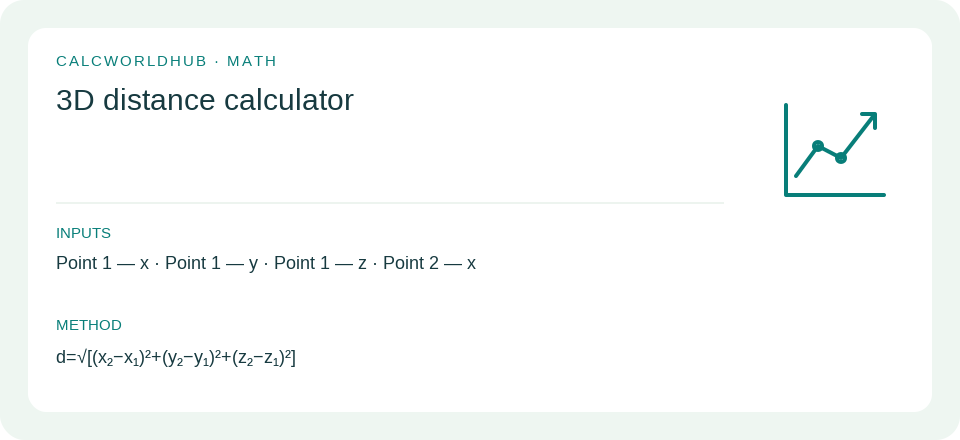
- Enter Point 1 — x, Point 1 — y, Point 1 — z, Point 2 — x, then complete the remaining labeled fields. Match the units shown beside each field and review the result together with the assumptions below.
- Read the worked example below to check the expected input format and result.
- Compare another scenario by changing one input at a time. Use Reset to return to the starting values.
3D distance calculator
Find straight-line Euclidean distance between two points in three-dimensional coordinates.
Inputs and units
- Point 1 — x: Coordinate of the first point on the named Cartesian axis; keep all six coordinate values in one unit.
- Point 1 — y: Coordinate of the first point on the named Cartesian axis; keep all six coordinate values in one unit.
- Point 1 — z: Coordinate of the first point on the named Cartesian axis; keep all six coordinate values in one unit.
- Point 2 — x: Coordinate of the second point on the same axis and scale as point 1.
- Point 2 — y: Coordinate of the second point on the same axis and scale as point 1.
- Point 2 — z: Coordinate of the second point on the same axis and scale as point 1.
Formula and method
d=√[(x₂−x₁)²+(y₂−y₁)²+(z₂−z₁)²]
Worked example
From (1,2,3) to (5,6,7), d=√(4²+4²+4²)=√48≈6.928 units.
Interpreting the result
This is displacement magnitude, not a path length; identical points correctly produce zero.
Assumptions and limits
Coordinates must be finite and share the same Cartesian coordinate system and units.
Sources and method
- Defines three-dimensional position and displacement vectors; the Euclidean magnitude is independently recalculated from coordinate differences. OpenStax University Physics Volume 1: displacement and velocity vectors
Frequently asked questions
What does this 3d distance result tell me?
This is displacement magnitude, not a path length; identical points correctly produce zero.
What assumptions should I check?
Coordinates must be finite and share the same Cartesian coordinate system and units.
How do I use the 3D distance calculator?
Enter Point 1 — x, Point 1 — y, Point 1 — z, Point 2 — x, then complete the remaining labeled fields. Match the units shown beside each field and review the result together with the assumptions below.
What is a worked example of 3D distance?
From (1,2,3) to (5,6,7), d=√(4²+4²+4²)=√48≈6.928 units.
What does the 3D distance calculator calculate?
Find straight-line Euclidean distance between two points in three-dimensional coordinates.
See the calculation methodology.