How to use this calculator
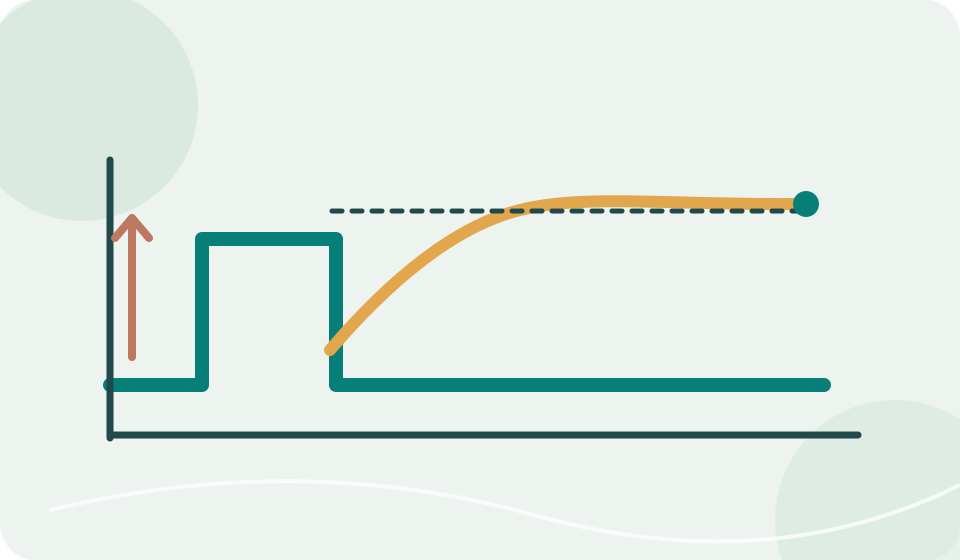
Estimate a conventional 555 one-shot pulse while its capacitor charges to two-thirds of supply.
- Enter Timing resistance (kΩ), Timing capacitance (µF). Match the units shown beside each field and review the result together with the assumptions below.
- Read the worked example below to check the expected input format and result.
- Compare another scenario by changing one input at a time. Use Reset to return to the starting values.
555 monostable pulse duration explained
For the conventional 555 monostable timing model, the capacitor charges through R from zero until it reaches two-thirds of supply. That threshold gives the ideal pulse duration ln(3)RC; the displayed inputs are in kΩ and µF.
Inputs, symbols, and units
r— Timing resistance (kΩ)- Timing resistance (kΩ).
c— Timing capacitance (µF)- Timing capacitance (µF).
Formula and method
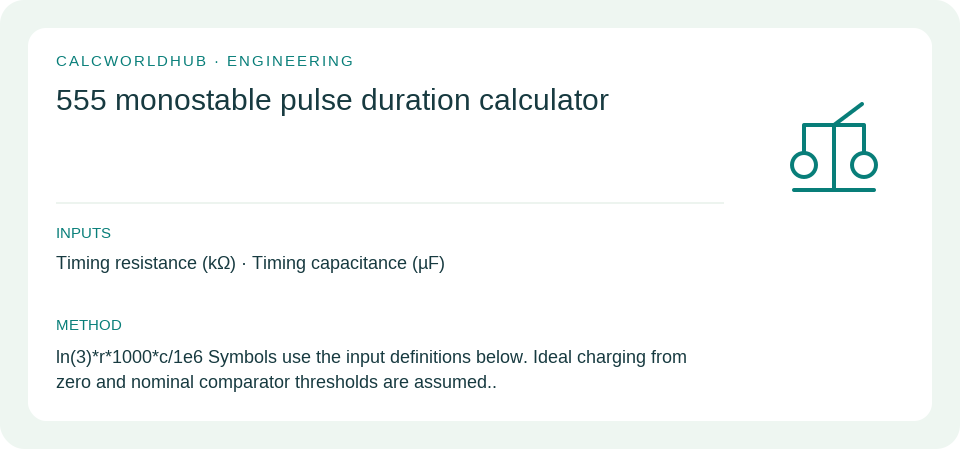
ln(3)*r*1000*c/1e6
Symbols use the input definitions below. Ideal charging from zero and nominal comparator thresholds are assumed..
A worked scenario
Timing resistance (kΩ) = 100; Timing capacitance (µF) = 10.
- 555 monostable pulse duration: 1.098612 s
This scenario uses the stated units and assumptions. Displayed values are rounded only after calculation.
Assumptions and edge cases
Ideal charging from zero and nominal comparator thresholds are assumed.
Frequently asked questions
Why approximately 1.1RC?
The exact ideal factor is ln(3).
Does triggering restart every variant?
Not necessarily; this models only pulse charging.
Are long pulses exact?
Leakage can create substantial error.
How do I use the 555 monostable pulse duration calculator?
Enter Timing resistance (kΩ), Timing capacitance (µF). Match the units shown beside each field and review the result together with the assumptions below.
What is a worked example of 555 monostable pulse duration?
Timing resistance (kΩ) = 100; Timing capacitance (µF) = 10. 555 monostable pulse duration: 1.098612 s This scenario uses the stated units and assumptions. Displayed values are rounded only after calculation.
Read our calculation methodology.