How to use this calculator
Measure the share of receivables available for collection that were cleared during a period.
- Enter Beginning accounts receivable, Credit sales during period, Ending total receivables, Ending current receivables. Match the units shown beside each field and review the result together with the assumptions below.
- Read the worked example below to check the expected input format and result.
- Compare another scenario by changing one input at a time. Use Reset to return to the starting values.
How this calculation works
The collection effectiveness index (CEI) compares the receivable balance collected during a period with the balance that was available to collect. It uses opening receivables, credit sales, and two closing balances: total receivables and the portion still current.
Inputs and units
beginningAR— Beginning accounts receivable- Total open receivables at the start of the selected period, in your currency.
creditSales— Credit sales during period- Credit sales posted during the same period, in the same currency.
endingAR— Ending total receivables- All open receivables at period end, including current and past-due amounts.
endingCurrent— Ending current receivables- The portion of ending receivables that is still current and not past due or in dispute.
Formula
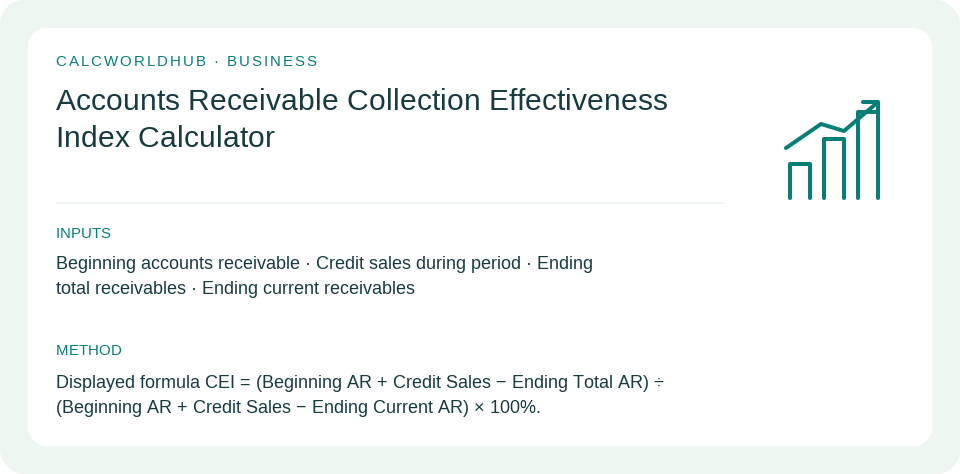
CEI = (Beginning AR + Credit Sales − Ending Total AR) ÷ (Beginning AR + Credit Sales − Ending Current AR) × 100%.
Method
The numerator is a collection proxy: opening receivables plus new credit sales, less ending total receivables. The denominator removes ending current receivables from the collectible pool, then converts the ratio to a percentage.
Worked example
Beginning AR of $80,000 plus $120,000 of credit sales creates a $200,000 pool. With $70,000 ending AR and $20,000 still current, CEI = $130,000 ÷ $180,000 × 100 = 72.22%.
Assumptions and limits
Use balances and credit sales from one reporting period and one currency. CEI can be distorted by write-offs, credits, disputes, changed credit terms, or balances transferred between periods; it is a management indicator, not a cash-receipt reconciliation.
Frequently asked questions
What does a CEI of 100% mean?
Under the entered period balances, the collection proxy equals the receivables pool that was available for collection.
How is CEI different from days sales outstanding?
CEI is a percentage based on opening AR, credit sales, and closing current and total AR; DSO estimates collection time from sales and average receivables.
Can CEI exceed 100%?
It can when credits, write-offs, reclassifications, or other adjustments make the numerator larger than the collectible pool. Review the ledger movements before interpreting it.
What counts as ending current receivables?
Use the current, not-yet-past-due portion defined by your accounting system and reporting policy.
How do I use the Accounts Receivable Collection Effectiveness Index Calculator?
Enter Beginning accounts receivable, Credit sales during period, Ending total receivables, Ending current receivables. Match the units shown beside each field and review the result together with the assumptions below.
Reference: Oracle Financials documentation for the collection effectiveness index formula. See our calculation methodology.