How to use this calculator
Combine collection days, inventory days, and payable days using consistent average balances and period flows.
- Enter Average accounts receivable, Average inventory, Average accounts payable, Credit sales over period, then complete the remaining labeled fields. Match the units shown beside each field and review the result together with the assumptions below.
- Read the worked example below to check the expected input format and result.
- Compare another scenario by changing one input at a time. Use Reset to return to the starting values.
Working capital cash conversion cycle explained
Use Average accounts receivable with Average inventory to reproduce the sample calculation, then review the stated limits before carrying the result into another scenario.
A numerical walkthrough
Average accounts receivable = 50000; Average inventory = 80000; Average accounts payable = 40000; Credit sales over period = 600000; Cost of goods sold over period = 360000; Days in the same period = 365.
- Cash conversion cycle: 70.972222 days
- Collection days: 30.416667 days
- Inventory days: 81.111111 days
- Payable days using COGS proxy: 40.555556 days
The entered annual values give 30.416667 collection days, 81.111111 inventory days, and 40.555556 payable days; the cash cycle is 70.972222 days.
The model behind the numbers
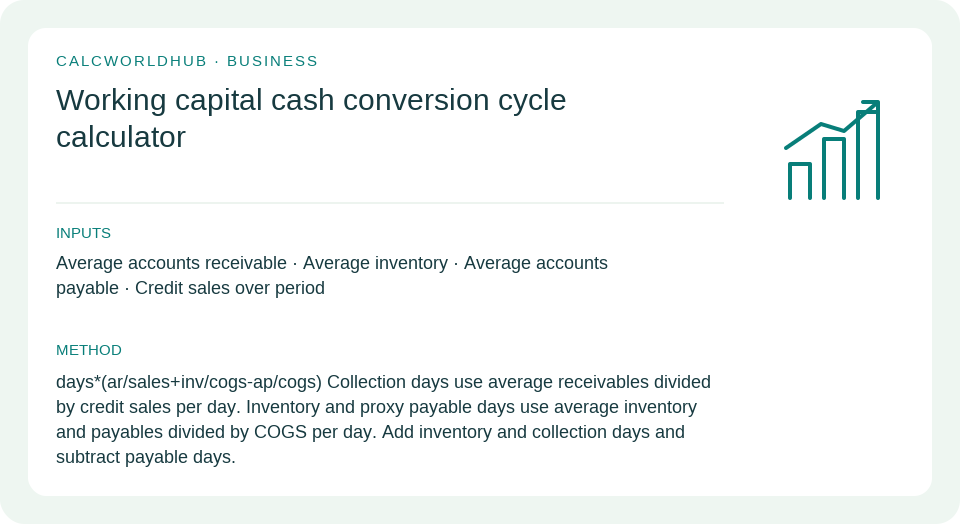
days*(ar/sales+inv/cogs-ap/cogs)
Collection days use average receivables divided by credit sales per day. Inventory and proxy payable days use average inventory and payables divided by COGS per day. Add inventory and collection days and subtract payable days.
What to enter
ar— Average accounts receivable- Average accounts receivable.
inv— Average inventory- Average inventory.
ap— Average accounts payable- Average accounts payable.
sales— Credit sales over period- Credit sales over period.
cogs— Cost of goods sold over period- Cost of goods sold over period.
days— Days in the same period- Days in the same period.
Interpreting the result
Payables days use COGS as an explicit proxy for credit purchases; businesses with material purchase/COGS differences need a purchases-based denominator.
Frequently asked questions
Should balances be closing or average?
Use period averages consistent with the flow period.
Can the cycle be negative?
Yes, supplier financing may exceed collection and inventory time.
Are all sales appropriate?
Use credit sales for receivables days where available.
How do I use the Working capital cash conversion cycle calculator?
Enter Average accounts receivable, Average inventory, Average accounts payable, Credit sales over period, then complete the remaining labeled fields. Match the units shown beside each field and review the result together with the assumptions below.
What is a worked example of Working capital cash conversion cycle?
Average accounts receivable = 50000; Average inventory = 80000; Average accounts payable = 40000; Credit sales over period = 600000; Cost of goods sold over period = 360000; Days in the same period = 365. Cash conversion cycle: 70.972222 days Collection days: 30.416667 days Inventory days: 81.111111 days Payable days using COGS proxy: 40.555556 days The entered annual values give 30.416667 collection days, 81.111111 inventory days, and 40.555556 payable days; the cash cycle is 70.972222 days.
Read our calculation methodology.