How to use this calculator
Estimate cash tied up in receivables and inventory after supplier payment terms are considered.
- Enter Annual credit sales, Annual cost of goods sold, Days in the period, Days sales outstanding (DSO), then complete the remaining labeled fields. Match the units shown beside each field and review the result together with the assumptions below.
- Read the worked example below to check the expected input format and result.
- Compare another scenario by changing one input at a time. Use Reset to return to the starting values.
How this calculation works
A cash conversion cycle expresses time in days, while a funding estimate expresses the operating balances in currency. This page converts annual credit sales and cost of goods sold into daily flows, applies the entered collection, inventory, and supplier-payment days, and shows the three balances before combining them.
Inputs and units
annualCreditSales— Annual credit sales- Credit sales for the same annual period used for cost of goods sold.
annualCogs— Annual cost of goods sold- COGS for the same period; used to value inventory and payables days.
daysPeriod— Days in the period- Use the day count matching the annual flows, commonly 365.
dsoDays— Days sales outstanding (DSO)- Average collection time for credit sales, in days.
dioDays— Days inventory outstanding (DIO)- Average days of COGS held in inventory.
dpoDays— Days payable outstanding (DPO)- Average days of COGS financed by supplier payables.
Formula
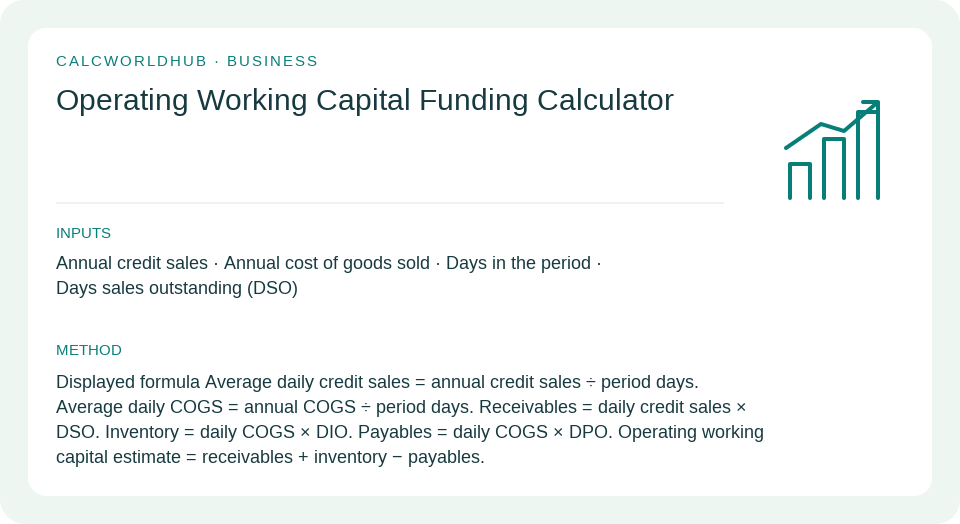
Average daily credit sales = annual credit sales ÷ period days. Average daily COGS = annual COGS ÷ period days. Receivables = daily credit sales × DSO. Inventory = daily COGS × DIO. Payables = daily COGS × DPO. Operating working capital estimate = receivables + inventory − payables.
Method
The estimate values receivables at average daily credit sales and inventory and payables at average daily cost of goods sold. COGS is used as a practical proxy for purchases in the payable estimate; DSO, DIO, and DPO are assumed to describe the same operating period and business scope.
Worked example
With $3,650,000 annual credit sales, $2,190,000 COGS, a 365-day period, DSO 30, DIO 45, and DPO 30, receivables are $300,000, inventory is $270,000, payables are $180,000, and estimated operating working capital is $390,000.
Assumptions and limits
This is a simplified operating-funding estimate, not a balance-sheet valuation or cash forecast. Using COGS as a proxy for purchases can misstate payables when inventory purchases differ materially from cost of sales. It excludes cash, debt, taxes, seasonality, customer and supplier concentration, non-COGS expenses, and changes in margins. It can be negative when supplier credit exceeds the modeled receivable and inventory balances.
Frequently asked questions
How is this different from the cash conversion cycle?
The cash conversion cycle is a time measure in days. This calculator estimates currency amounts tied up in operating balances.
Why use COGS for inventory and payables?
The simplified model values inventory and supplier financing at average daily cost of goods sold, rather than at sales value.
Can the result be negative?
Yes. In the model, supplier payables can exceed estimated receivables and inventory funding.
Should I enter average or closing balance days?
Use DSO, DIO, and DPO computed from balances and flows that cover the same period and operating scope.
How do I use the Operating Working Capital Funding Calculator?
Enter Annual credit sales, Annual cost of goods sold, Days in the period, Days sales outstanding (DSO), then complete the remaining labeled fields. Match the units shown beside each field and review the result together with the assumptions below.
Read our calculation methodology.