How to use this calculator
Estimate how many days of purchases or cost of sales are represented by average accounts payable.
- Enter Average trade accounts payable (currency), Cost of sales for period (currency), Days in measurement period. Match the units shown beside each field and review the result together with the assumptions below.
- Read the worked example below to check the expected input format and result.
- Compare another scenario by changing one input at a time. Use Reset to return to the starting values.
How this calculation works
Days payable outstanding (DPO) relates average trade payables to cost of sales over a period. It is one working-capital measure; use an average balance and expense base that match the period and accounting definition.
Inputs and units
payables— Average trade accounts payable (currency)- Average balance over the measurement period.
cogs— Cost of sales for period (currency)- Cost of goods sold or another consistent purchase base for the same period.
days— Days in measurement period- Use the actual period length, such as 90, 180, or 365 days.
Formula
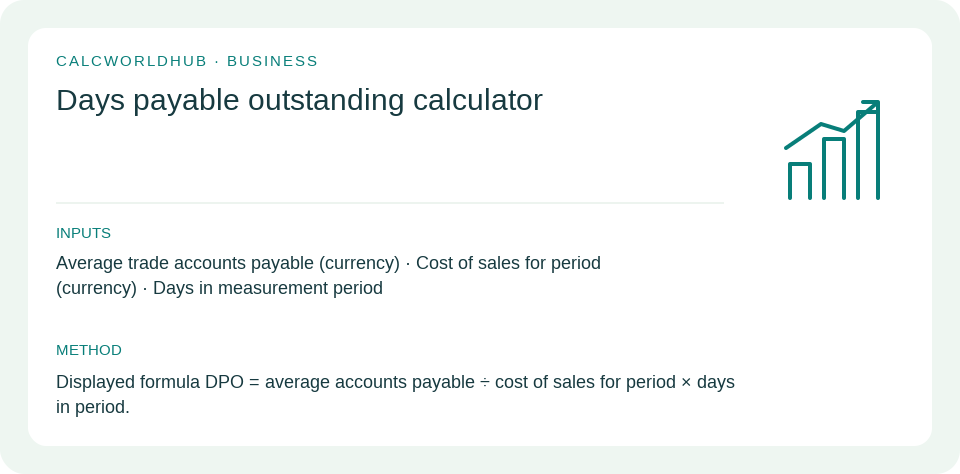
DPO = average accounts payable ÷ cost of sales for period × days in period.
Worked example
Average payables of $180,000 against $1,200,000 cost of sales over 365 days gives DPO = 180,000 ÷ 1,200,000 × 365 = 54.75 days.
Assumptions and limits
Cost of sales may be an imperfect proxy for credit purchases. Seasonality, supplier terms, non-trade payables, and accounting choices affect comparisons. DPO is not a recommended payment delay.
Frequently asked questions
Is DPO the exact time invoices remain unpaid?
No. It is an aggregate ratio, not an invoice-level aging report.
Should I use purchases or COGS?
Use the purchase base that best matches your payables definition and disclose it; cost of sales is a common proxy.
Is a higher DPO always better?
No. It may reflect longer terms or delayed payment and can affect supplier relationships; interpretation needs context.
How do I use the Days payable outstanding calculator?
Enter Average trade accounts payable (currency), Cost of sales for period (currency), Days in measurement period. Match the units shown beside each field and review the result together with the assumptions below.
What is a worked example of Days payable outstanding?
Average payables of $180,000 against $1,200,000 cost of sales over 365 days gives DPO = 180,000 ÷ 1,200,000 × 365 = 54.75 days.
Read our calculation methodology.