How to use this calculator
Compare period output value with a combined cost-valued input bundle.
- Enter Output value for the period, Labor input cost, Materials input cost, Energy input cost, then complete the remaining labeled fields. Match the units shown beside each field and review the result together with the assumptions below.
- Read the worked example below to check the expected input format and result.
- Compare another scenario by changing one input at a time. Use Reset to return to the starting values.
Multifactor productivity cost index explained
Compare one period’s output value with the combined labor, material, energy and other input costs on the same price basis.
How the calculation works
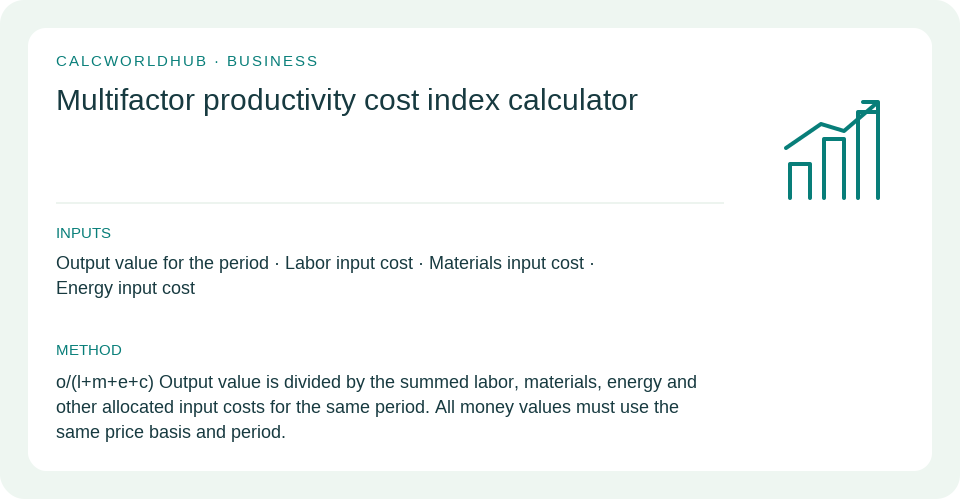
o/(l+m+e+c)
Output value is divided by the summed labor, materials, energy and other allocated input costs for the same period. All money values must use the same price basis and period.
Set up the calculation
o— Output value for the period- Monetary value of output during the selected period, using the same currency and price basis as the input costs.
l— Labor input cost- Labor cost assigned to producing the output during that same period.
m— Materials input cost- Materials cost consumed during the selected production period.
e— Energy input cost- Energy cost consumed during that period.
c— Other capital and input cost allocation- Other allocated input costs on the same period and price basis; exclude costs already counted above.
Limits of this model
All money values must use the same price basis and period. Price changes can move this index without a change in physical productivity.
Check this example
Output value for the period = 200000; Labor input cost = 50000; Materials input cost = 70000; Energy input cost = 10000; Other capital and input cost allocation = 20000.
- Cost-valued multifactor productivity: 1.33333333 output value/input cost
The four input costs total 150,000 currency units, so output value 200,000 gives 1.3333 output-value units per input-cost unit for the period.
Interpreting the result
A value above 1 means output value exceeds the summed input cost in the selected currency basis; price changes can move this index without a change in physical output per input.
Frequently asked questions
Can I mix units such as hours and kilograms in the denominator?
No, this version values inputs in common currency.
Does a value above one equal profit margin?
No, it is an output-to-entered-input ratio and may omit costs.
How should periods be compared?
Use consistent coverage and adjust price bases when needed.
How do I use the Multifactor productivity cost index calculator?
Enter Output value for the period, Labor input cost, Materials input cost, Energy input cost, then complete the remaining labeled fields. Match the units shown beside each field and review the result together with the assumptions below.
What is a worked example of Multifactor productivity cost index?
Output value for the period = 200000; Labor input cost = 50000; Materials input cost = 70000; Energy input cost = 10000; Other capital and input cost allocation = 20000. Cost-valued multifactor productivity: 1.33333333 output value/input cost The four input costs total 150,000 currency units, so output value 200,000 gives 1.3333 output-value units per input-cost unit for the period.
Read our calculation methodology.