How to use this calculator
Track cooling and mass remaining during rapid discharge of a well-mixed insulated gas receiver.
- Enter Initial absolute tank pressure (Pa), Final absolute tank pressure (Pa), Initial tank temperature (K), Initial stored mass (kg), then complete the remaining labeled fields. Match the units shown beside each field and review the result together with the assumptions below.
- Read the worked example below to check the expected input format and result.
- Compare another scenario by changing one input at a time. Use Reset to return to the starting values.
Adiabatic well-mixed tank blowdown state explained
For a well-mixed insulated ideal-gas tank with constant heat-capacity ratio, use the final absolute pressure to estimate remaining mass and temperature. The model does not calculate venting time.
Inputs, symbols, and units
p0— Initial absolute tank pressure (Pa)- Initial absolute tank pressure (Pa). Enter the value for this state; the units shown are used without an unstated conversion.
pf— Final absolute tank pressure (Pa)- Final absolute tank pressure (Pa). Enter the value for this state; the units shown are used without an unstated conversion.
T0— Initial tank temperature (K)- Initial tank temperature (K). Enter the value for this state; the units shown are used without an unstated conversion.
m0— Initial stored mass (kg)- Initial stored mass (kg). Enter the value for this state; the units shown are used without an unstated conversion.
g— Heat capacity ratio- Heat capacity ratio. Enter the value for this state; the units shown are used without an unstated conversion.
Formula and method
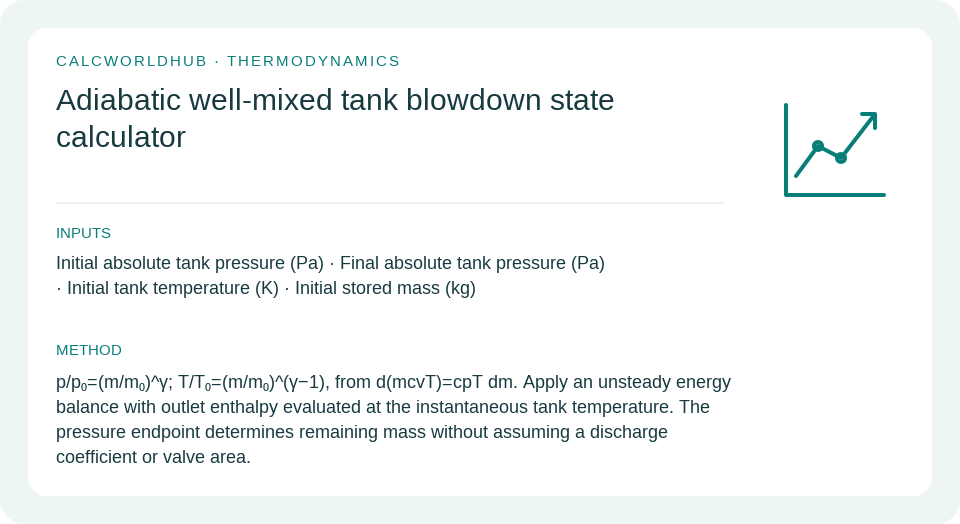
p/p₀=(m/m₀)^γ; T/T₀=(m/m₀)^(γ−1), from d(mcvT)=cpT dm.
Apply an unsteady energy balance with outlet enthalpy evaluated at the instantaneous tank temperature. The pressure endpoint determines remaining mass without assuming a discharge coefficient or valve area.
A worked scenario
Initial absolute tank pressure (Pa) = 1000000; Final absolute tank pressure (Pa) = 200000; Initial tank temperature (K) = 300; Initial stored mass (kg) = 5; Heat capacity ratio = 1.4.
- Final tank gas temperature: 189.415511 K
- Gas mass remaining: 1.58382 kg
- Gas mass discharged: 3.41618 kg
A 5 kg tank at 1,000 kPa and 300 K vents adiabatically to 200 kPa. The well-mixed model leaves 1.58382 kg at 189.416 K and discharges 3.41618 kg; it does not determine the elapsed venting time.
Assumptions and edge cases
Ideal gas, constant heat capacities, negligible wall heat and uniform tank conditions. Real slow blowdown approaches a more isothermal path.
Reading the outputs
Returns final uniform gas temperature, remaining mass and discharged mass; it does not calculate elapsed time.
Frequently asked questions
Does this give discharge duration?
No. A valve-flow model and time integration are needed for duration.
Why is this different from a nozzle temperature?
The tank itself loses energy as enthalpy exits; nozzle expansion is a separate downstream process.
Can the final pressure equal the initial pressure?
Yes. That boundary case gives zero discharge and unchanged temperature.
How do I use the Adiabatic well-mixed tank blowdown state calculator?
Enter Initial absolute tank pressure (Pa), Final absolute tank pressure (Pa), Initial tank temperature (K), Initial stored mass (kg), then complete the remaining labeled fields. Match the units shown beside each field and review the result together with the assumptions below.
What is a worked example of Adiabatic well-mixed tank blowdown state?
Initial absolute tank pressure (Pa) = 1000000; Final absolute tank pressure (Pa) = 200000; Initial tank temperature (K) = 300; Initial stored mass (kg) = 5; Heat capacity ratio = 1.4. Final tank gas temperature: 189.415511 K Gas mass remaining: 1.58382 kg Gas mass discharged: 3.41618 kg A 5 kg tank at 1,000 kPa and 300 K vents adiabatically to 200 kPa. The well-mixed model leaves 1.58382 kg at 189.416 K and discharges 3.41618 kg; it does not determine the elapsed venting time.
Background or definition reference: DOE Fundamentals Handbook: thermodynamic energy balances.
Read our calculation methodology.