Adjusted R-squared calculator
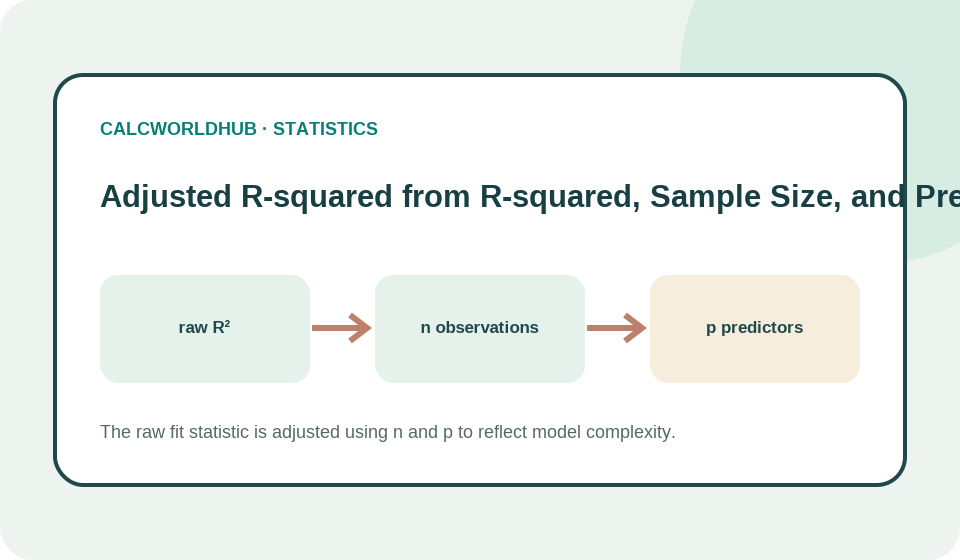
Adjust R² for sample size and predictor count to account for model complexity.
Related calculators and articles
Compare methods and explore more free tools in statistics.
How to use this calculator
Adjust R² for sample size and predictor count to account for model complexity.
- Enter R squared (0 to 1), Sample size n, Predictors p. Match the units shown beside each field and review the result together with the assumptions below.
- Read the worked example below to check the expected input format and result.
- Compare another scenario by changing one input at a time. Use Reset to return to the starting values.
Adjusted R-squared calculator
Adjust R² for sample size and predictor count to account for model complexity.
Inputs and units
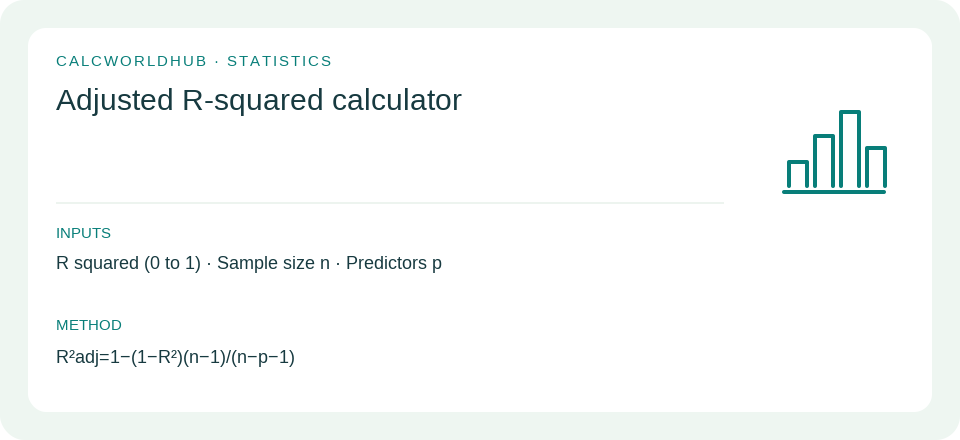
- R squared (0 to 1): Unadjusted coefficient of determination from the fitted model, entered as a fraction from 0 to 1.
- Sample size n: Number of observations used in the fitted regression; it must exceed predictor count plus one.
- Predictors p: Number of fitted explanatory variables, excluding the intercept.
Formula and method
R²adj=1−(1−R²)(n−1)/(n−p−1)
Worked example
For R²=0.82, n=80, p=4, R²adj=1−0.18·79/75=0.8104.
Interpreting the result
Adjusted R² can be below zero and can decrease when added predictors contribute little fit; it is a comparison statistic, not a prediction guarantee.
Assumptions and limits
R² must be 0–1, n a positive integer, and n>p+1 with p a nonnegative integer. Assumes the standard regression definition and a compatible fitted model.
Sources and method
- Gives adjusted R-squared and degrees-of-freedom terms. Here p counts predictors excluding the intercept, equivalent to the source notation with the intercept included. Penn State STAT 501: multiple linear regression
Frequently asked questions
What does this adjusted r squared result tell me?
Adjusted R² can be below zero and can decrease when added predictors contribute little fit; it is a comparison statistic, not a prediction guarantee.
What assumptions should I check?
R² must be 0–1, n a positive integer, and n>p+1 with p a nonnegative integer. Assumes the standard regression definition and a compatible fitted model.
How do I use the Adjusted R-squared calculator?
Enter R squared (0 to 1), Sample size n, Predictors p. Match the units shown beside each field and review the result together with the assumptions below.
What is a worked example of Adjusted R-squared?
For R²=0.82, n=80, p=4, R²adj=1−0.18·79/75=0.8104.
What does the Adjusted R-squared calculator calculate?
Adjust R² for sample size and predictor count to account for model complexity.
See the calculation methodology.