How to use this calculator
Estimate theoretical and effective farm-machine field capacity, then calculate hours needed for a field area.
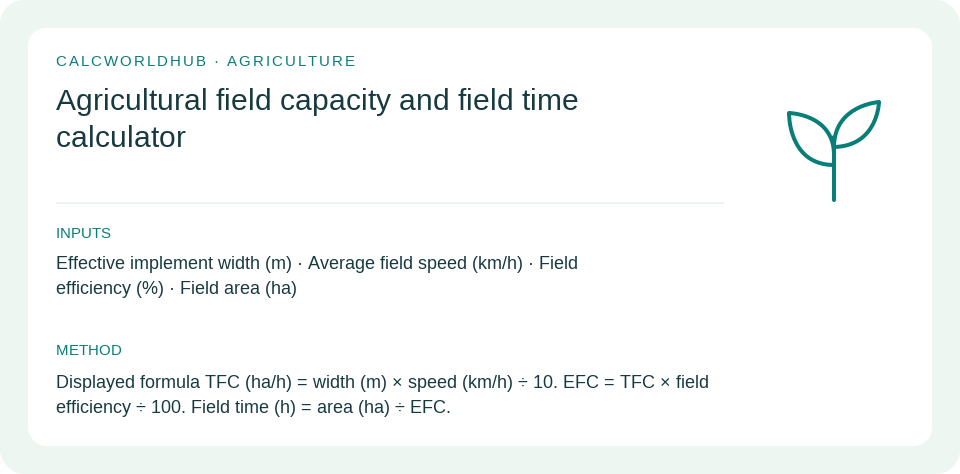
- Enter Effective implement width (m), Average field speed (km/h), Field efficiency (%), Field area (ha). Match the units shown beside each field and review the result together with the assumptions below.
- Read the worked example below to check the expected input format and result.
- Compare another scenario by changing one input at a time. Use Reset to return to the starting values.
How this calculation works
Field capacity turns implement width and ground speed into a theoretical area rate. A field-efficiency allowance then accounts for turns, overlap, refilling, adjustment, and other time when the machine is not covering new ground.
Inputs and units
width— Effective implement width (m)- Working width in metres; reduce nominal width if passes overlap.
speed— Average field speed (km/h)- Average speed while the implement is operating in the field.
efficiency— Field efficiency (%)- Share of theoretical capacity achieved after normal turns and field delays; use 1–100%.
area— Field area (ha)- Area to cover using the entered implement and operating assumptions.
Formula
TFC (ha/h) = width (m) × speed (km/h) ÷ 10. EFC = TFC × field efficiency ÷ 100. Field time (h) = area (ha) ÷ EFC.
Method
Enter the working width actually covered on a pass, average operating speed, a field-efficiency estimate, and the area to complete. TFC represents uninterrupted travel; EFC is the planning rate after the efficiency allowance.
Worked example
A 6 m implement travelling at 8 km/h has a theoretical capacity of 4.8 ha/h. At 75% field efficiency, effective capacity is 3.6 ha/h, so covering 24 ha takes about 6.67 operating hours.
Assumptions and limits
Field efficiency varies with field shape, turning time, overlap, soil, operator, implement, and refills. Use measured local records when available; this estimate does not include travel to the field or setup outside it.
Frequently asked questions
What is theoretical field capacity?
It is the area rate implied by implement width and speed with no turning, overlap, refill, or other field-time loss.
How should I choose field efficiency?
Use observed acreage and operating hours for comparable work when possible. Published or remembered percentages are only planning assumptions.
Does field time include road travel?
No. The result estimates time working the entered area, not transport, setup, maintenance, or weather delays.
How do I use the Agricultural field capacity and field time calculator?
Enter Effective implement width (m), Average field speed (km/h), Field efficiency (%), Field area (ha). Match the units shown beside each field and review the result together with the assumptions below.
What is a worked example of Agricultural field capacity and field time?
A 6 m implement travelling at 8 km/h has a theoretical capacity of 4.8 ha/h. At 75% field efficiency, effective capacity is 3.6 ha/h, so covering 24 ha takes about 6.67 operating hours.
Reference: Iowa State University Extension field-capacity and field-efficiency guide. See our calculation methodology.