How to use this calculator
Apply an entered empirical air-bending factor to estimate forming force from material strength and die geometry.
- Enter Bend length (mm), Sheet thickness (mm), Tensile strength (N/mm²), Die opening (mm), then complete the remaining labeled fields. Match the units shown beside each field and review the result together with the assumptions below.
- Read the worked example below to check the expected input format and result.
- Compare another scenario by changing one input at a time. Use Reset to return to the starting values.
Air bending force estimate explained
How the calculation works
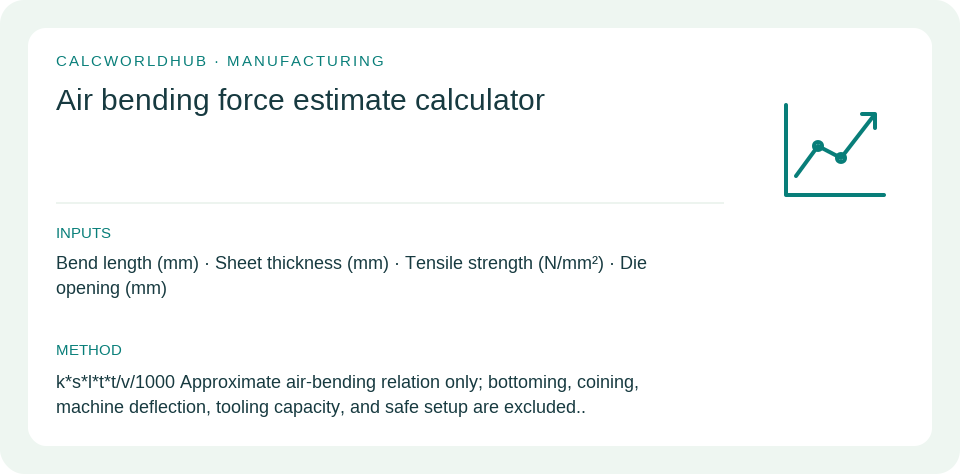
k*s*l*t*t/v/1000
Approximate air-bending relation only; bottoming, coining, machine deflection, tooling capacity, and safe setup are excluded..
Set up the calculation
l— Bend length (mm)- Length of the bend line under load, in millimetres.
t— Sheet thickness (mm)- Sheet thickness, in millimetres; the estimate scales with thickness squared.
s— Tensile strength (N/mm²)- Material tensile strength in N/mm². Use a value representative of the sheet condition.
v— Die opening (mm)- Die opening in millimetres; larger openings reduce the estimated air-bending force in this model.
k— Empirical process factor- Empirical process factor for tooling and setup. It is a calibration input, not a universal material constant.
Limits of this model
Approximate air-bending relation only; bottoming, coining, machine deflection, tooling capacity, and safe setup are excluded.
Check this example
Bend length (mm) = 1000; Sheet thickness (mm) = 2; Tensile strength (N/mm²) = 450; Die opening (mm) = 16; Empirical process factor = 1.33.
- Air bending force estimate: 149.625 kN
Reading the outputs
The result estimates the force for the entered bend length and tooling factor. Thickness has a squared effect, while a wider die opening lowers this model estimate; compare the result with the press capacity and setup limits.
Frequently asked questions
Is factor 1.33 universal?
No, it is an illustrative starting value that must suit the tooling model.
Does this certify press capacity?
No.
Can die opening change force?
The idealized force varies inversely with die opening.
How do I use the Air bending force estimate calculator?
Enter Bend length (mm), Sheet thickness (mm), Tensile strength (N/mm²), Die opening (mm), then complete the remaining labeled fields. Match the units shown beside each field and review the result together with the assumptions below.
What is a worked example of Air bending force estimate?
Bend length (mm) = 1000; Sheet thickness (mm) = 2; Tensile strength (N/mm²) = 450; Die opening (mm) = 16; Empirical process factor = 1.33. Air bending force estimate: 149.625 kN
Read our calculation methodology.