How to use this calculator
Estimate developed length of a bend along the neutral axis using an entered K-factor.
- Enter Inside bend radius (mm), Sheet thickness (mm), K-factor, Bend rotation angle (degrees). Match the units shown beside each field and review the result together with the assumptions below.
- Read the worked example below to check the expected input format and result.
- Compare another scenario by changing one input at a time. Use Reset to return to the starting values.
Sheet metal neutral axis bend allowance explained
Bend allowance is the length of the material’s neutral-axis arc within a bend. The K-factor locates that axis through the sheet thickness, and the rotation angle determines the fraction of the arc. Straight flange lengths and bend deductions are separate quantities.
Inputs, symbols, and units
r— Inside bend radius (mm)- Inside bend radius in millimeters.
t— Sheet thickness (mm)- Sheet thickness in millimeters, using the same length unit as radius.
k— K-factor- Dimensionless neutral-axis position divided by sheet thickness; use a factor calibrated for the material and process.
a— Bend rotation angle (degrees)- Material rotation from the flat state in degrees, not the included interior angle.
Formula and method
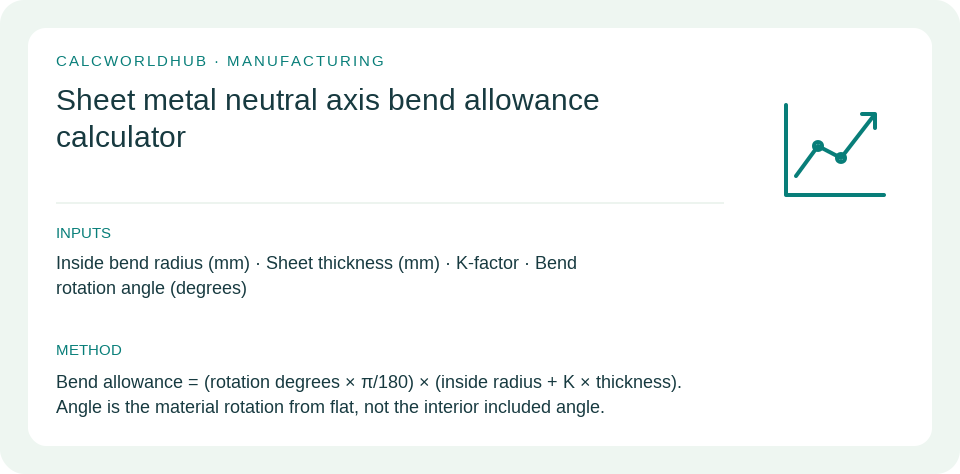
Bend allowance = (rotation degrees × π/180) × (inside radius + K × thickness).
Angle is the material rotation from flat, not the interior included angle.
A worked scenario
Inside bend radius (mm) = 2; Sheet thickness (mm) = 1; K-factor = 0.4; Bend rotation angle (degrees) = 90.
- Sheet metal neutral axis bend allowance: 3.769911 mm
The neutral-axis radius is 2+0.4×1=2.4 mm. A 90° rotation spansπ/2 radians, so bend allowance is 2.4×π/2≈3.769911 mm, excluding straight flanges.
Assumptions and edge cases
Angle is the material rotation from flat, not the interior included angle. K-factor must suit the process; springback and empirical bend tables are excluded.
Frequently asked questions
What does K-factor locate?
The neutral axis at K times thickness from the inner surface.
Is a 90-degree interior bend entered as 90?
Yes; for other bends distinguish rotation from interior angle.
Does allowance include straight flanges?
No, add their appropriate tangent lengths separately.
How do I use the Sheet metal neutral axis bend allowance calculator?
Enter Inside bend radius (mm), Sheet thickness (mm), K-factor, Bend rotation angle (degrees). Match the units shown beside each field and review the result together with the assumptions below.
What is a worked example of Sheet metal neutral axis bend allowance?
Inside bend radius (mm) = 2; Sheet thickness (mm) = 1; K-factor = 0.4; Bend rotation angle (degrees) = 90. Sheet metal neutral axis bend allowance: 3.769911 mm The neutral-axis radius is 2+0.4×1=2.4 mm. A 90° rotation spansπ/2 radians, so bend allowance is 2.4×π/2≈3.769911 mm, excluding straight flanges.
Method reference: Autodesk sheet-metal K-factor convention.
Read our calculation methodology.