How to use this calculator
Determine how much of an ideal diffraction-limited point image fits inside a centered circular detector or collection aperture.
- Enter Vacuum wavelength (nm), Image space f number, Detector collection radius (µm). Match the units shown beside each field and review the result together with the assumptions below.
- Read the worked example below to check the expected input format and result.
- Compare another scenario by changing one input at a time. Use Reset to return to the starting values.
Airy pattern energy inside a detector radius explained
Estimate encircled energy and edge intensity for a centered detector sampling the Airy pattern of a circular pupil.
How the calculation works
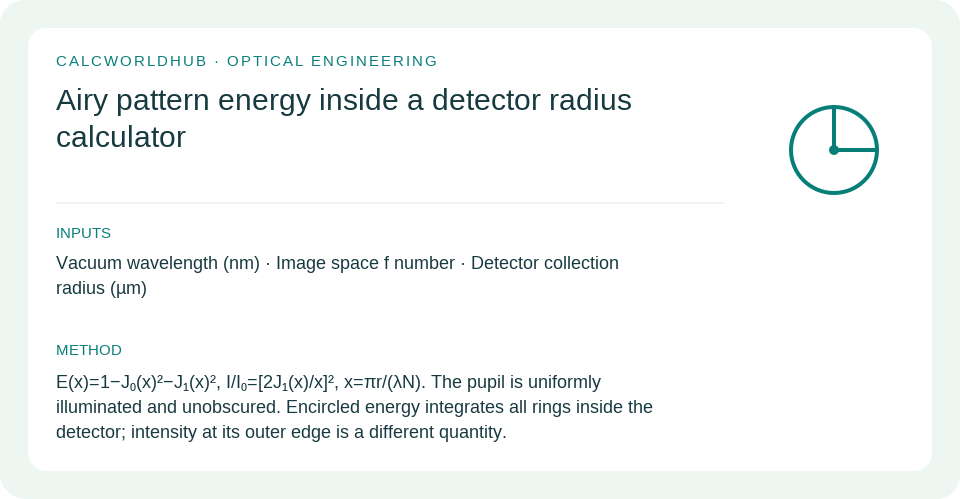
E(x)=1−J₀(x)²−J₁(x)², I/I₀=[2J₁(x)/x]², x=πr/(λN).
The pupil is uniformly illuminated and unobscured. Encircled energy integrates all rings inside the detector; intensity at its outer edge is a different quantity.
Inputs and units
wavelength— Vacuum wavelength (nm)- Monochromatic vacuum wavelength in nanometres.
fnumber— Image space f number- Effective image-side f-number of a clear circular pupil.
radius— Detector collection radius (µm)- Radius around the exact diffraction-pattern center.
Limits of this model
Scalar monochromatic diffraction and a perfectly centered aperture. Numerical Bessel integration is limited to normalized radius 100; aberrations and detector offsets need a two-dimensional model.
Check this example
Vacuum wavelength (nm) = 550; Image space f number = 4; Detector collection radius (µm) = 3.
- Encircled optical power fraction: 0.839909
- Relative intensity at radius: 0.006059
- First dark ring radius: 2.683274 µm
At the first dark ring approximately 83.78 percent of the total optical power lies inside the radius, even though edge intensity is zero.
Reading the outputs
Collected fraction and edge intensity are normalized ratios; the first dark-ring radius is µm.
Frequently asked questions
Why is power still outside the first dark ring?
The outer bright rings contain the remaining energy.
Is the first dark radius a Gaussian beam radius?
No. Airy and Gaussian width conventions are different.
Does a zero collection radius receive finite power?
No. A point has zero area even though central intensity is finite.
How do I use the Airy pattern energy inside a detector radius calculator?
Enter Vacuum wavelength (nm), Image space f number, Detector collection radius (µm). Match the units shown beside each field and review the result together with the assumptions below.
What is a worked example of Airy pattern energy inside a detector radius?
Vacuum wavelength (nm) = 550; Image space f number = 4; Detector collection radius (µm) = 3. Encircled optical power fraction: 0.839909 Relative intensity at radius: 0.006059 First dark ring radius: 2.683274 µm At the first dark ring approximately 83.78 percent of the total optical power lies inside the radius, even though edge intensity is zero.
Background or definition reference: MIT optics lecture notes.
Read our calculation methodology.