How to use this calculator
Predict sinusoidal contrast transfer for an ideal incoherent image through an unobscured circular pupil.
- Enter Vacuum wavelength (nm), Image space f number, Image spatial frequency (cycles/mm). Match the units shown beside each field and review the result together with the assumptions below.
- Read the worked example below to check the expected input format and result.
- Compare another scenario by changing one input at a time. Use Reset to return to the starting values.
Diffraction limited circular pupil MTF explained
A clear circular pupil has a normalized diffraction-limited modulation transfer function that falls from one at zero spatial frequency to zero at its optical cutoff. Wavelength and f-number set that cutoff; the entered frequency determines the normalized position on the curve.
Inputs, symbols, and units
wavelength— Vacuum wavelength (nm)- Monochromatic vacuum wavelength in nanometres.
fnumber— Image space f number- Effective image-side f-number for the imaging cone.
frequency— Image spatial frequency (cycles/mm)- Nonnegative sinusoidal pattern frequency in the image plane.
Formula and method
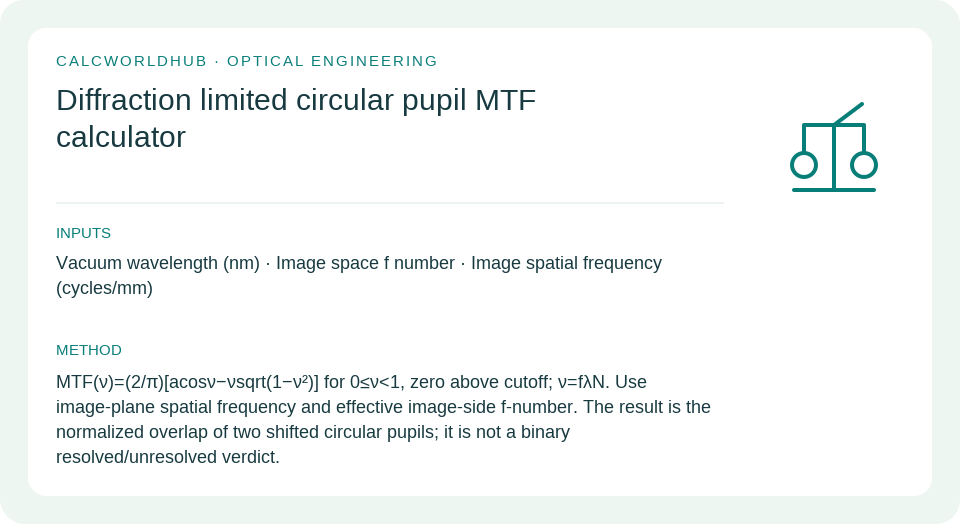
MTF(ν)=(2/π)[acosν−νsqrt(1−ν²)] for 0≤ν<1, zero above cutoff; ν=fλN.
Use image-plane spatial frequency and effective image-side f-number. The result is the normalized overlap of two shifted circular pupils; it is not a binary resolved/unresolved verdict.
A worked scenario
Vacuum wavelength (nm) = 550; Image space f number = 4; Image spatial frequency (cycles/mm) = 100.
- Incoherent diffraction MTF: 0.722164
- Optical cutoff spatial frequency: 454.545455 cycles/mm
- Normalized spatial frequency: 0.22
At 550 nm and f/4 the ideal cutoff is about 454.5 cycles/mm, while 100 cycles/mm retains substantial contrast.
Assumptions and edge cases
Monochromatic incoherent diffraction, clear circular pupil, zero aberration. Coherent imaging, central obstructions and defocus have other transfer functions.
Reading the outputs
MTF and normalized frequency are dimensionless; cutoff is cycles/mm.
Frequently asked questions
Does zero MTF mean the lens transmits no light?
No. It means that sinusoidal pattern frequency loses contrast.
Is a line pair the same as a cycle?
For this spatial-frequency convention yes.
Can I multiply this by a detector MTF?
For independent linear shift-invariant stages at the same image scale, their transfer functions multiply.
How do I use the Diffraction limited circular pupil MTF calculator?
Enter Vacuum wavelength (nm), Image space f number, Image spatial frequency (cycles/mm). Match the units shown beside each field and review the result together with the assumptions below.
What is a worked example of Diffraction limited circular pupil MTF?
Vacuum wavelength (nm) = 550; Image space f number = 4; Image spatial frequency (cycles/mm) = 100. Incoherent diffraction MTF: 0.722164 Optical cutoff spatial frequency: 454.545455 cycles/mm Normalized spatial frequency: 0.22 At 550 nm and f/4 the ideal cutoff is about 454.5 cycles/mm, while 100 cycles/mm retains substantial contrast.
Background or definition reference: Edmund Optics modulation transfer function.
Read our calculation methodology.