How to use this calculator
Recover a block-based quadrature signal and inspect the envelope and phase of a selected sample.
- Enter Uniform samples (signal units), Sample index. Match the units shown beside each field and review the result together with the assumptions below.
- Read the worked example below to check the expected input format and result.
- Compare another scenario by changing one input at a time. Use Reset to return to the starting values.
Analytic signal envelope and phase sample explained
Use Uniform samples (signal units) with Sample index to reproduce the sample calculation, then review the stated limits before carrying the result into another scenario.
How the calculation works
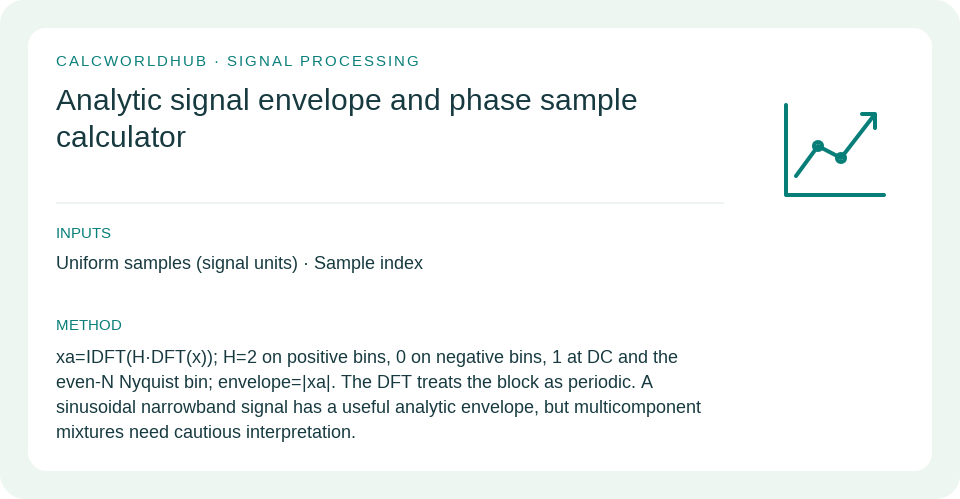
xa=IDFT(H·DFT(x)); H=2 on positive bins, 0 on negative bins, 1 at DC and the even-N Nyquist bin; envelope=|xa|.
The DFT treats the block as periodic. A sinusoidal narrowband signal has a useful analytic envelope, but multicomponent mixtures need cautious interpretation.
Set up the calculation
x— Uniform samples (signal units)- Chronological real samples; use a comma-separated list in the same signal units. Use comma-separated values in the stated order.
index— Sample index- Zero-based position in the supplied block. Enter a whole number.
Limits of this model
Two to 256 real samples. Edge discontinuities create artifacts, and phase at a zero analytic amplitude has no physical meaning.
Check this example
Uniform samples (signal units) = [0, 1, 0, -1, 0, 1, 0, -1]; Sample index = 1.
- Analytic envelope: 1 signal units
- Analytic phase: -1.32242168e-14 deg
- Quadrature component: -2.30806123e-16 signal units
Inspect sample one of an eight-point sinusoidal block; its original value and quadrature form a unit-magnitude analytic sample.
Reading the outputs
Envelope is nonnegative; phase is principal degrees; the quadrature component is the Hilbert-transformed signal value.
Frequently asked questions
Is the envelope the absolute input?
No; it combines the input with its quadrature component.
Why do block edges matter?
The transform joins the last sample back to the first.
Does a DC offset affect the result?
Yes; DC remains in the analytic signal and can change its magnitude.
How do I use the Analytic signal envelope and phase sample calculator?
Enter Uniform samples (signal units), Sample index. Match the units shown beside each field and review the result together with the assumptions below.
What is a worked example of Analytic signal envelope and phase sample?
Uniform samples (signal units) = [0, 1, 0, -1, 0, 1, 0, -1]; Sample index = 1. Analytic envelope: 1 signal units Analytic phase: -1.32242168e-14 deg Quadrature component: -2.30806123e-16 signal units Inspect sample one of an eight-point sinusoidal block; its original value and quadrature form a unit-magnitude analytic sample.
Background or definition reference: SciPy analytic signal convention.
Read our calculation methodology.