Angular frequency calculator
Convert cycles per second to radians per second.
Calculator
How to use this calculator
Convert frequency in hertz to angular frequency in radians per second using ω = 2πf.
- Enter Frequency (Hz). Match the units shown beside each field and review the result together with the assumptions below.
- Read the worked example below to check the expected input format and result.
- Compare another scenario by changing one input at a time. Use Reset to return to the starting values.
Convert cycles per second to radians per second
Frequency counts complete cycles each second; angular frequency expresses the same cycle rate in radians per second.
Inputs and units
- Frequency (Hz): Enter nonnegative cycles per second. One hertz is one complete cycle each second.
Formula and method
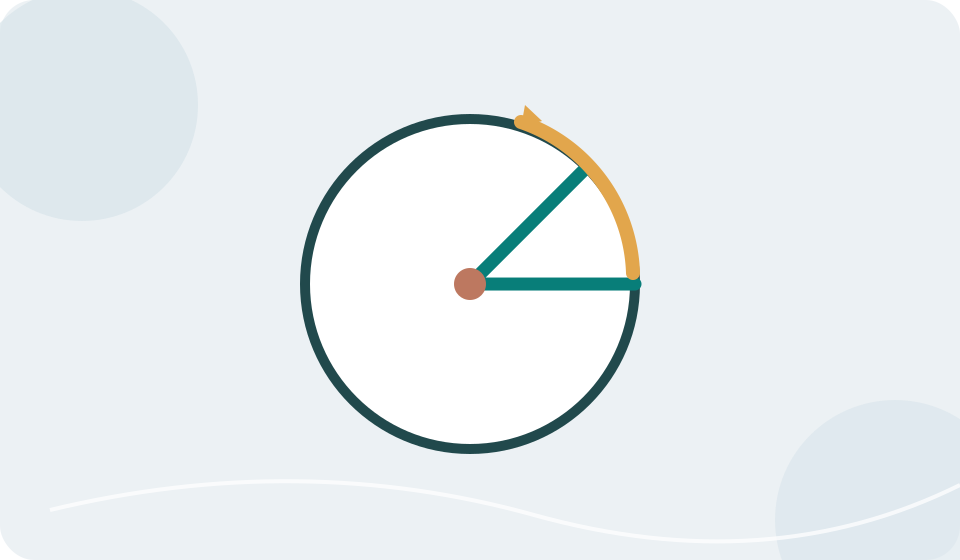
Angular frequency ω = 2πf. Since one cycle covers 2π radians, multiply hertz by 2π to obtain rad/s.
Worked example
At 60 Hz, ω = 2π × 60 = 120π ≈ 376.991 rad/s.
Interpreting the result
The radian value is the phase angle swept per second. It is not a different physical oscillation rate from 60 cycles per second.
Assumptions and limits
This conversion assumes a periodic signal with a fixed frequency. For a varying signal, instantaneous frequency may change over time.
Method references
Frequently asked questions
Why does angular frequency include 2π?
A complete cycle is 2π radians, so every cycle counted by frequency contributes 2π radians.
Does 60 Hz mean 60 radians per second?
No. It means 60 cycles per second, equivalent to 120π radians per second.
How do I use the Angular frequency calculator?
Enter Frequency (Hz). Match the units shown beside each field and review the result together with the assumptions below.
What is a worked example of Angular frequency?
At 60 Hz, ω = 2π × 60 = 120π ≈ 376.991 rad/s.
What does the Angular frequency calculator calculate?
Convert frequency in hertz to angular frequency in radians per second using ω = 2πf.
Good calculators show their work.
CalcWorldHub is built around clear inputs and visible assumptions. Results are estimates for planning; check official sources or your provider’s terms when exact figures matter.