Angular size calculator
Compare an object’s apparent width in the sky or field of view with the line of sight to its edges.
inputs.
Calculator
How to use this calculator
Estimate the angular diameter of an object from its physical diameter and distance using the small-angle geometry relationship.
- Complete the labeled inputs for Angular size. Use the units requested by each field, then read the displayed result alongside the method and limits below.
- Read the worked example below to check the expected input format and result.
- Compare another scenario by changing one input at a time. Use Reset to return to the starting values.
From physical width to apparent angle
Formula and method
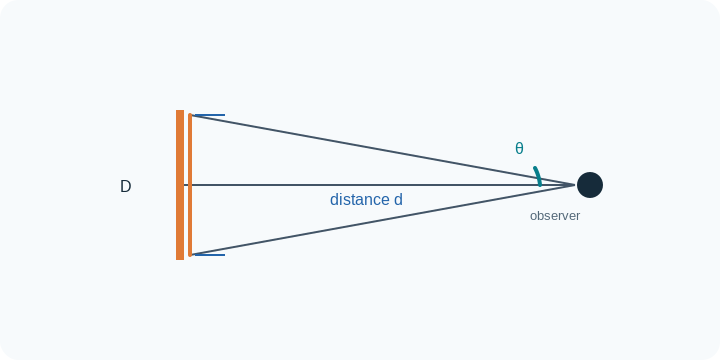
For a centered object of diameter D at distance d, angular diameter θ = 2 arctan(D/(2d)). The small-angle approximation is θ≈D/d radians when D is much smaller than d.
Worked example
A 10 m object at 1,000 m subtends 2 arctan(10/2,000) ≈ 0.009999 rad, or about 0.573°. The small-angle estimate gives nearly the same value.
Interpreting the result
The angle describes apparent size, not physical size. A distant large object can subtend the same angle as a nearby smaller one.
Assumptions and limits
The exact geometry assumes the distance is measured to the object’s center and the diameter is perpendicular to the viewing direction. Very large angles need the exact expression rather than the small-angle approximation.
Read our calculation methodology.
Frequently asked questions
How do I use the Angular size calculator?
Complete the labeled inputs for Angular size. Use the units requested by each field, then read the displayed result alongside the method and limits below.
What is a worked example of Angular size?
A 10 m object at 1,000 m subtends 2 arctan(10/2,000) ≈ 0.009999 rad, or about 0.573°. The small-angle estimate gives nearly the same value.
What does the Angular size calculator calculate?
Estimate the angular diameter of an object from its physical diameter and distance using the small-angle geometry relationship.
What assumptions apply to Angular size?
The exact geometry assumes the distance is measured to the object’s center and the diameter is perpendicular to the viewing direction. Very large angles need the exact expression rather than the small-angle approximation.
Which method does the Angular size calculator use?
For a centered object of diameter D at distance d, angular diameter θ = 2 arctan(D/(2d)). The small-angle approximation is θ≈D/d radians when D is much smaller than d. Angular size is the angle between sight lines to the object’s edges.
Good calculators show their work.
CalcWorldHub is built around clear inputs and visible assumptions. Results are estimates for planning; check official sources or your provider’s terms when exact figures matter.