Annual gross with regular overtime calculator
Model annual pay with the same overtime hours each week for 52 weeks.
Calculator
How to use this calculator
Estimate annual gross pay from salary and a repeated weekly overtime scenario using an assumed 52-week year.
- Enter Annual salary ($), Scheduled hours per week, Overtime hours per week, Overtime multiplier. Match the units shown beside each field and review the result together with the assumptions below.
- Read the worked example below to check the expected input format and result.
- Compare another scenario by changing one input at a time. Use Reset to return to the starting values.
Add a regular weekly overtime scenario to annual salary
This estimate starts with annual salary and adds overtime pay for the same number of hours each week over a full 52-week year. Weeks worked was removed because it canceled out of the prior formula and never changed the result.
Inputs and units
- Annual salary ($): Annual base salary used to infer a regular hourly equivalent.
- Scheduled hours per week: Regular weekly hours used in the hourly-equivalent calculation.
- Overtime hours per week: Additional hours assumed each week throughout the year.
- Overtime multiplier: Multiplier applied to the inferred regular hourly equivalent.
Formula and method
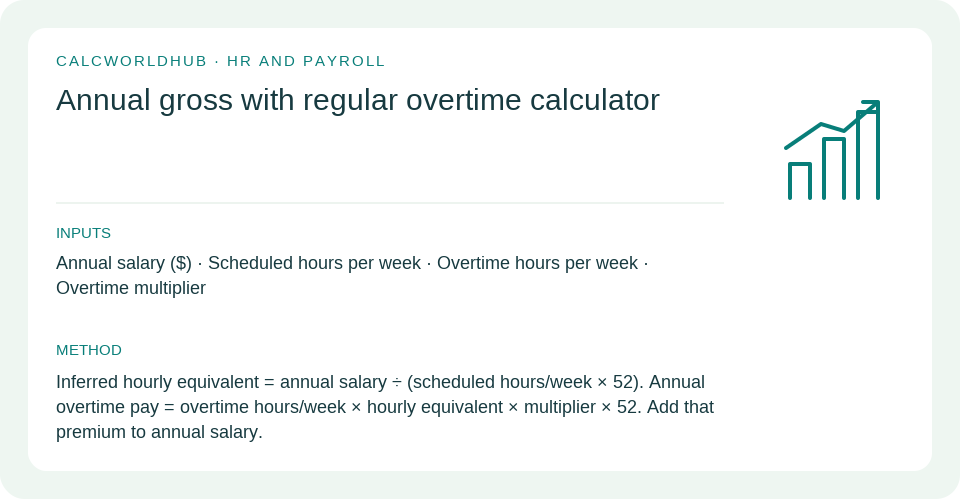
Inferred hourly equivalent = annual salary ÷ (scheduled hours/week × 52). Annual overtime pay = overtime hours/week × hourly equivalent × multiplier × 52. Add that premium to annual salary.
Worked example
At $52,000 salary, 40 scheduled hours, 4 overtime hours per week, and a 1.5 multiplier, the inferred rate is $25/hour. Annual overtime pay is 4 × $25 × 1.5 × 52 = $7,800, giving $59,800 gross.
Interpreting the result
The output is a modeled annual gross amount before deductions, with the entered weekly overtime repeated for all 52 weeks.
Assumptions and limits
This does not determine legal overtime eligibility or the required regular rate. U.S. rules vary by coverage, exemptions, workweek, state law, and compensation type; the overtime multiplier is an assumption.
Method references
Frequently asked questions
Does the tool decide whether I qualify for overtime?
No. It applies the multiplier you enter. Eligibility and the legally required regular rate depend on applicable law and employment facts.
Why is there no weeks-worked field?
The earlier formula used that value to infer an hourly amount and multiplied by the same value again, so it canceled. This version states the 52-week assumption directly.
How do I use the Annual gross with regular overtime calculator?
Enter Annual salary ($), Scheduled hours per week, Overtime hours per week, Overtime multiplier. Match the units shown beside each field and review the result together with the assumptions below.
What is a worked example of Annual gross with regular overtime?
At $52,000 salary, 40 scheduled hours, 4 overtime hours per week, and a 1.5 multiplier, the inferred rate is $25/hour. Annual overtime pay is 4 × $25 × 1.5 × 52 = $7,800, giving $59,800 gross.
What does the Annual gross with regular overtime calculator calculate?
Estimate annual gross pay from salary and a repeated weekly overtime scenario using an assumed 52-week year.
Good calculators show their work.
CalcWorldHub is built around clear inputs and visible assumptions. Results are estimates for planning; check official sources or your provider’s terms when exact figures matter.