Weekly overtime gross pay calculator
Model pay for one week using the stated schedule and overtime assumptions.
Calculator
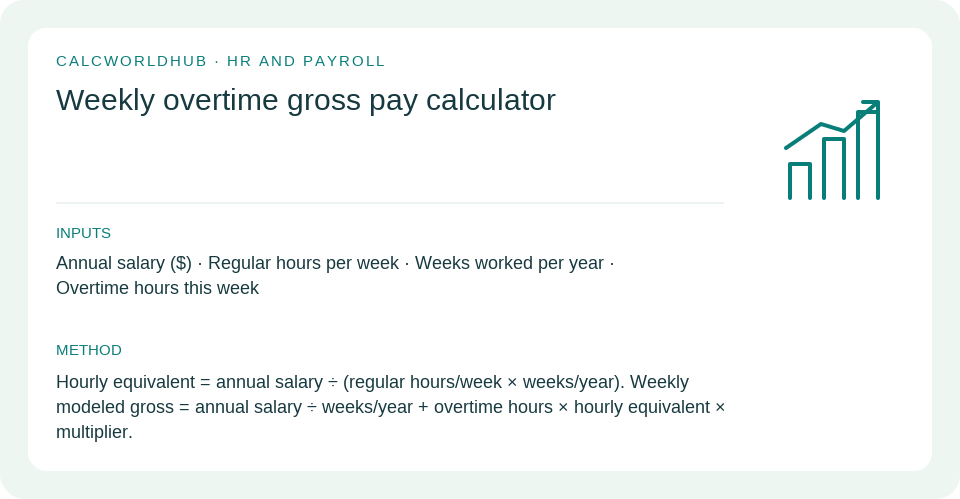
How to use this calculator
Model one week of gross pay from annual salary, regular hours, weeks per year, overtime hours, and an assumed multiplier.
- Enter Annual salary ($), Regular hours per week, Weeks worked per year, Overtime hours this week, then complete the remaining labeled fields. Match the units shown beside each field and review the result together with the assumptions below.
- Read the worked example below to check the expected input format and result.
- Compare another scenario by changing one input at a time. Use Reset to return to the starting values.
Model one week of salary-equivalent pay with overtime
This scenario converts an annual salary into a regular hourly equivalent using entered weekly hours and weeks per year, then adds the selected overtime hours for one week.
Inputs and units
- Annual salary ($): Annual base salary for the scenario.
- Regular hours per week: Positive scheduled weekly hours used to derive the hourly equivalent.
- Weeks worked per year: Positive weeks used to annualize the hourly-equivalent calculation.
- Overtime hours this week: Nonnegative additional hours for this weekly scenario.
- Overtime multiplier: Pay multiplier applied to the derived hourly equivalent.
Formula and method
Hourly equivalent = annual salary ÷ (regular hours/week × weeks/year). Weekly modeled gross = annual salary ÷ weeks/year + overtime hours × hourly equivalent × multiplier.
Worked example
With $52,000 salary, 40 regular hours, 52 weeks, 5 overtime hours, and a 1.5 multiplier, the hourly equivalent is $25 and modeled weekly gross is $1,000 + 5×$25×1.5 = $1,187.50.
Interpreting the result
This estimates a single week under a constant salary-equivalent assumption.
Assumptions and limits
It does not determine legal overtime eligibility, the required regular rate, or payroll deductions. U.S. federal and state rules can depend on coverage, exemption, workweek, compensation, and other facts.
Method references
Frequently asked questions
Does this determine legally required overtime?
No. It applies the entered multiplier to a simplified hourly equivalent and is not a payroll compliance calculation.
Why enter weeks per year?
The annual salary is divided by this value to derive regular weekly pay and its hourly equivalent.
How do I use the Weekly overtime gross pay calculator?
Enter Annual salary ($), Regular hours per week, Weeks worked per year, Overtime hours this week, then complete the remaining labeled fields. Match the units shown beside each field and review the result together with the assumptions below.
What is a worked example of Weekly overtime gross pay?
With $52,000 salary, 40 regular hours, 52 weeks, 5 overtime hours, and a 1.5 multiplier, the hourly equivalent is $25 and modeled weekly gross is $1,000 + 5×$25×1.5 = $1,187.50.
What does the Weekly overtime gross pay calculator calculate?
Model one week of gross pay from annual salary, regular hours, weeks per year, overtime hours, and an assumed multiplier.
Good calculators show their work.
CalcWorldHub is built around clear inputs and visible assumptions. Results are estimates for planning; check official sources or your provider’s terms when exact figures matter.