Annualized simple return calculator
Express a holding-period gain or loss as a simple yearly average.
inputs.
Calculator
How to use this calculator
Calculate simple annualized return from beginning value, ending value, and holding period.
- Enter Beginning value ($), Ending value ($), Holding period (years). Match the units shown beside each field and review the result together with the assumptions below.
- Read the worked example below to check the expected input format and result.
- Compare another scenario by changing one input at a time. Use Reset to return to the starting values.
Spread a holding-period return evenly across elapsed years
This calculator divides total simple holding-period gain or loss by the starting value, then divides that percentage by the number of years. It does not compound returns from year to year.
Inputs and units
- Beginning value ($): Positive value at the start of the holding period.
- Ending value ($): Value at the end of the period, in the same currency and on a comparable basis.
- Holding period (years): Positive elapsed time over which the start and end values are compared.
Formula and method
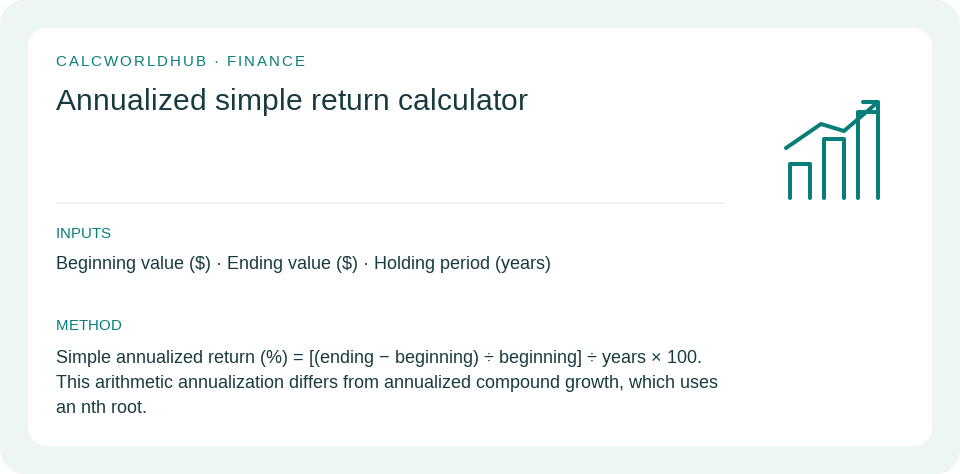
Simple annualized return (%) = [(ending − beginning) ÷ beginning] ÷ years × 100. This arithmetic annualization differs from annualized compound growth, which uses an nth root.
Worked example
A value moving from $10,000 to $11,600 over 2 years gained 16% in total. The simple annualized return is 16% ÷ 2 = 8% per year.
Interpreting the result
The result allocates the total gain evenly across the stated years for a simple comparison. It does not imply that the value actually rose by 8% in either year.
Assumptions and limits
Assumes no deposits or withdrawals and ignores timing, fees, tax, inflation, and volatility. Use a money-weighted measure for interim cash flows or a compound annual growth rate when a compounded endpoint rate is needed.
Method references
Frequently asked questions
Is this the same as CAGR?
No. This page divides holding-period return by years. CAGR is a compound rate that geometrically links beginning and ending values over time.
How do I use the Annualized simple return calculator?
Enter Beginning value ($), Ending value ($), Holding period (years). Match the units shown beside each field and review the result together with the assumptions below.
What is a worked example of Annualized simple return?
A value moving from $10,000 to $11,600 over 2 years gained 16% in total. The simple annualized return is 16% ÷ 2 = 8% per year.
What does the Annualized simple return calculator calculate?
Calculate simple annualized return from beginning value, ending value, and holding period.
What assumptions apply to Annualized simple return?
Assumes no deposits or withdrawals and ignores timing, fees, tax, inflation, and volatility. Use a money-weighted measure for interim cash flows or a compound annual growth rate when a compounded endpoint rate is needed.
Good calculators show their work.
CalcWorldHub is built around clear inputs and visible assumptions. Results are estimates for planning; check official sources or your provider’s terms when exact figures matter.