Annualized compound return calculator
Find the equivalent compound annual rate between a starting value and an ending value.
inputs.
Calculator
How to use this calculator
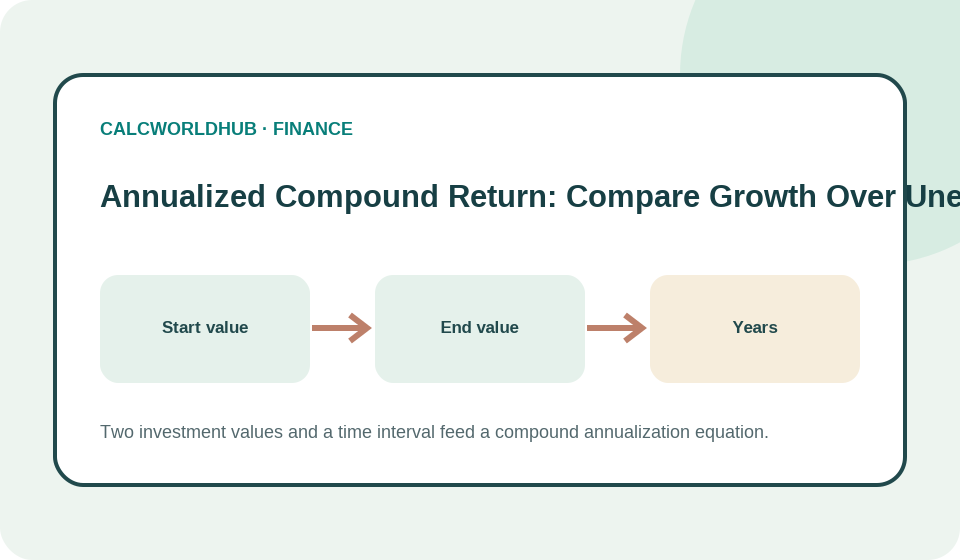
Convert a beginning value, ending value, and holding period into a compound annual return.
- Enter Beginning value, Ending value, Holding period (years). Match the units shown beside each field and review the result together with the assumptions below.
- Read the worked example below to check the expected input format and result.
- Compare another scenario by changing one input at a time. Use Reset to return to the starting values.
Convert a holding-period change into an annual compound rate
The annualized compound return is the constant yearly rate that would connect the starting value to the ending value over the stated number of years. It smooths the path into one equivalent rate; it does not describe what happened in each individual year.
Inputs and units
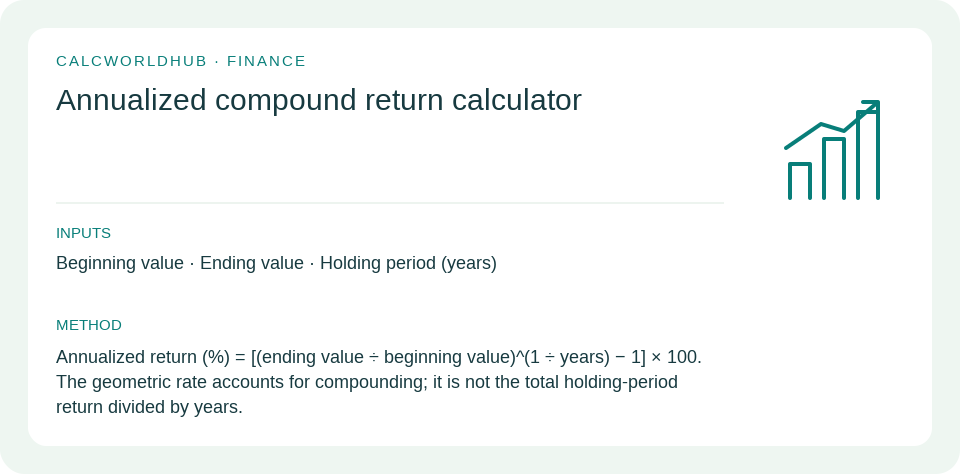
- Beginning value: The positive starting amount, in the same currency as the ending value.
- Ending value: The nonnegative ending amount after the holding period.
- Holding period (years): A positive elapsed time expressed in years; use fractional years only if that matches your measurement convention.
Formula and method
Annualized return (%) = [(ending value ÷ beginning value)^(1 ÷ years) − 1] × 100. The geometric rate accounts for compounding; it is not the total holding-period return divided by years.
Worked example
A value rising from $10,000 to $11,600 over 2 years has annualized return [(11,600/10,000)^(1/2) − 1] × 100 ≈ 7.7033% per year. Compounding that rate for two years gives the 16% cumulative gain, subject to rounding.
Interpreting the result
The rate is a compact way to compare growth across different holding periods when the beginning and ending values are comparable. It assumes no intervening deposits or withdrawals and says nothing about volatility or the likelihood of repeating the result.
Assumptions and limits
Beginning value must be positive, holding period must exceed zero, and ending value cannot be negative. Contributions, withdrawals, taxes, fees, inflation, and the path of returns are excluded; cash-flow timing requires a money-weighted method such as an internal rate of return.
Method references
Frequently asked questions
Is annualized return the same as the total return?
No. Total return covers the full holding period; annualized compound return is the constant per-year rate equivalent to that total change over the stated duration.
How do I use the Annualized compound return calculator?
Enter Beginning value, Ending value, Holding period (years). Match the units shown beside each field and review the result together with the assumptions below.
What is a worked example of Annualized compound return?
A value rising from $10,000 to $11,600 over 2 years has annualized return [(11,600/10,000)^(1/2) − 1] × 100 ≈ 7.7033% per year. Compounding that rate for two years gives the 16% cumulative gain, subject to rounding.
What does the Annualized compound return calculator calculate?
Convert a beginning value, ending value, and holding period into a compound annual return.
What assumptions apply to Annualized compound return?
Beginning value must be positive, holding period must exceed zero, and ending value cannot be negative. Contributions, withdrawals, taxes, fees, inflation, and the path of returns are excluded; cash-flow timing requires a money-weighted method such as an internal rate of return.
Good calculators show their work.
CalcWorldHub is built around clear inputs and visible assumptions. Results are estimates for planning; check official sources or your provider’s terms when exact figures matter.