How to use this calculator
Estimate an annualized return for dated cash flows that occur at uneven intervals.
- Enter Dated cash flows, Cash-flow dates (YYYY-MM-DD). Match the units shown beside each field and review the result together with the assumptions below.
- Read the worked example below to check the expected input format and result.
- Compare another scenario by changing one input at a time. Use Reset to return to the starting values.
How this calculation works
XIRR solves for the annual rate that makes the present value of each dated cash flow sum to zero. Unlike an ordinary periodic IRR, it discounts each amount by the actual day count from the first date using a 365-day year.
Inputs and units
cashFlows— Dated cash flows- One amount per date, in the same order. Enter investment outflows as negative and receipts as positive.
dates— Cash-flow dates (YYYY-MM-DD)- Enter one valid ISO date for each cash flow, from earliest to latest.
Formula
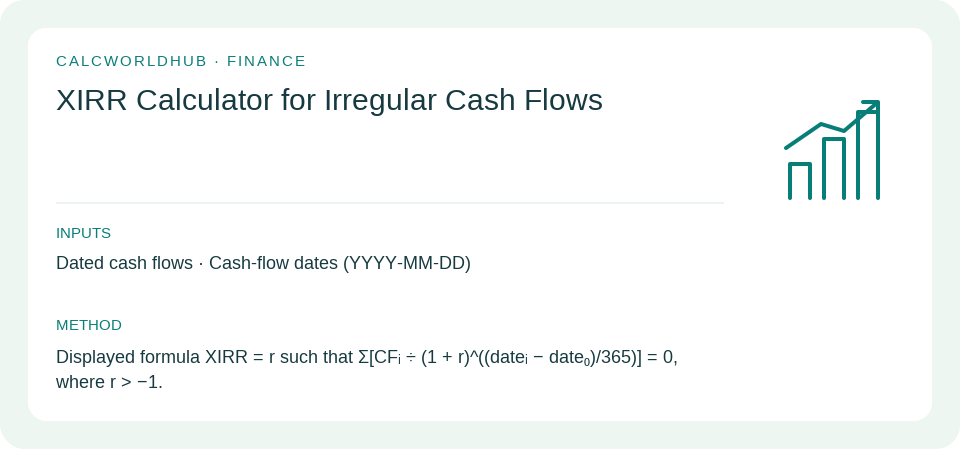
XIRR = r such that Σ[CFᵢ ÷ (1 + r)^((dateᵢ − date₀)/365)] = 0, where r > −1.
Method
The calculator brackets a rate that changes discounted cash flows from a positive net present value to a negative one, then narrows that interval with bisection. Cash flows are paired with dates in the order entered.
Worked example
For cash flows of −$10,000 on 2025-01-01, $5,000 on 2025-07-01, and $6,000 on 2026-01-01, the annualized XIRR is about 13.23% using Actual/365 dates.
Assumptions and limits
Enter ISO dates in chronological order, with the earliest date first, and at least one negative and one positive cash flow. Cash-flow schedules with several sign changes can have multiple valid roots; this tool returns one bracketed solution and does not enumerate every root.
Frequently asked questions
How is XIRR different from IRR?
XIRR uses each payment date and actual elapsed days; periodic IRR assumes evenly spaced periods.
Why must cash flows include both signs?
A rate of return is defined here as a discount rate that balances at least one investment outflow against at least one receipt.
Can a cash-flow schedule have more than one XIRR?
Yes. Multiple sign changes can create several roots. This calculator reports one bracketed root, so inspect unusual schedules carefully.
What does the 365-day basis mean?
Each date is discounted using the number of calendar days from the first cash flow divided by 365, including across leap years.
How do I use the XIRR Calculator for Irregular Cash Flows?
Enter Dated cash flows, Cash-flow dates (YYYY-MM-DD). Match the units shown beside each field and review the result together with the assumptions below.
Reference: Microsoft Excel XIRR reference for irregular dated cash flows and Actual/365 discounting. See our calculation methodology.