How to use this calculator
Estimate when an initial investment is recovered from a five-year series of unequal annual net cash flows.
- Enter Initial investment ($), Net cash flow in year 1 ($), Net cash flow in year 2 ($), Net cash flow in year 3 ($), then complete the remaining labeled fields. Match the units shown beside each field and review the result together with the assumptions below.
- Read the worked example below to check the expected input format and result.
- Compare another scenario by changing one input at a time. Use Reset to return to the starting values.
How this calculation works
A single average-cash-flow payback estimate can hide the order of receipts and costs. Enter the initial outlay and net cash flow for each year; the result finds the first recovery point and interpolates within that year.
Inputs and units
investment— Initial investment ($)- Positive cash outlay at time zero.
cf1— Net cash flow in year 1 ($)- Net cash flow for the first year; can be negative.
cf2— Net cash flow in year 2 ($)- Net cash flow for the second year; can be negative.
cf3— Net cash flow in year 3 ($)- Net cash flow for the third year; can be negative.
cf4— Net cash flow in year 4 ($)- Net cash flow for the fourth year; can be negative.
cf5— Net cash flow in year 5 ($)- Net cash flow for the fifth year; can be negative.
Formula
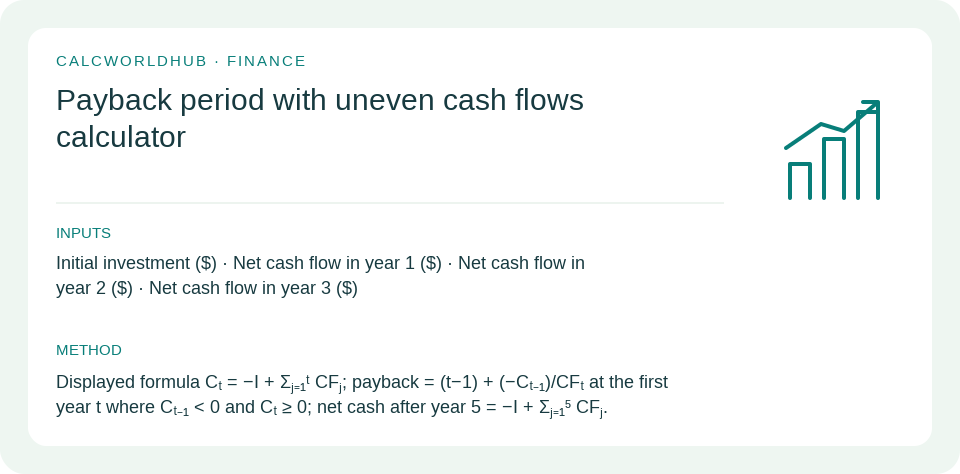
Cₜ = −I + Σⱼ₌₁ᵗ CFⱼ; payback = (t−1) + (−Cₜ₋₁)/CFₜ at the first year t where Cₜ₋₁ < 0 and Cₜ ≥ 0; net cash after year 5 = −I + Σⱼ₌₁⁵ CFⱼ.
Method
Cash flows are accumulated in order. When cumulative cash flow crosses the initial outlay within a year, the remaining unrecovered amount is divided by that year’s positive cash flow to estimate a fractional payback year.
Worked example
For an initial outlay of $10,000 and annual net cash flows of $3,000, $3,500, and $4,000 in the first three years, recovery occurs after 2 + $3,500/$4,000 = 2.875 years.
Assumptions and limits
This is simple, undiscounted payback and assumes each entered annual net cash flow accrues evenly within its year for the fractional-year interpolation. It ignores the time value of money, taxes, financing, and cash flows beyond year 5. A negative later cash flow does not undo the first recovery date.
Frequently asked questions
Does this discount future cash flows?
No. It uses nominal cash flows without discounting; use a discounted-cash-flow analysis to account for time value of money.
What if the investment is never recovered within five years?
The result reports that it is not recovered within the entered five-year horizon.
Can an annual cash flow be negative?
Yes. A negative year adds another cash outflow and changes the first time cumulative cash flow crosses the initial investment.
How do I use the Payback period with uneven cash flows calculator?
Enter Initial investment ($), Net cash flow in year 1 ($), Net cash flow in year 2 ($), Net cash flow in year 3 ($), then complete the remaining labeled fields. Match the units shown beside each field and review the result together with the assumptions below.
What is a worked example of Payback period with uneven cash flows?
For an initial outlay of $10,000 and annual net cash flows of $3,000, $3,500, and $4,000 in the first three years, recovery occurs after 2 + $3,500/$4,000 = 2.875 years.
Reference: NASA Cost Estimating Handbook discussion of payback-period analysis. See our calculation methodology.