Net present value calculator
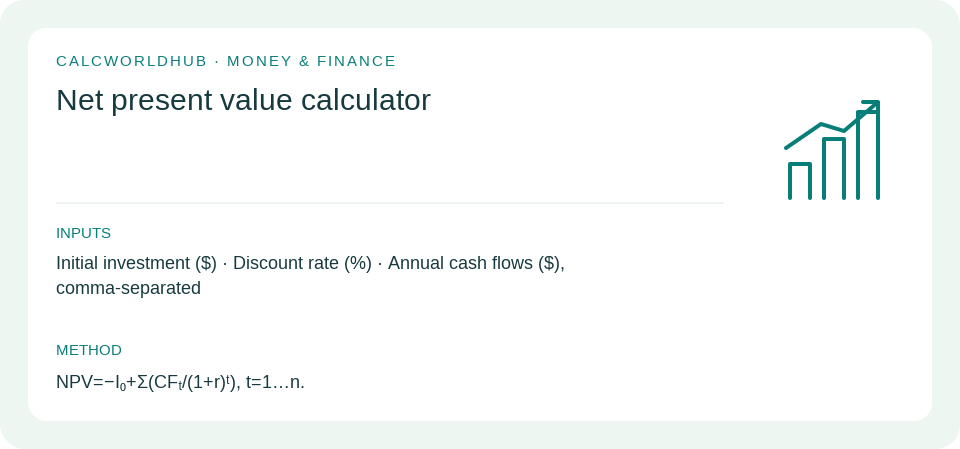
Discount a sequence of annual cash flows and subtract the initial investment to estimate net present value.
Calculator
How to use this calculator
Discount a sequence of annual cash flows and subtract the initial investment to estimate net present value.
- Enter Initial investment ($), Discount rate (%), Annual cash flows ($), comma-separated. Match the units shown beside each field and review the result together with the assumptions below.
- Read the worked example below to check the expected input format and result.
- Compare another scenario by changing one input at a time. Use Reset to return to the starting values.
Net present value calculator
Discount a sequence of annual cash flows and subtract the initial investment to estimate net present value.
What it measures
Each future cash flow is discounted by its period count and the selected annual rate. The initial outlay occurs at time zero and is subtracted without discounting.
Inputs and units
- Initial investment ($): Initial time-zero investment outflow in dollars.
- Discount rate (%): Annual discount rate as a percentage; use a rate above −100%.
- Annual cash flows ($), comma-separated: Future annual cash flows in chronological order, comma-separated; each value is assigned one successive year.
Formula and method
NPV=−I₀+Σ(CFₜ/(1+r)ᵗ), t=1…n.
Worked example
A $10,000 outlay followed by $3,000, $3,500, $4,000, and $4,500 at 8% has NPV≈$2,261.43.
Interpreting the result
Positive NPV means discounted inflows exceed the entered outlay at the assumed rate; it is not a guarantee that a project will earn that return.
Assumptions and limits
Assumes end-of-year cash flows, a constant rate, and one initial outlay. It omits taxes, financing details, uncertainty, and any cash flows not entered.
Sources and method
- Defines NPV by discounting cash inflows and outflows to present value and comparing them. OpenStax Principles of Finance 2e: NPV method
Frequently asked questions
Why subtract the initial investment separately?
It occurs at time zero, so it is not discounted like future cash flows.
What does a positive NPV mean?
At the chosen discount rate, the discounted future inflows exceed the initial outlay.
How do I use the Net present value calculator?
Enter Initial investment ($), Discount rate (%), Annual cash flows ($), comma-separated. Match the units shown beside each field and review the result together with the assumptions below.
What is a worked example of Net present value?
A $10,000 outlay followed by $3,000, $3,500, $4,000, and $4,500 at 8% has NPV≈$2,261.43.
What does the Net present value calculator calculate?
Discount a sequence of annual cash flows and subtract the initial investment to estimate net present value.
See the calculation methodology.
Good calculators show their work.
CalcWorldHub is built around clear inputs and visible assumptions. Results are estimates for planning; check official sources or your provider’s terms when exact figures matter.